Cracking the X Algorithm: How Twitter Reach Works
SchedulifyX Team · August 28, 2026
Discover how the X algorithm works. We break down open-source code, engagement weights, link penalties, and X Premium to help you maximize your Twitter reach.
If you are a marketer, creator, or brand trying to grow an audience today, you have undoubtedly asked yourself: how does twitter algorithm work? Since the platform's transition to X and the unprecedented move to open-source portions of its ranking code, the landscape of digital engagement has fundamentally shifted. Understanding the X algorithm is no longer just about guessing; it is a blend of analyzing documented code and observing real-world platform behavior.
In this comprehensive guide, we will dive deep into the mechanics of the twitter algorithm. We will explore exactly how X ranks the "For You" timeline, breaking down the open-sourced ranking code and comparing it with practitioner inferences based on observed behavior. By understanding these mechanics, you can strategically optimize your content to maximize your twitter reach.
The Foundation: What the Open-Source Code Revealed
In early 2023, X made a historic move by publishing a snapshot of its recommendation algorithm on GitHub. This provided unprecedented transparency into how tweets are selected, scored, and filtered for the "For You" timeline.
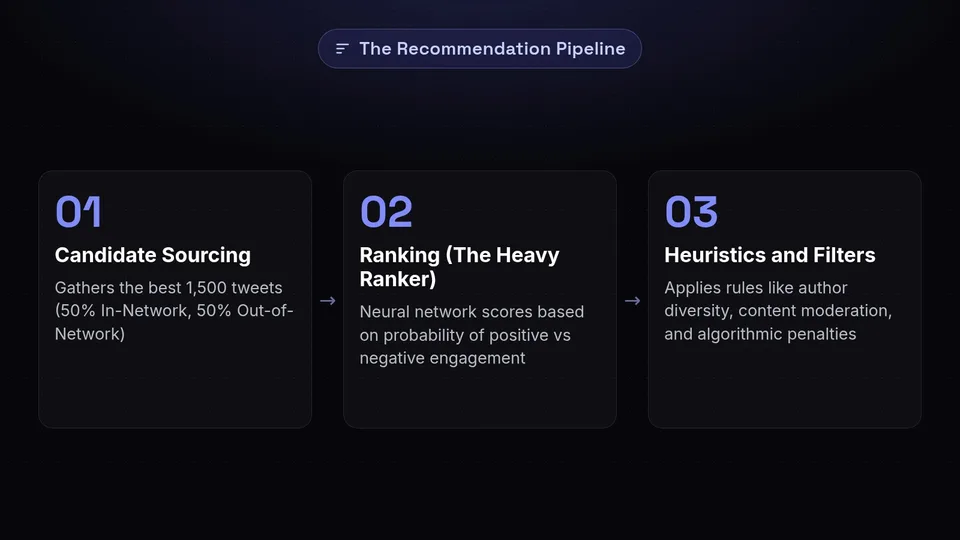
The recommendation pipeline is divided into three main stages:
- Candidate Sourcing: The system gathers the best 1,500 tweets from a pool of hundreds of millions. About 50% come from people you follow (In-Network) and 50% from people you don't follow (Out-of-Network).
- Ranking (The Heavy Ranker): A neural network scores each tweet based on the probability of positive engagement (likes, retweets, replies) versus negative engagement (blocks, mutes, "not interested").
- Heuristics and Filters: The final stage applies rules like author diversity (preventing too many tweets from one person), content moderation, and algorithmic penalties.
Documented vs. Inferred
Documented Fact: The three-stage pipeline and the existence of the "Heavy Ranker" neural network are explicitly documented in the GitHub repository. We know for a fact that the algorithm calculates a score based on predicted user actions.
Practitioner Inference: Because the neural network's weights update continuously based on real-time data, practitioners infer that the exact multipliers found in the 2023 code dump are fluid. The baseline architecture is documented, but the day-to-day tuning is inferred through A/B testing and analytics monitoring.
Engagement Weighting: Why Replies Rule the Timeline
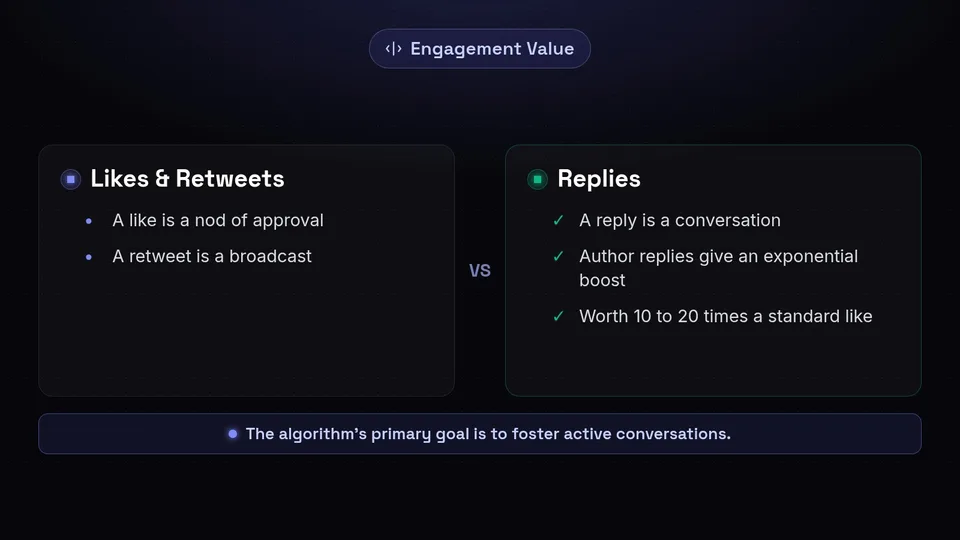
When asking how does twitter algorithm work, engagement is usually the first topic of conversation. Not all interactions are created equal. The algorithm's primary goal is to foster active conversations rather than passive consumption.
Historically, likes and retweets were the primary drivers of virality. However, recent observations and code analysis reveal a significant shift toward conversational metrics.
The Power of the Reply
In the current iteration of the X algorithm, replies carry immense weight. When a user replies to your post, it signals to the algorithm that your content is highly engaging and thought-provoking. Furthermore, if you (the author) reply back to that user, the algorithmic score of the original post receives an exponential boost.
"A like is a nod of approval. A retweet is a broadcast. But a reply is a conversation, and X's ultimate goal is to keep users talking on the platform."
Documented vs. Inferred
Documented Fact: The open-source code explicitly contains parameters for `favorite_count`, `retweet_count`, and `reply_count`. The code also includes specific multipliers for "author replied to a reply," proving that two-way conversations are structurally favored by the ranking engine.
Practitioner Inference: Practitioners infer that replies currently count far more than likes in the modern timeline, estimating that a single reply can be worth up to 10 to 20 times the algorithmic weight of a standard like. This is inferred from observing accounts with low follower counts achieving massive twitter reach simply by asking provocative questions that generate hundreds of comments, despite having very few likes.
The Outbound Link Penalty: Keeping Users on the Platform

Every social media network wants to keep users on its own platform to maximize ad impressions. X is no different. One of the most heavily debated topics among marketers is the treatment of outbound links.
If you post a link to your blog, YouTube channel, or newsletter, you will likely notice a severe drop in impressions compared to a text-only or native-image post.
Navigating the Link Penalty
To circumvent this, many creators use the "link in reply" strategy. They will post a highly engaging thread or standalone tweet, and then place the outbound link in the first comment. While X has caught on to this to some extent, it remains a popular tactic.
Documented vs. Inferred
Documented Fact: The open-source code revealed a specific penalty applied to URLs. Posts containing links are classified differently and generally receive a negative modifier in the ranking phase, unless the link points to a highly trusted media domain or an internal X link.
Practitioner Inference: The exact severity of the penalty today is inferred. Practitioners estimate that including a link in the main post can reduce twitter reach by 50% to 80%. Furthermore, it is inferred that X has recently started applying slight penalties to the "link in reply" workaround, meaning users must get creative with how they direct traffic (e.g., "Link in my bio").
X Premium (Paid Tier): Boosting Visibility and Reach

The introduction of X Premium (formerly Twitter Blue) fundamentally altered the twitter algorithm. Paying for the premium tier is no longer just about getting a blue checkmark; it is a direct investment in algorithmic visibility.
How the Paid Tier Affects Reach
X Premium subscribers receive a multiplier on their content's ranking score. This applies to both standalone posts in the "For You" timeline and, most notably, replies. When an X Premium user replies to a viral post, their comment is algorithmically pushed to the top of the reply section, granting them massive visibility.
Documented vs. Inferred
Documented Fact: The open-sourced code contains a literal boolean and multiplier for premium users. The code explicitly shows that a ranking boost is applied to accounts holding a premium subscription, confirming that paying directly influences reach.
Practitioner Inference: Practitioners infer the exact ROI of this boost. It is widely observed that non-premium users find it nearly impossible to rank high in the reply section of large accounts. The inference is that the "reply boost" for Premium users is so aggressively weighted that it overrides natural engagement metrics (like a non-premium user getting 100 likes on a reply vs. a premium user getting 2 likes).
The Power of Dwell Time: Stopping the Scroll
As algorithms evolve, they move beyond simple clicks and taps. Dwell time—the amount of time a user spends looking at your post—has become a critical metric for the X algorithm.
When a user stops scrolling to read a long-form post, watch a native video, or expand an image, the Heavy Ranker registers this as positive engagement. This is why long-form text posts (available to Premium users) and engaging formatting are highly effective.
To ensure your posts are perfectly formatted to capture attention, you can use tools like our character counter to craft precise, punchy hooks that make users stop scrolling.
Documented vs. Inferred
Documented Fact: The open-source code tracks specific actions like `profile_clicks`, `video_playback_time`, and whether a user clicked into a tweet to view the replies (a metric known as a "click-through"). These are documented positive signals.
Practitioner Inference: The concept of passive "dwell time" (simply pausing on a tweet without clicking anything) is heavily inferred by practitioners. While video watch time is documented, practitioners infer that X's neural network also measures the milliseconds a user spends hovering over a text post before scrolling away, similar to TikTok's or LinkedIn's algorithms.
Posting Frequency and Consistency: Finding the Sweet Spot
How often should you post? This is a vital question for anyone managing a brand on X. Posting too little means you fall out of the algorithm's favor; posting too much can trigger spam filters or cannibalize your own engagement.
Effective X (Twitter) scheduling is essential for maintaining a consistent presence without overwhelming your audience.
The Danger of Spamming
If you post 20 times a day, the algorithm will not show all 20 posts to your followers. X's heuristics include "author diversity" rules, meaning the "For You" timeline actively prevents a single user from dominating a feed.
Documented vs. Inferred
Documented Fact: The open-source code includes an "author diversity" penalty. The system is explicitly designed to limit the number of consecutive tweets shown from the same author in a single user's timeline. Rate limits and anti-spam caps are also well-documented.
Practitioner Inference: Practitioners infer the "sweet spot" for daily posting. Based on observed behavior, marketing experts infer that posting 2 to 4 high-quality times per day yields the best cumulative twitter reach. Posting more than this often results in diminishing returns, where subsequent posts receive artificially suppressed impressions.
Documented Facts vs. Practitioner Inference: A Summary
To truly understand how does twitter algorithm work, you must separate what we know from the code from what we observe in the wild. Here is a clear breakdown:
- Engagement: Documented: The code has multipliers for likes, retweets, and replies. Inferred: Replies are currently weighted vastly higher than likes in real-time practice.
- Outbound Links: Documented: URLs apply a negative modifier to the rank score. Inferred: The penalty reduces reach by 50-80%, and "link in reply" tactics are slowly being penalized as well.
- X Premium: Documented: A multiplier exists in the code for paid users. Inferred: This boost is the only reliable way to rank in the reply sections of viral tweets.
- Dwell Time: Documented: Clicks, profile views, and video watch time are tracked. Inferred: Passive reading time on text posts heavily influences the Heavy Ranker.
- Posting Frequency: Documented: The algorithm enforces author diversity to prevent feed domination. Inferred: The optimal posting frequency is 2-4 times per day to avoid self-cannibalization.
How SchedulifyX Helps You Master the Twitter Algorithm
Mastering the X algorithm requires consistency, strategic timing, and a deep understanding of engagement metrics. You can't just post randomly and hope for the best. You need to leverage the documented rules and practitioner insights to build your twitter reach.
This is where SchedulifyX comes in. As an AI-powered social media scheduling platform, SchedulifyX takes the guesswork out of your X strategy. Our platform helps you:
- Optimize Posting Times: Schedule your posts when your audience is most active to maximize early engagement (which the Heavy Ranker loves).
- Draft Engaging Threads: Use our AI tools and character counters to craft compelling hooks that increase dwell time and encourage replies.
- Manage Consistency: Maintain that perfect inferred sweet spot of 2-4 posts per day without having to be glued to your screen.
Stop fighting the algorithm and start making it work for you. Sign up for SchedulifyX today and take control of your X growth strategy.