How to Get Verified on Instagram: Meta Verified vs. Traditional
SchedulifyX Team · August 24, 2026
Learn how to get verified on Instagram in 2026. Discover the differences between Meta Verified and traditional verification, eligibility, and how to avoid scams.
For years, the blue checkmark on Instagram was the ultimate status symbol. It was an exclusive digital VIP rope, reserved only for A-list celebrities, massive global brands, and public figures with extensive media coverage. If you are reading this, you have likely asked yourself, "how can I get Instagram verification?" and wondered if that coveted blue badge is finally within your reach.
Today, the landscape of verified accounts has fundamentally shifted. Instagram now offers two completely distinct paths to the blue checkmark: the traditional, notability-based verification (which remains free but highly exclusive) and the newer Meta Verified subscription (which is paid but accessible to almost anyone willing to verify their identity). Because these two routes exist side-by-side, understanding how to get verified on Instagram requires a deep dive into what each path entails, what the badge actually signals today, and which route makes the most sense for your personal brand or business.
In this comprehensive guide, we will cover both routes honestly. We will explain the strict eligibility requirements for the traditional badge, the exact documentation you need for the paid Meta Verified tier, what verification actually gets you (and what it doesn't), and the realistic odds for a small account applying the traditional way. Finally, we will issue a stark warning about the thriving Instagram verification scam industry that preys on ambitious creators and brands.
The Evolution of the Blue Checkmark: What Does It Signal Now?
To understand how to get verified on Instagram today, you first have to understand how the meaning of the blue badge has evolved. When Instagram first introduced verification, its sole purpose was to protect well-known figures from impersonation. If you saw a blue checkmark next to a pop star's name, it meant Instagram had confirmed it was actually them, not a fan account or a scammer.
Over time, however, the badge morphed into a cultural status symbol. It became a marker of "clout," signaling that a person or brand was important enough to warrant Instagram's attention. This created a massive supply-and-demand problem. Millions of users wanted the badge for the prestige, but Instagram only granted it to a fraction of a percent of users based on strict "notability" criteria.
The Introduction of Meta Verified
In response to user demand for better account protection and customer support—and undoubtedly inspired by similar moves across the social media industry—Meta introduced Meta Verified. This paid subscription model allows everyday users to purchase the blue checkmark, provided they can prove their identity with a government-issued ID.
This dual-system has fundamentally changed what the badge signals. Because the badge looks identical regardless of how it was obtained, the blue checkmark no longer exclusively means "this person is famous." Instead, it simply means "this person is exactly who they claim to be."
While some purists argue that the paid tier has diluted the prestige of the badge, the reality is that Meta Verified has democratized access to crucial account security features and direct customer support that were previously gatekept. Whether you earn it through press coverage or pay for it through a subscription, Instagram verification now serves its original, most vital purpose: authenticating identity in an era of deepfakes, bots, and impersonators.
Path 1: Traditional Instagram Verification (Notability-Based)
The traditional route is the original method for Instagram verification. It is completely free, but it is notoriously difficult to achieve. Instagram uses this route to verify accounts that are in the public interest and have a high likelihood of being impersonated.
Eligibility Criteria for Traditional Verification
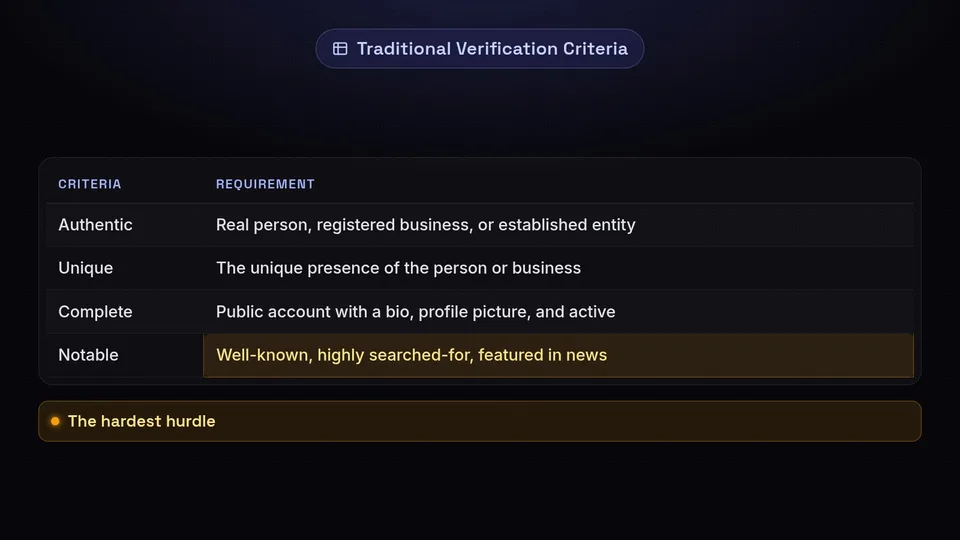
If you are wondering how can I get Instagram verification the traditional way, you must meet four non-negotiable criteria set by Meta. Your account must be:
- Authentic: Your account must represent a real person, registered business, or established entity. You cannot verify a meme page, a fan account, or a general interest page (e.g., "Cute Puppies Daily").
- Unique: Your account must be the unique presence of the person or business it represents. Instagram generally only verifies one account per person or business, with exceptions for language-specific accounts.
- Complete: Your account must be public, have a bio, and have a profile picture. It must also be active at the time you apply.
- Notable: This is the hardest hurdle. Your account must represent a well-known, highly searched-for person, brand, or entity. Instagram reviews accounts that are featured in multiple news sources, and they explicitly do not consider paid or promotional content as sources for review.
What Documentation is Required?
When applying for the traditional badge, you must provide documentation that proves both your identity and your notability.
- Proof of Identity: For individuals, this means a government-issued photo ID (driver's license, passport, or national ID card). For businesses, this requires official documents like articles of incorporation, a utility bill in the business's name, or tax filings.
- Proof of Notability (Press Links): The application allows you to submit up to five links to articles, social media accounts, or other links that show your account is in the public interest. Crucial tip: These must be organic press features in reputable, top-tier publications (e.g., Forbes, The New York Times, TechCrunch). Press releases, paid advertorials, and self-published Medium articles will be ignored by reviewers.
The Realistic Odds for a Small Account
We promised to be honest, so here is the hard truth: if you are a small account with fewer than 10,000 followers and no significant mainstream press coverage, your odds of getting verified through the traditional route are virtually zero.
Instagram's review team relies heavily on Google search volume and organic news presence. If your name or your brand's name does not generate pages of legitimate news articles when searched, the application will be denied within a few days. You can reapply every 30 days, but unless your PR situation has dramatically changed, the result will be the same. For small accounts, focusing on traditional verification is often a waste of time. Instead, your energy should be spent on building your audience, generating real news, or opting for the Meta Verified route.
How to Apply for Traditional Verification
If you believe you meet the notability criteria, the application process is straightforward:
- Open the Instagram app and navigate to your profile.
- Tap the hamburger menu (three horizontal lines) in the top right corner.
- Select Settings and privacy.
- Scroll down to Creator tools and controls (or Business tools, depending on your account type).
- Tap Request verification.
- Fill out the form, upload your ID, add your notability links, and tap Submit.
You will receive a notification in your Activity feed within 30 days letting you know if your request was approved or denied.
Path 2: Meta Verified (The Paid Subscription Route)
For the vast majority of users asking "how to get verified on Instagram," Meta Verified is the most practical and immediate answer. Launched as a direct response to the shifting social media landscape, Meta Verified allows creators and individuals to pay a monthly fee (typically around
Eligibility Criteria for Meta Verified
While Meta Verified is much more accessible than the traditional route, you cannot simply buy it anonymously. Meta has strict identity requirements to ensure the integrity of the program. To be eligible, you must:
- Be at least 18 years old.
- Have a prior posting history (brand new, empty accounts are not eligible).
- Have two-factor authentication (2FA) enabled on your account.
- Have a profile name that matches your legal name exactly as it appears on your government-issued ID.
- Have a profile picture (often referred to as a PFP) that clearly shows your face, which must match the photo on your government ID.
Note for Businesses: Meta initially rolled out Meta Verified exclusively for individual creators. However, they have recently expanded Meta Verified for Businesses, which has a slightly different pricing structure and requires business verification documents rather than just a personal ID.
What Documentation is Required?
The documentation for Meta Verified is strictly focused on identity verification, not notability.
- Government-Issued ID: You will need to upload a clear, high-resolution photo of your passport, driver's license, or national ID.
- Selfie Video: In most regions, Meta requires you to record a short selfie video during the application process. This uses facial recognition technology to ensure the person applying is a live human whose face matches the ID and the PFP on the account.
How to Apply for Meta Verified
The process is incredibly seamless, designed to get you verified within 48 hours:
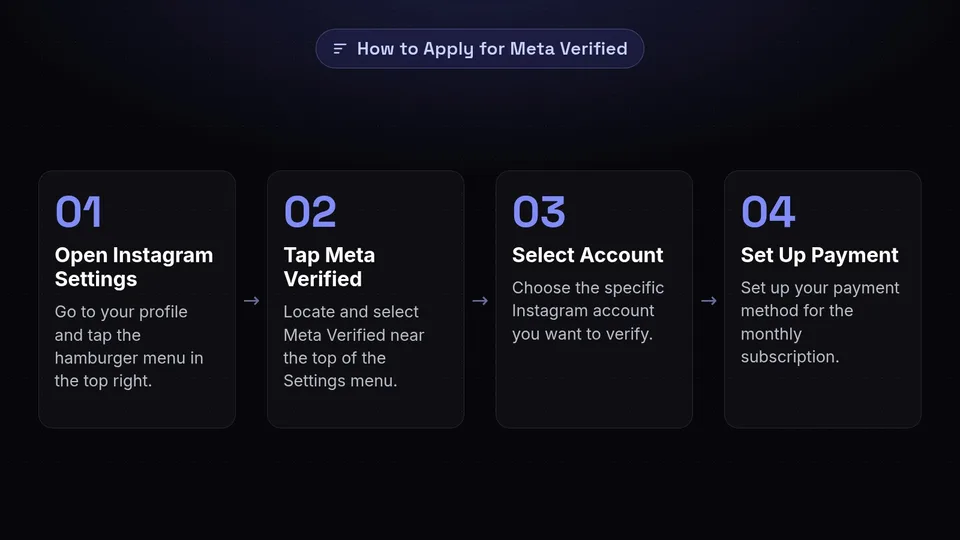
- Open Instagram and go to your profile.
- Tap the hamburger menu in the top right.
- Tap Meta Verified (usually located near the top of the Settings menu).
- Select the account you want to verify.
- Set up your payment method for the monthly subscription.
- Follow the on-screen prompts to upload your ID and record your selfie video.
- Wait for the review process. (If denied, your subscription fee is fully refunded).
Once approved, you cannot change your profile name, username, date of birth, or profile picture without going through the verification review process all over again. This strict rule is what gives the Meta Verified badge its credibility regarding identity.
What Instagram Verification Actually Gets You (And What It Doesn't)
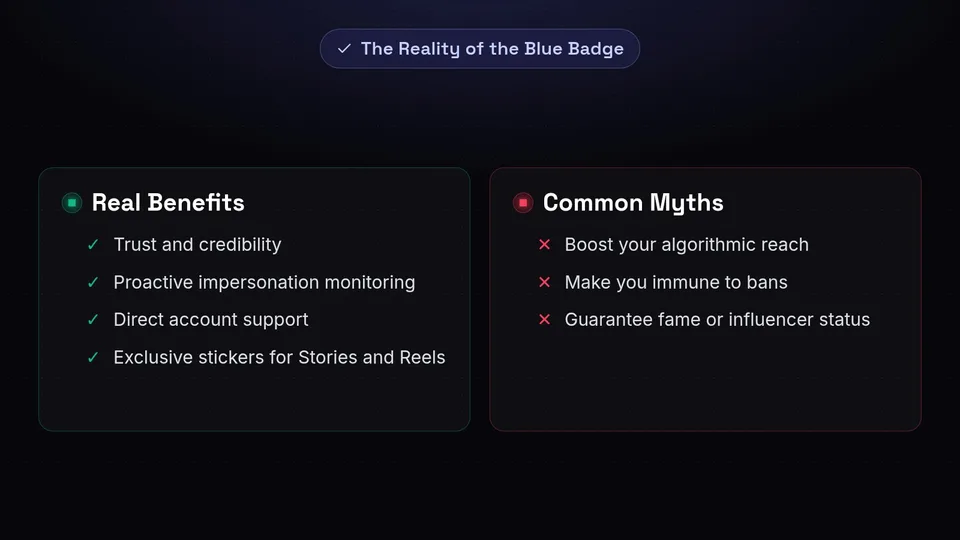
Whether you earn the badge through notability or buy it through Meta Verified, the blue checkmark comes with specific benefits. However, there are also massive misconceptions about what the badge actually does for your account's performance.
The Real Benefits of Instagram Verification
- Trust and Credibility: The blue badge instantly signals to profile visitors that you are authentic. In a sea of fake accounts, this credibility can increase your conversion rates for followers, clients, and brand deals.
- Proactive Impersonation Monitoring (Meta Verified): If you pay for Meta Verified, Meta actively monitors the platform for accounts trying to impersonate you using your name or photos, shutting them down faster.
- Direct Account Support (Meta Verified): This is arguably the most valuable feature of the paid subscription. Meta Verified users get access to actual human customer support for account issues. If you have ever been locked out of your account or dealt with a shadowban, you know how impossible it is to reach Instagram support. Meta Verified solves this.
- Exclusive Features: Meta Verified users get exclusive stickers for Stories and Reels, and occasionally receive early access to new platform features.
What Verification Does NOT Get You (Busting the Myths)
- It Does NOT Boost Your Algorithmic Reach: This is the biggest myth on Instagram. Having a blue checkmark does not make the algorithm favor your Reels, nor does it push your posts to the top of the Explore page. Your reach is still 100% dependent on the quality of your content and how your audience engages with it.
- It Does NOT Make You Immune to Bans: Verified accounts must still follow the Community Guidelines. If you post prohibited content, buy fake followers, or use unauthorized third-party automation tools, you can and will be suspended, regardless of your blue badge.
- It Does NOT Guarantee Fame: Because anyone can now purchase the badge via Meta Verified, the checkmark alone will not make you an influencer. It is a tool for authenticity, not a substitute for a solid content strategy.
The Dark Side: Beware of Instagram Verification Scams
Because the desire to get verified is so strong, a massive, highly organized black market has emerged. If you are searching for "how to get verified on Instagram," you are the exact target demographic for these scammers. You must tread carefully.
The "I Know a Guy at Meta" Scam
This is the most common scam. You will receive a DM or an email from someone claiming to work at a digital PR agency. They will tell you they have an "inside connection" or a "Meta Media Portal representative" who can bypass the notability requirements and grant you the traditional badge for a fee—usually ranging from
The Truth: Meta employees do not sell verification. While legitimate PR agencies can help you get the press required for traditional verification, no one can guarantee approval. If you pay these scammers, they will either take your money and disappear, or worse, they will ask for your Instagram password to "process the application" and steal your account.
The Phishing Email Scam
You receive an official-looking email claiming to be from "Instagram Verification Support." The email states that your account has been pre-approved for the blue badge and provides a link to "claim your badge now."
The Truth: Instagram will never email you to offer verification. You must initiate the process inside the app. If you click the link in the phishing email, it will take you to a fake login page designed to steal your username, password, and 2FA codes. Once they have this, they will hijack your account and hold it for ransom.
The PR Article Farm Scam
Some "agencies" offer to build your notability by publishing articles about you. They charge thousands of dollars to place your name in low-tier, pay-to-play blogs or international websites that no one reads.
The Truth: Instagram's review team is highly trained to spot fake PR. They know which websites sell articles and will immediately discount them. You will have wasted your money on useless articles and still receive a denial on your verification request.
How to Protect Yourself
- Never pay a third party for the blue badge itself.
- Never give your Instagram password to anyone claiming they can verify you.
- Only apply for verification through the official Instagram app settings.
- If you want the badge but lack mainstream press, simply use the official Meta Verified subscription. It is the only legitimate way to pay for a blue checkmark.
Conclusion: Growing Your Account with SchedulifyX
Figuring out how to get verified on Instagram in 2026 comes down to choosing the path that fits your current reality. If you are a globally recognized public figure or a major brand with extensive organic press, the traditional notability route is your rightful path. For the rest of us—creators, small business owners, and rising influencers—the Meta Verified subscription is a fantastic, legitimate way to secure your identity, build trust with your audience, and get access to much-needed customer support.
However, remember that the blue checkmark is just a badge; it is not a content strategy. Whether you are verified or not, the only way to truly succeed on Instagram is by consistently posting high-quality, engaging content that resonates with your target audience.
That is where SchedulifyX comes in. Our AI-powered social media scheduling platform helps you plan, create, and automate your Instagram content strategy with precision. By using SchedulifyX to maintain a consistent posting schedule and analyze your performance data, you can focus on building the real influence and notability that makes your account truly valuable. Start scheduling your way to success today, and let the blue checkmark be the cherry on top of a thriving digital presence.