How to Increase Engagement Rate: The Ultimate Action Guide
SchedulifyX Team · October 13, 2026
Learn how to increase your social media engagement rate with proven, prioritized levers. Move beyond benchmarks and discover exactly what to change today.
If you have recently analyzed your social media performance, you likely started by asking, "What is a good engagement rate?" You looked at the industry averages, compared your metrics against your competitors, and figured out exactly where you stand. But knowing your baseline is only the first half of the battle. The far more difficult question—and the one that actually moves the needle—is: What do I change to make it better?
This article is the definitive, action-oriented companion to our engagement rate benchmarks guide. While benchmarks tell you what is considered "good," this guide gives you the exact levers you need to pull to how to increase engagement rate across your social channels. We are not going to give you vague advice like "be authentic" or "post high-quality content." Instead, we are breaking down the mechanical, algorithmic, and psychological levers that dictate user interaction, ordered by their actual effect on your metrics.
Before we dive into the tactics to improve engagement rate, it is critical to understand the math behind the metric. If you haven't already, run your current numbers through our engagement rate calculator to establish your starting point. Keep that number handy, because we are about to deconstruct exactly how to raise it.
The Engagement Illusion: When a Rising Rate is Actually a Red Flag
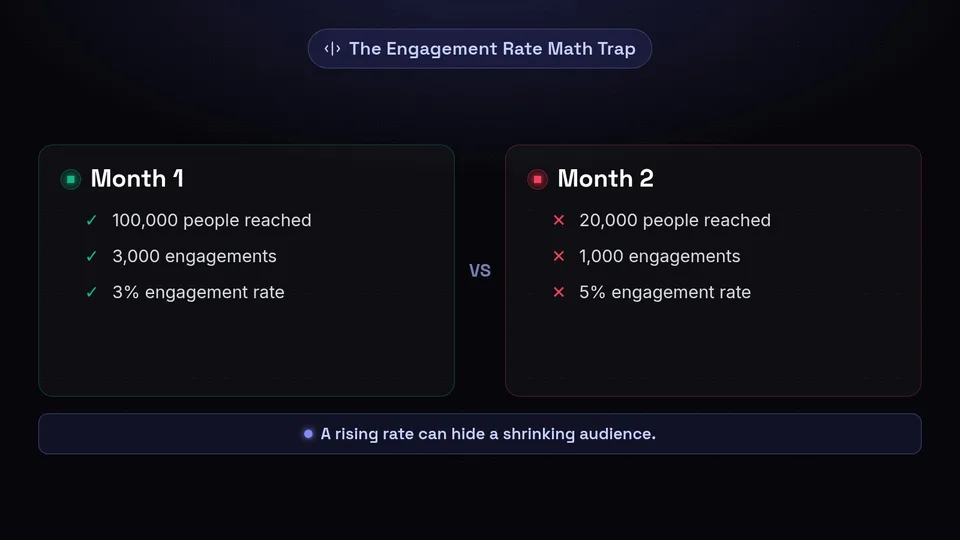
Before we explore the levers to boost engagement, we must address a dangerous mathematical trap that catches many seasoned marketers off guard: the illusion of the shrinking audience.
Engagement rate is a ratio. Most commonly, it is calculated as (Total Engagements / Total Reach) x 100. Because it is a ratio, the number can go up even if your account is actually dying. Let's look at the arithmetic.
Imagine in Month 1, your post reaches 100,000 people and gets 3,000 engagements. Your engagement rate is 3%. In Month 2, your account gets hit by an algorithm change, or your content grows stale. Your next post reaches only 20,000 people, but your die-hard loyalists still interact, yielding 1,000 engagements. Your engagement rate just spiked to 5%.
A rising engagement rate while overall reach falls is not a victory; it is usually a symptom of a shrinking, echo-chamber audience. You are losing the broader algorithm distribution and only reaching your most loyal followers.
When you set out to increase instagram engagement or LinkedIn interactions, your goal must be to increase the rate while maintaining or growing your reach. If your reach is plummeting, do not celebrate a higher percentage. With that crucial caveat out of the way, let's look at the most powerful levers you can pull, in order of their actual impact on the algorithm.
Lever 1: Format Choice (The Ultimate Multiplier)

The single biggest lever you control is the format of your content. You can have the greatest copywriting in the world, but if you put it in a format that the platform's algorithm is actively suppressing, your engagement rate will tank.
Social media platforms are constantly at war for user attention, and they prioritize formats that keep users on the app longer. Right now, short-form vertical video (Reels, TikToks, Shorts) and seamless carousels dominate the landscape. The format you choose dictates the potential energy of your post.
Aligning Format with Intent
If you want to increase instagram engagement, you need to stop treating all formats equally. Each format serves a different algorithmic purpose:
- Single Static Images: Currently the lowest-performing format for cold reach. They are easily scrolled past and offer very little "dwell time" (the amount of time a user stops to look at a post). Use these only for major announcements to your existing, warm audience.
- Carousels: The engagement workhorse. Carousels force the user to swipe, which counts as an interaction. Furthermore, platforms like Instagram and LinkedIn will often re-serve a carousel to a user who didn't engage the first time, showing them the second slide instead. This gives you two bites at the apple. Carousels are the best format for generating Saves and Shares.
- Short-Form Video (Reels): The reach engine. Videos naturally accumulate more dwell time. While they might get a lower percentage of likes relative to their massive reach, they are unparalleled for generating comments and shares if the hook is strong.
Action Step: Audit your last 30 posts. Calculate the engagement rate by format. If your static images are pulling a 1% rate and your carousels are pulling a 4% rate, the fastest way to improve engagement rate is to completely stop posting static images and convert those ideas into carousels or videos.
Lever 2: The First Line and the First Frame

If format is the vehicle, the hook is the engine. The algorithm measures user interest in milliseconds. On video platforms, the "first frame" (the visual the user sees before they even process the audio) and the first 3 seconds dictate whether the video will be pushed to a wider audience. On text-based platforms like LinkedIn or X, the first line determines if the user will click "See more."
Most brands bury the lede. They start with an introduction, a logo animation, or a polite greeting. By the time they get to the value, the user has already scrolled away. To boost engagement, you must aggressively front-load the value or the curiosity gap.
Mastering the Visual Hook
For video content, the first frame must disrupt the scroll. This means high contrast, dynamic movement, or a visually confusing element that forces the brain to pause and process. Combine this with a text overlay that immediately promises value.
Instead of a video starting with "Hi guys, today I want to talk about...", it should start mid-action with a text overlay saying: "The 3 reasons your engagement is dropping (and how to fix it)."
Mastering the Text Hook
For written content, the first line is your only chance to earn the read. The most effective text hooks utilize one of three psychological triggers:
- The Contrarian Stance: "Stop posting every day. It's killing your account."
- The Specific Result: "How we generated 4,000 inbound leads using one 5-slide carousel."
- The Relatable Pain Point: "You're spending 5 hours a week on content that nobody is reading."
Action Step: Spend 80% of your content creation time on the first 3 seconds of your video or the first two lines of your caption. If the hook fails, the rest of the content does not matter because nobody will see it.
Lever 3: Posting to the Audience You Have, Not the One You Want
This is perhaps the most common strategic error brands make. You want to reach CMOs, so you start posting high-level strategy content about enterprise marketing. But your current audience consists mostly of junior marketers and college students who followed you for your tactical, entry-level tutorials.
When you post content for the audience you want to an audience that doesn't care about it, your existing followers scroll past. The algorithm sees your own followers ignoring your post, assumes the content is low-quality, and immediately kills its reach. Your engagement rate plummets.
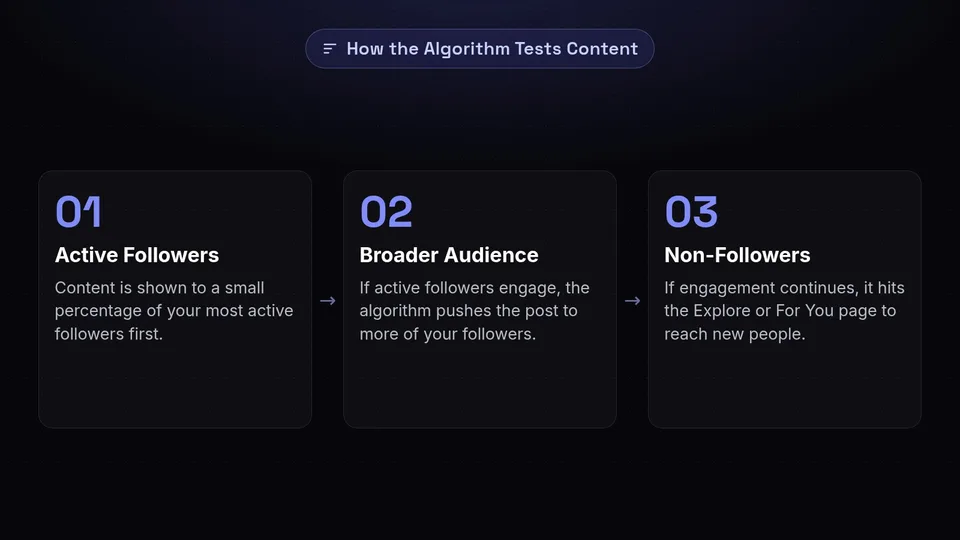
The algorithm tests your content in concentric circles. First, it shows it to a small percentage of your most active followers. If they engage, it shows it to more followers. If they engage, it pushes it to the Explore page or the For You feed to reach non-followers.
You cannot bypass your current audience to reach a new one. Your current audience is the algorithmic gatekeeper to your future audience.
Action Step: If you need to pivot your content to a new demographic, you must do it incrementally. Blend your new messaging with the formats and topics your current audience already loves. Bridge the gap slowly so you don't trigger a massive drop in baseline engagement.
Lever 4: Asking for the Algorithmically Weighted Interaction
Not all engagements are created equal. A "Like" is a low-friction interaction. It takes zero effort, and the algorithms know this. Therefore, a Like carries the lowest weight in the algorithmic scoring system.
If you want to know how to increase engagement rate in a way that actually triggers viral distribution, you need to optimize for high-friction interactions: Saves, Shares, and Long Comments.
The Hierarchy of Engagement
- The Share (The Growth Multiplier): When someone shares your post to their Story or sends it via DM, they are putting their own reputation on the line to endorse your content. The algorithm views this as the ultimate signal of quality. To get shares, create content that is highly relatable, incredibly funny, or perfectly articulates an opinion the user holds but couldn't express themselves.
- The Save (The Value Signal): A save indicates that your content is so valuable the user wants to reference it later. This tells the algorithm your content is highly educational or resourceful. To get saves, use carousels, checklists, cheat sheets, and step-by-step tutorials.
- The Comment (The Community Builder): Comments show active participation. However, not all comments are equal. A single fire emoji is weighted less than a multi-sentence debate. To get high-quality comments, ask polarizing (but professional) questions or ask users to share their specific experiences.
- The Like (The Baseline): Likes are good for vanity metrics, but they rarely trigger massive reach on their own anymore.
Action Step: Stop using generic calls-to-action like "Like and comment!" Instead, tailor the CTA to the specific format. On a highly educational carousel, write: "Save this post for your next campaign planning session." On a relatable meme, write: "Send this to your work bestie who needs to hear this." Ask for the interaction the platform weights most heavily on that specific surface.
Lever 5: Replying Inside the First Hour (Engagement Velocity)
The speed at which a post accumulates engagement is called "engagement velocity." The algorithm pays close attention to how much traction a post gets in the first 60 minutes after publishing. If a post explodes out of the gate, the platform's machine learning models flag it as breaking news or highly viral material, drastically increasing its distribution.
You can artificially boost your engagement velocity by being hyper-active in the comments immediately after posting. When a user leaves a comment, and you reply within minutes, two things happen:
- You double the total comment count on the post (your reply counts as an engagement).
- The user receives a notification that you replied. They often click back to the post to read your reply, giving you another impression and potentially another comment, creating a localized engagement loop.
Furthermore, early commenters are often your "super fans." By rewarding their promptness with immediate interaction, you train them to continue engaging early on your future posts, creating a snowball effect over time.
Action Step: Never "post and ghost." Schedule your content using a platform like SchedulifyX for a time when you know you can be at your desk. Block out the 30 to 60 minutes immediately following the post to reply to every single comment thoughtfully.
Lever 6: Cutting the Posts That Dilute the Average
Many social media managers operate under the outdated belief that they must post every single day to stay relevant. This leads to "filler content"—posts published purely to check a box on the content calendar. Filler content usually receives sub-par engagement.
Here is the secret most platform engineers won't tell you: The algorithm assigns an overarching "account score" based on your average performance.
If you post 5 times a week, and 2 of those posts are incredible (getting a 6% engagement rate) but 3 of those posts are mediocre filler (getting a 1% engagement rate), your average engagement rate is dragged down. The algorithm begins to view your account as inconsistent, and it lowers the baseline reach it gives to your future posts.
To improve engagement rate rapidly, you must become ruthless about pruning your content calendar. Every post that performs below your baseline average is actively harming the distribution of your high-performing posts.
Action Step: Look at your analytics for the past quarter. Identify the bottom 20% of your posts. What do they have in common? Are they company culture posts? Links to blog articles? Generic holiday greetings? Whatever they are, stop posting them immediately. Cutting your losers is mathematically faster than trying to improve your winners.
The Uncomfortable Truth: Posting Less Often, But Better
This brings us to the most uncomfortable lever—the one that goes against everything traditional social media gurus preach. If you want to massively increase instagram engagement and overall social traction, you probably need to post less often.
Let's look at the arithmetic reason this works. Quality and quantity are fundamentally at odds when you have limited resources. If you spend 10 hours a week creating 5 posts, you are spending 2 hours per post. The content is average, yielding an average engagement rate of 2%.
Now, imagine you take those same 10 hours and create only 2 posts. You spend 5 hours on each. You refine the hook. You design custom graphics. You ensure the copywriting is flawless. Because the quality is vastly superior, these posts achieve a 6% engagement rate.
Not only is your percentage higher, but the algorithmic snowball effect kicks in. Because the 6% posts signal high quality to the platform, they are pushed to the Explore page. Your total reach on those 2 posts will often eclipse the total reach you would have gotten on the 5 mediocre posts. You gain more followers, build deeper trust, and your "account score" rises.
Stop feeding the content machine with garbage. The algorithm does not reward you for showing up; it rewards you for keeping users on the platform. Two viral posts a week will always outperform seven mediocre posts.
The Danger of Engagement Bait: Raising the Number, Lowering the Account
As you implement these strategies to boost engagement, you will be tempted by the dark side: engagement bait. It is crucial that we explicitly address why this is a terrible long-term strategy.
Engagement bait includes tactics like:
- "Tag 3 friends in the comments to win!"
- "Comment the word 'LINK' letter by letter without being interrupted!"
- Using engagement pods (groups of creators who artificially like and comment on each other's posts).
- Posting intentionally controversial or misspelled content just to get people to correct you in the comments.
Yes, these tactics will temporarily raise your engagement numbers. However, they will simultaneously destroy your account health. Social media platforms employ sophisticated machine learning models specifically designed to detect engagement bait. When the algorithm detects unnatural clustering of keywords (like "tag a friend") or repetitive comment patterns, it silently restricts your account.
More importantly, engagement bait ruins your audience data. If you run a "tag a friend" giveaway, you will attract thousands of followers who only care about free stuff, not your brand. When you return to posting your regular educational or product content, these new followers will ignore it. Your reach will remain artificially inflated by the new follower count, but your engagements will drop back to normal, absolutely destroying your engagement rate ratio.
Action Step: Never trade long-term account health for a short-term dopamine hit of fake metrics. Build genuine engagement through high-value formats, compelling hooks, and community interaction.
Conclusion: Automate Your Strategy with SchedulifyX
Learning how to increase engagement rate is not about tricking the algorithm; it is about aligning your content with human psychology and platform incentives. By shifting to high-performing formats, obsessing over your first-frame hooks, respecting your current audience, asking for weighted interactions like Saves and Shares, and ruthlessly cutting filler content, you will see a dramatic improvement in your metrics.
Remember the uncomfortable truth: it is better to post twice a week with exceptional quality than to post daily mediocrity. Focus on the levers that actually move the needle.
Executing this high-level strategy requires time, focus, and impeccable timing. You cannot be chained to your phone waiting for the perfect moment to post so you can reply in the first hour. That is where SchedulifyX comes in. Our AI-powered social media scheduling platform allows you to plan your high-value carousels and Reels in advance, optimize your posting times for maximum initial velocity, and manage all your community interactions from a single dashboard.
Stop guessing and start growing. Use SchedulifyX to automate your distribution so you can focus your energy on the one thing algorithms can't automate: creating truly exceptional content.