How to Recycle Social Content Without Looking Repetitive
SchedulifyX Team · November 10, 2026
Your best posts only reached part of your audience. How to recycle evergreen social content so every outing feels new, with sensible spacing and a library.
Most accounts sit on a back catalogue of posts that worked once and then vanished. Feeds move quickly, so most of your followers never saw any given post, and everyone who has followed you since has never seen any of it. Recycling social content is how you get a second and third return from work you have already done.
The risk is looking like an account on autopilot. Post the same caption and the same image every few weeks and regular followers notice, comment sections ask whether you posted this already, and some platforms treat identical posts as spam. This guide covers how to choose evergreen posts worth reviving, how to change them enough that each outing is a new piece, and how to space them so your feed never feels like a rerun.
What counts as evergreen content
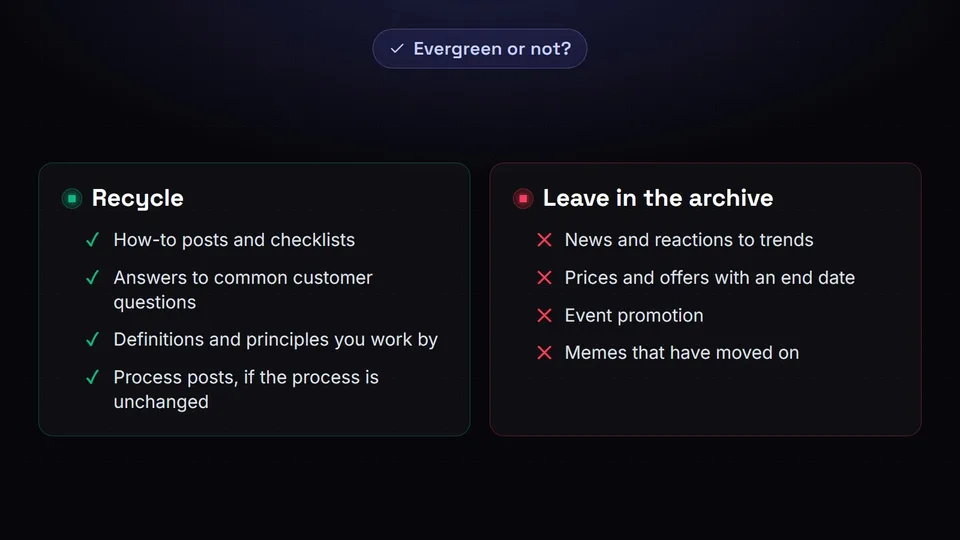
Evergreen content on social media is anything that stays true and useful long after you publish it. How-to posts, answers to the questions customers ask most, definitions, checklists, principles you work by and explanations of how something in your field actually works all qualify. So do behind-the-scenes posts about your process, as long as the process has not changed.
Plenty of good posts are not evergreen. News, prices, offers with an end date, event promotion, reactions to a trend and anything built on a meme that has since moved on all date quickly. Recycling them does more harm than good, because an out-of-date post tells new followers your account is not paying attention.
A simple test sorts the archive. Would this post still be accurate if someone read it a year from now? Does it depend on a date, a price or a moment? Would you still say the same thing today? A post that passes all three is a candidate. A post that is accurate but tied to an old example can still qualify once you update the example.
Why recycling works
Three things make recycling worthwhile. First, organic reach means each post is seen by only part of your audience, and which part changes from post to post. A post that did well with the people who saw it has, by definition, not been seen by everyone else.
Second, audiences turn over. People who followed you in the last six months were not there when your best explainer went out, and they are often the people who need it most, because they are newest to what you do.
Third, a post that has already performed is a tested idea. You know the topic interests your audience and roughly how it lands. Starting from a proven idea and giving it a new form is lower risk than starting from a blank page, which makes recycling a sensible part of any reposting strategy rather than a shortcut.
The repetition problem
What makes recycling look lazy is sameness: the identical caption, the same image, the same day of the week, the same order on every network. Loyal followers recognise it, and once they do, they start to skim everything you post.
Platforms have their own reasons to dislike exact copies. X's rules treat repeatedly posting identical or nearly identical posts as platform manipulation. Instagram's originality systems replace identical reposts with the original in recommendations, and in April 2026 Instagram extended its rules on reposted content beyond Reels to photos and carousels. Those rules are aimed mainly at accounts that repost other people's work, but the safe reading for your own archive is the same: change enough that the post is a new piece rather than a copy.
In practice that means never re-uploading a post unchanged to the same platform. Every recycled post should differ in at least one visible way: the format, the angle, the opening line or the examples it uses.
Five ways to make an old post new
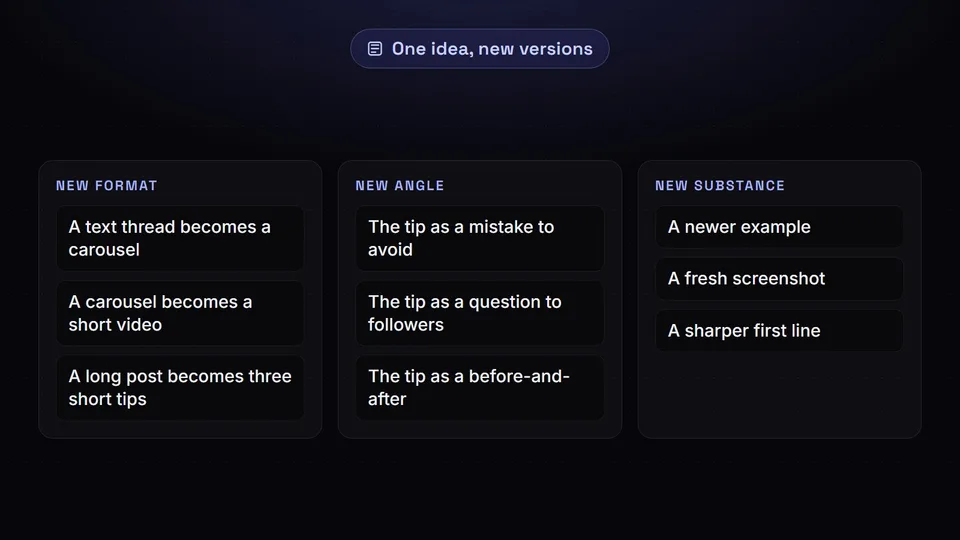
Change the format. The easiest way to give an idea a second life is to move it to a different shape. A text thread becomes a carousel; a carousel becomes a short talking-to-camera video; a long post becomes three short tips spread over a fortnight; a video becomes a quote card with the best line from it. Each format reaches people who prefer it, and the idea feels new because it is presented differently.
Change the angle. The same advice can be framed as a mistake to avoid, a question to your audience, a before-and-after or a short story about the time it went wrong. "How to write a hook" and "three hooks we stopped using" cover the same ground but read as different posts.
Update the substance. Swap in a newer example, a fresh screenshot of how something looks now or a better explanation you have learned since. This is the most honest form of recycling, because the post is genuinely improved, and it is the one most likely to earn new engagement.
Rewrite the first line. The opening line decides whether anyone reads on, and it is the part followers are most likely to remember. A new hook on a familiar idea often performs as well as the original.
Change the audience. Rework a post for beginners as a version for experienced readers, or turn a general tip into one aimed at a specific group you serve. The core idea stays; the examples and vocabulary change.
How often to bring a post back
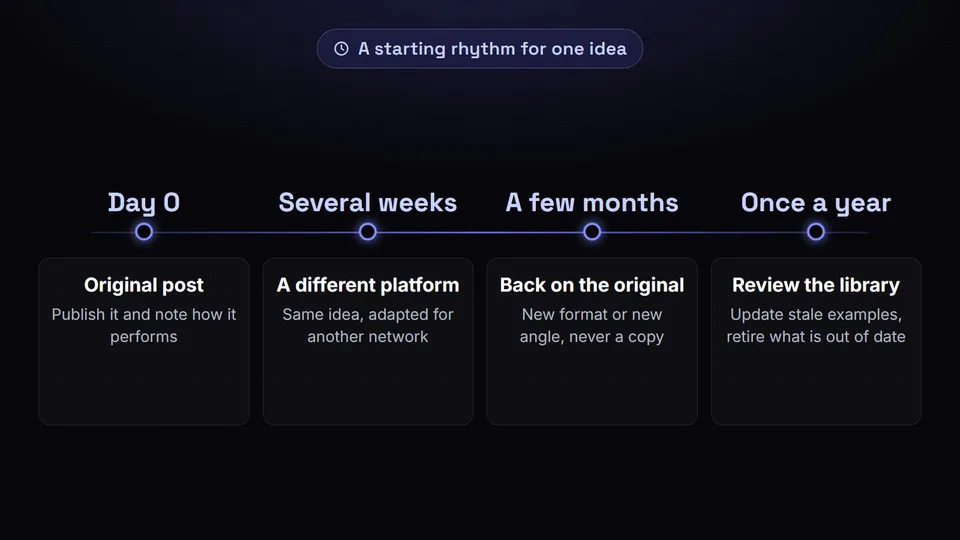
There is no universal interval, but the principle is simple: leave enough time that the audience has partly turned over and that you have something new to add. A useful starting point is to give a recycled idea its next outing on a different platform first, after several weeks, and to bring it back to the original platform only after a few months, in a new format or from a new angle.
Fast feeds, where posts fade within a day or two, tolerate shorter gaps than slower ones. A post that people save and come back to, such as a checklist, needs longer, because more of your followers will remember it. Whatever the interval, keep the same idea from appearing twice in one week across your channels unless you are running a deliberate campaign.
Once a year, review every evergreen post you rely on. Retire anything that is no longer accurate, update anything with stale examples, and note which ideas keep performing, because those are your best candidates for the next round.
Build an evergreen library
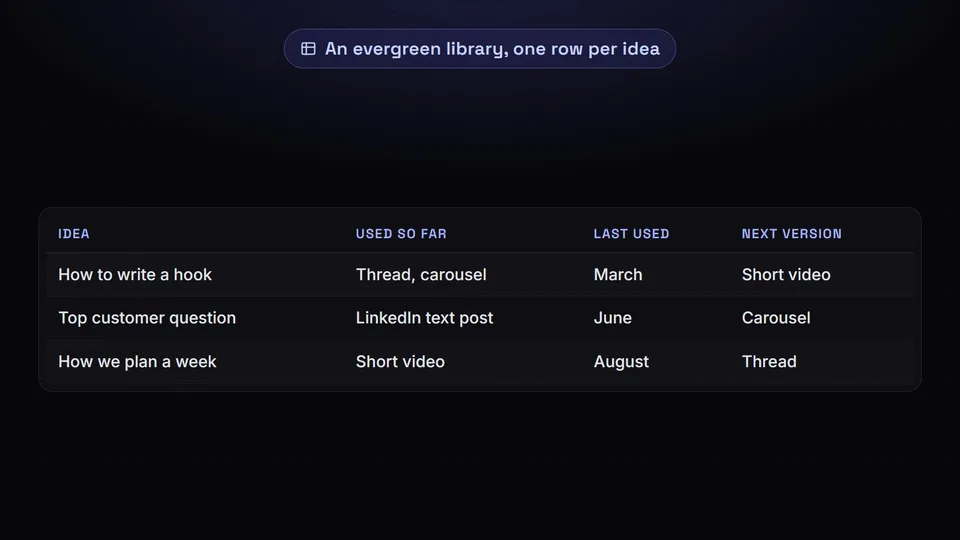
Recycling works best when it is a system rather than a scramble. Keep a simple library of your evergreen posts in a spreadsheet or your planning tool, with one row per idea. Useful columns are the idea itself, the formats and platforms it has appeared on, the date it was last used, how it performed and the next version you plan to make.
Tag each idea by topic so you can balance your calendar, for example by making sure a month does not lean too heavily on one subject. When you plan a week, pull one or two items from the library alongside new work. The library also shows you gaps: if every evergreen idea is a how-to, you may be missing posts about why your audience should care in the first place.
Add new evergreen posts to the library as you publish them. That way the archive keeps growing in value instead of disappearing down the feed.
Reposting across platforms
Most platforms now have a native repost or share button that puts an existing post in front of your followers again. It is useful for amplifying something recent, such as a post that is doing well or one from a colleague, but it is not recycling: the post is unchanged, and followers who saw it the first time will recognise it immediately.
Cross-posting needs the same care as recycling. Each network has its own formats, caption lengths and expectations, so adapt the post rather than copying it everywhere at once. A LinkedIn text post may become an Instagram carousel and a short video for TikTok, each written for the people on that platform. Spreading those versions over days or weeks also means one good idea keeps working across your calendar instead of appearing everywhere in the same hour.
Check that recycling is working
Treat each recycled version as its own post and judge it on its own results. Compare it with the original on the measures that show genuine interest, such as saves, shares, replies and clicks, rather than on reach alone, because a new format can reach a different slice of your audience without being any better or worse.
Read the comments as well as the numbers. A few people saying they remember the earlier version is harmless and can even help, because it shows the idea stuck. Comments asking why you keep posting the same thing are a signal to leave longer gaps or change more between versions.
Record what you learn in the library. Over time you will see which kinds of idea survive several outings and which are best used once, and which formats suit which platforms for your audience. That knowledge is what turns recycling from a way of filling the calendar into a way of improving it.
Conclusion
Recycling evergreen content is one of the most efficient things a social team can do, provided each outing is a new piece. Choose posts that are still true, change the format, angle, hook or examples every time, leave sensible gaps, and keep a library so nothing good is lost.
A plan like this is easier to keep when it is scheduled ahead. With SchedulifyX you can schedule each new version of an idea for the platform it suits, weeks or months in advance, so your best work keeps reaching new people while you focus on making the next thing.
