Meta Algorithm 2026: Winning on Facebook & Instagram
SchedulifyX Team · July 21, 2026
Discover how Meta's 2026 algorithm updates impact Facebook and Instagram. Learn actionable strategies for AI content, Reels, and engagement to boost reach.
Welcome to the new era of social media marketing. As we navigate through 2026, the digital landscape has undergone a seismic shift. Meta has officially rolled out its most comprehensive, AI-driven algorithm update to date, fundamentally altering how content is distributed, consumed, and monetized across its platforms. If your brand is still relying on the playbooks of 2023 or 2024, you are likely seeing a drastic decline in organic reach and engagement. The meta algorithm 2026 is not just a minor tweak; it is a complete overhaul centered around predictive artificial intelligence, the 'unconnected graph,' and hyper-personalized user experiences.
In this comprehensive guide, we will break down the intricacies of the latest facebook algorithm update and the massive instagram algorithm changes. We will explore how AI-recommended content prioritization is leveling the playing field, why Reels distribution has shifted from quantity to quality, and which engagement signals actually matter today. Finally, we will provide you with a future-proof meta marketing strategy to ensure your brand not only survives but thrives, leveraging advanced tools like SchedulifyX to stay ahead of the curve.
The Core Philosophy Behind the Meta Algorithm 2026
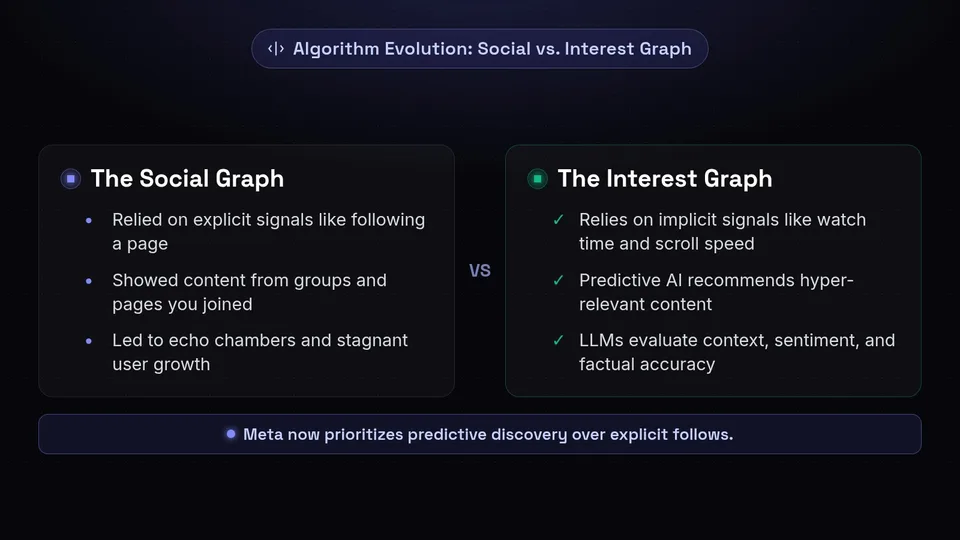
To understand the specific changes to Facebook and Instagram, marketers must first understand the overarching philosophy driving Meta's engineering teams in 2026. For years, the social media algorithm was built on the 'Social Graph'—you saw content from the people you followed, the pages you liked, and the groups you joined. While effective in the early days of social media, this model led to echo chambers and stagnant user growth.
Enter the 'Interest Graph' and predictive AI. The meta algorithm 2026 is designed with one primary directive: maximize user retention through hyper-relevant, frictionless content discovery. Meta's generative AI and machine learning models are now sophisticated enough to predict what a user wants to see before they even know they want to see it. This means the algorithm relies less on explicit signals (like following a page) and heavily on implicit signals (like watch time, scroll speed, and micro-interactions).
Furthermore, Meta has integrated its Large Language Models (LLMs) directly into the content evaluation process. The algorithm now 'understands' the context, sentiment, and factual accuracy of a video or post with near-human comprehension. Content that is deemed highly original, deeply engaging, and contextually rich is pushed to the top, while repetitive, unoriginal, or engagement-baiting content is aggressively suppressed.
Facebook Algorithm Update: What is Changing?
The facebook algorithm update of 2026 has transformed the platform from a digital town square into a highly curated, personalized entertainment and information hub. Here is a detailed breakdown of the critical changes you need to know.
Hyper-Personalization via AI
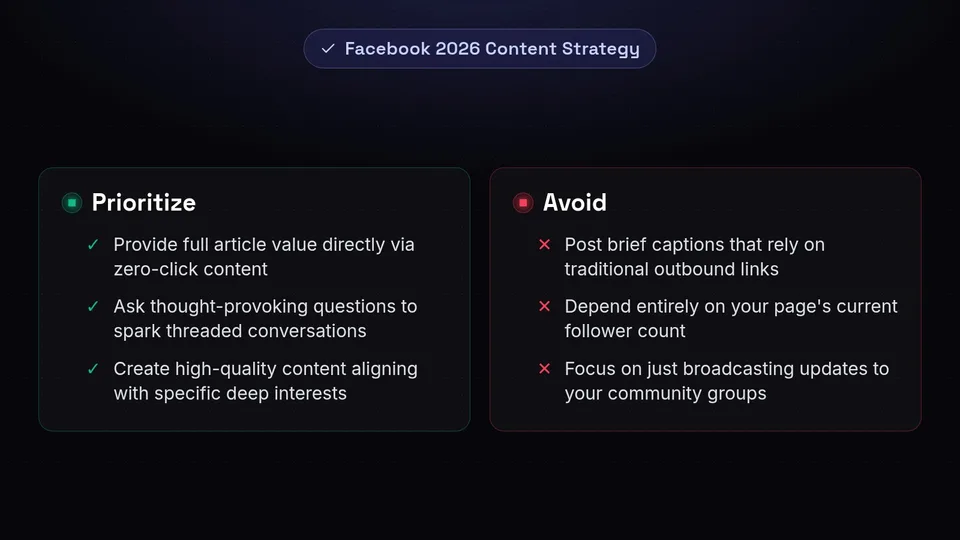
Facebook's feed is now split into distinct, AI-managed streams. The primary 'Home' feed is heavily populated with AI-recommended content from creators and pages users do not follow. This is a massive opportunity for brands. If you create high-quality content that aligns with a specific user's deep interests, Facebook will serve your content to them, regardless of your follower count. The algorithm uses thousands of data points—including a user's off-platform activity, group interactions, and historical viewing habits—to curate this feed.
The Decline of Traditional Link Posts
If your strategy involves posting a brief caption with a link to your blog or website, you will struggle in 2026. Meta wants to keep users on its platform. The new algorithm severely penalizes traditional outbound link posts unless they generate immediate, high-quality discussion in the comments. To adapt, marketers must utilize 'zero-click content'—providing the full value of the article or update directly within the Facebook post, using the link only as an optional resource for deeper reading.
Community and Group Prioritization
While the main feed is shifting toward unconnected video content, Facebook Groups remain the stronghold of the traditional social graph. However, the algorithm now evaluates Group content based on 'Meaningful Community Interactions' (MCI). Posts that spark long-form, threaded conversations among group members are prioritized. Brands managing communities must focus on asking thought-provoking questions and fostering peer-to-peer interactions rather than just broadcasting updates.
Instagram Algorithm Changes: The New Rules of Engagement

Instagram has always been the visual powerhouse of Meta's ecosystem, but the instagram algorithm changes in 2026 have redefined what constitutes 'good' content. The platform has moved away from the chaotic, high-volume posting strategies of the past and is now rewarding deep, intentional engagement.
Reels Distribution: Quality Over Quantity
In previous years, marketers were told to post Reels daily to hack the algorithm. In 2026, this strategy will backfire. The algorithm now measures 'Viewer Satisfaction Score' (VSS) for Reels. This score is calculated based on completion rate, re-watch rate, and the rate at which users share the Reel via Direct Messages (DMs). A single, highly polished, deeply entertaining or educational Reel posted once a week will drastically outperform seven mediocre Reels. The AI also strictly penalizes watermarked content and unoriginal aggregations.
The Rise of 'Saves' and 'Shares'
Likes and comments are officially vanity metrics. The 2026 Instagram algorithm views 'Saves' and 'Shares' (particularly DM shares) as the ultimate indicators of content value. If a user saves your carousel post to reference later, or shares your Reel with a friend in a DM, the algorithm registers this as a massive positive signal. Your content strategy must pivot to creating 'saveable' content (infographics, tutorials, deep-dives) and 'shareable' content (relatable humor, breaking news, profound insights).
Stories and Close Friends Dynamics
Instagram Stories have evolved. The algorithm now groups Stories based on the user's historical interaction with the creator. To stay at the front of the Stories queue, brands must utilize interactive stickers (polls, sliders, Q&As) effectively. Furthermore, the 'Close Friends' feature has been expanded for brand use, allowing businesses to create exclusive, highly-engaged micro-communities. The algorithm heavily favors content posted to these segmented lists.
AI-Recommended Content and the 'Unconnected Graph'
The most profound shift in the meta algorithm 2026 is the dominance of the 'unconnected graph'. Historically, your reach was capped by your follower count plus a small percentage of viral spillover. Today, up to 60% of the content a user sees on Facebook and Instagram comes from accounts they do not follow. This is powered by Meta's advanced AI recommendation engine.
How does the AI decide what to show? It uses a complex system of semantic analysis and visual recognition. When you upload a video, Meta's AI analyzes the audio transcript, reads the text on the screen, identifies the objects in the video, and even gauges the emotional tone. It then matches this 'content DNA' with users who have exhibited a historical preference for that exact type of content.
For marketers, this means SEO is no longer just for Google. Social SEO is paramount. Your captions must be rich with targeted keywords, your video scripts must clearly state the topic within the first three seconds, and your visual branding must be consistent. The AI needs to easily categorize your content so it can serve it to the right unconnected audience.
Engagement Signals That Actually Matter in 2026
To master any social media algorithm, you must understand the signals it values. Meta has refined its tracking to focus on active, intentional user behaviors rather than passive scrolling.
- Dwell Time: How long does a user pause on your post? Even if they do not like or comment, a high dwell time signals to the algorithm that the content is capturing attention. Long-form captions and engaging carousels are excellent for boosting dwell time.
- Direct Message Shares: As public sharing shifts to private sharing, Meta tracks how often your content is sent in DMs. This is the highest-value signal in 2026.
- Profile Clicks and Deep Dives: If a user sees your Reel, clicks to your profile, and watches three more of your videos, the algorithm categorizes your account as highly engaging and will push your future content to that user and others like them.
- Negative Feedback: Hiding a post, unfollowing, or swiping away from a Reel within the first second are strong negative signals. The algorithm is unforgiving; a string of posts with high negative feedback will tank your account's overall trust score.
Crafting a Winning Meta Marketing Strategy for 2026
Knowing how the algorithm works is only half the battle. Implementing a robust meta marketing strategy that leverages these changes is where the real success lies. Here are the actionable steps your brand must take today.
Embrace AI and Automation
You cannot beat an AI algorithm without using AI yourself. Marketers must leverage generative AI for ideation, scriptwriting, and data analysis. However, the final output must remain authentically human. Use AI to analyze which topics are trending within your niche, and then create original, human-centric content around those topics.
Focus on Originality and Authenticity
Meta's 2026 update includes strict penalties for 'aggregator' accounts—pages that simply repost other people's content. To win, your brand must invest in original production. Show the faces behind your brand, share behind-the-scenes processes, and lean into authentic storytelling. Highly polished, corporate-style advertisements are being ignored in favor of raw, relatable, native-looking content.
Optimize for 'Zero-Click' Value
As mentioned earlier, keep users on the platform. If you have a new blog post, summarize the top five points in an Instagram Carousel or a Facebook text post. Provide so much value within the post itself that the user feels satisfied, saving the link for those who truly want a deep dive. The algorithm will reward you with massive reach for keeping users engaged on Meta's real estate.
Leverage SchedulifyX for Optimal Posting
Timing and consistency still matter, but managing a multi-platform strategy manually is impossible in 2026. This is where SchedulifyX becomes your ultimate competitive advantage. SchedulifyX is an AI-powered social media scheduling platform designed specifically to align with the latest algorithm updates.
With SchedulifyX, you can:
- Utilize Predictive AI Scheduling: SchedulifyX analyzes your specific audience's historical activity to determine the exact minute they are most likely to engage, ensuring your content hits the feed when it matters most.
- Optimize Social SEO Automatically: The platform's built-in AI suggests the best keywords, hashtags, and alt-text to ensure Meta's recommendation engine categorizes your content perfectly.
- Track Advanced Metrics: Move beyond basic analytics. SchedulifyX tracks DM share velocity, save rates, and dwell time estimates, giving you a clear picture of how your content is performing against the 2026 algorithm signals.
Frequently Asked Questions (FAQ)
How often should I post on Instagram in 2026?
Quality trumps quantity. Aim for 3-4 highly valuable posts per week. This could be a mix of two Reels and two deep-dive Carousels. Daily posting of mediocre content will harm your algorithmic standing.
Do hashtags still work on Facebook and Instagram?
Yes, but not in the way they used to. Hashtags in 2026 act as categorization tags for the AI, not just search terms for users. Use 3-5 highly relevant, niche-specific hashtags rather than 30 generic ones.
How can I recover from a drop in organic reach?
If you've been hit by the recent algorithm changes, stop posting traditional promotional content immediately. Pivot to 100% value-driven, original video content. Focus on sparking conversations in the comments and encouraging DM shares. Consistency in this new approach will slowly rebuild your account's trust score.
Conclusion: Adapt and Thrive with SchedulifyX
The meta algorithm 2026 represents a fundamental evolution in how we connect online. The shift towards AI-recommended content, the prioritization of deep engagement signals, and the focus on the unconnected graph mean that marketers must be more strategic, creative, and analytical than ever before. The days of 'post and pray' are officially over.
By understanding the nuances of the facebook algorithm update and the instagram algorithm changes, you can pivot your meta marketing strategy to focus on original, highly-engaging, zero-click content. Remember, the algorithm is not your enemy; it is a highly sophisticated matching engine looking for the best content to serve to eager audiences.
To truly master this new landscape, you need the right tools. Do not leave your social media success to chance. Sign up for SchedulifyX today and let our AI-powered scheduling and analytics platform help you dominate the 2026 algorithm. Streamline your workflow, optimize your posting times, and watch your organic reach soar.