2026 Social Media Privacy Regulations: A Guide for Marketers
SchedulifyX Team · July 15, 2026
Navigate the complex landscape of social media privacy 2026. Learn how cookie deprecation and new consent laws impact your data privacy marketing strategies.
The digital marketing landscape has undergone a seismic transformation. As we navigate through 2026, the era of unrestricted data harvesting and passive user tracking is definitively over. For digital marketers, social media managers, and brand strategists, understanding and adapting to social media privacy 2026 standards is no longer just a legal obligation—it is a fundamental business imperative. Consumers are more educated about their digital footprints than ever before, and global regulatory bodies have implemented stringent frameworks that fundamentally alter how brands interact with audiences online.
This comprehensive guide is designed specifically for marketing professionals who need to understand the nuances of the modern privacy landscape. We will explore the profound impacts of cookie deprecation, the intricacies of modern consent requirements, and how to pivot toward privacy-first advertising strategies. Whether you are managing organic campaigns or multi-million dollar paid social budgets, mastering data privacy marketing is the key to sustainable growth in 2026 and beyond.
Understanding Social Media Privacy in 2026
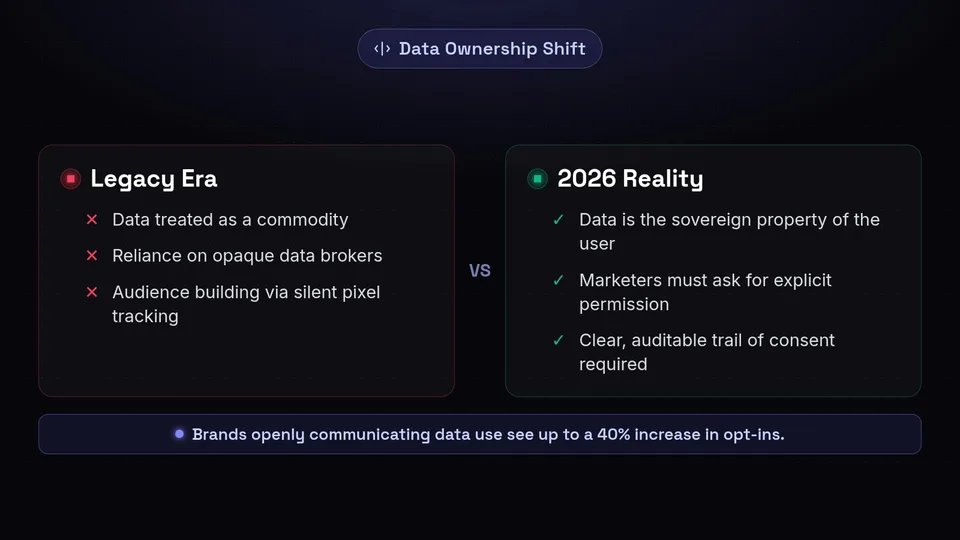
To truly grasp the current state of digital marketing, we must look at how social media privacy 2026 has evolved from the foundational laws of the late 2010s and early 2020s. The General Data Protection Regulation (GDPR) in Europe and the California Consumer Privacy Act (CCPA) were merely the beginning. Today, we are operating under a harmonized, yet highly complex, global web of privacy mandates that prioritize user agency, data minimization, and algorithmic transparency.
The Shift from Corporate Ownership to User Sovereignty
In the past, platforms and advertisers operated under the assumption that user data was a commodity to be collected, traded, and leveraged indefinitely. The 2026 regulatory environment flips this paradigm. Data is now legally recognized across most major jurisdictions as the sovereign property of the individual. Social media platforms act merely as temporary custodians of this data, and marketers are strictly guests who must ask for explicit permission before accessing it.
This shift means that privacy regulations marketers face today require a complete overhaul of traditional audience building. You can no longer rely on opaque data brokers or silent pixel tracking to build lookalike audiences. Instead, every data point you utilize must have a clear, auditable trail of consent originating from the user.
Algorithmic Transparency and Social Media
A major component of 2026 regulations involves algorithmic transparency. Social media platforms are now required to disclose how user data influences the content and advertisements shown in their feeds. For marketers, this means that highly personalized targeting is subject to greater scrutiny. Users have the right to opt-out of algorithmic profiling, which significantly reduces the pool of users eligible for hyper-targeted behavioral advertising.
"In 2026, transparency is the new currency. Brands that openly communicate how and why they use consumer data are seeing up to a 40% increase in opt-in rates compared to those relying on legacy, opaque consent banners."
The Reality of Cookie Deprecation and Its Impact
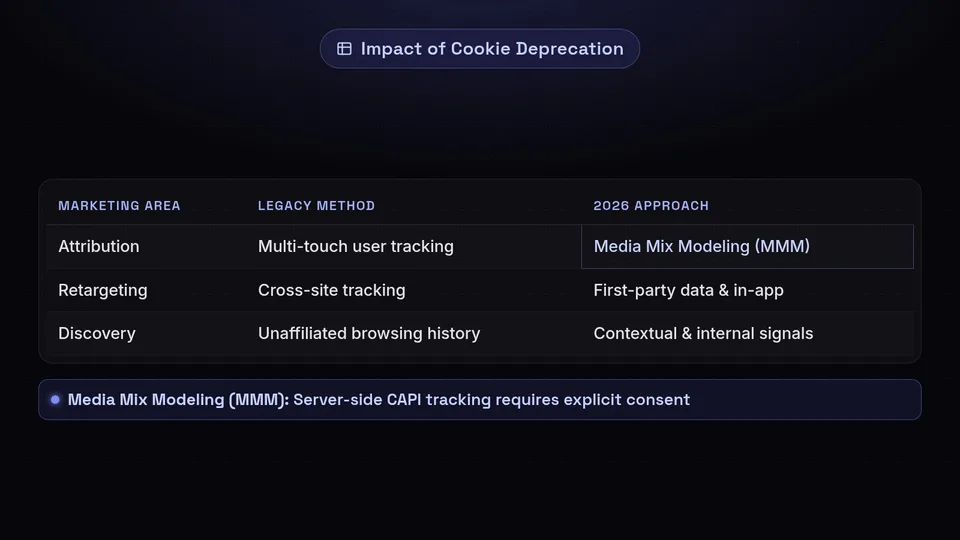
The marketing industry spent years preparing for it, and now it is our everyday reality: the complete and total deprecation of the third-party cookie. While browsers like Safari and Firefox blocked them years ago, the final phase-out across all major web browsers has fundamentally disrupted cross-site tracking and multi-touch attribution models.
How Cookie Deprecation Changes the Game
Cookie deprecation has effectively severed the invisible strings that marketers used to follow users from a social media ad, across the web, and ultimately to a conversion event on a third-party site. The impact is profound across three main areas:
- Attribution Modeling: Legacy multi-touch attribution models that relied on user-level tracking are obsolete. Marketers are now shifting to Media Mix Modeling (MMM) and incrementality testing to understand the true ROI of their social media spend.
- Retargeting: The days of showing a user an ad for a pair of shoes for three weeks just because they visited a product page are gone. Retargeting now relies heavily on first-party data matching and platform-specific in-app engagements.
- Audience Discovery: Finding new customers based on their browsing history on unaffiliated websites is no longer feasible. Advertisers must rely on the social platforms' internal signals and contextual relevance.
The Rise of Server-Side Tracking
To combat the loss of client-side cookies, marketers have rapidly adopted server-side tracking (also known as Server-to-Server or API tracking). Social media platforms provide Conversions APIs (CAPI) that allow brands to send first-party data directly from their servers to the platform's servers. While this helps recover some lost signal, it is strictly governed by the new consent requirements. You cannot legally pass a user's data through a CAPI unless that user has explicitly consented to data sharing for marketing purposes.
New Consent Requirements for Data Privacy Marketing
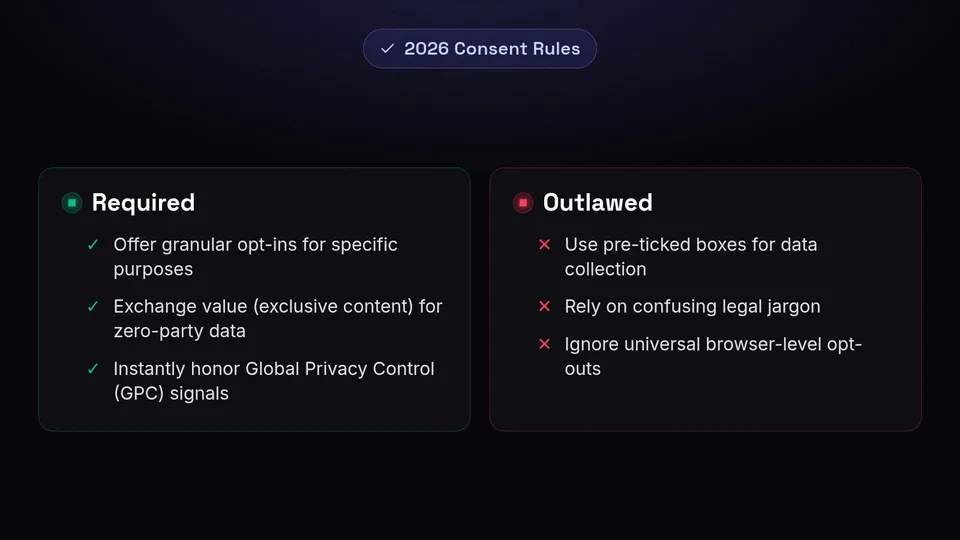
If there is one phrase that defines data privacy marketing in 2026, it is "explicit, informed, and granular consent." The days of pre-ticked boxes, confusing legal jargon, and "by continuing to use this site, you agree to our cookies" banners are explicitly outlawed in major markets.
Granular Opt-Ins and Zero-Party Data
Modern regulations mandate that users must be able to choose exactly what types of data they share and for what specific purposes. A user might consent to data collection for site analytics but reject data collection for personalized advertising. Marketers must respect these granular choices seamlessly across all touchpoints.
Because passive data collection is heavily restricted, the value of zero-party data has skyrocketed. Zero-party data is information that a customer intentionally and proactively shares with a brand. This includes preference center selections, quiz responses, and conversational data from chatbots. Collecting zero-party data requires a value exchange: what are you giving the consumer in return for their personal information? Exclusive content, personalized recommendations, and loyalty rewards are the primary drivers of zero-party data acquisition in 2026.
Global Privacy Control (GPC) and Universal Opt-Outs
Another major regulatory shift is the legal enforcement of Universal Opt-Out Mechanisms (UOOMs), such as the Global Privacy Control (GPC). Users can now set a preference at the browser or device level signaling that they do not want their data sold or shared for cross-context behavioral advertising. In 2026, websites and social media embedded browsers are legally required to detect and honor these signals instantly, overriding any site-specific consent banners.
For privacy regulations marketers, this means your tech stack must be agile enough to read GPC signals and dynamically suppress advertising tags and tracking scripts in real-time. Failure to honor a GPC signal is one of the most heavily fined compliance violations of the year.
Privacy-First Advertising Strategies That Work
Despite the strict regulations, social media marketing is far from dead. It has simply evolved. Successful brands are adopting privacy-first advertising strategies that respect user boundaries while still delivering highly relevant content and driving conversions.
Contextual Advertising Returns to the Forefront
With behavioral tracking diminished, contextual advertising has experienced a massive renaissance. Instead of targeting the user based on their past behavior, contextual advertising targets the environment in which the ad appears. On social media, this means aligning your ads with specific topics, hashtags, groups, or creator niches.
For example, instead of trying to find users who recently browsed for camping gear on external websites, a brand will target social media conversations, video categories, and influencer posts specifically related to outdoor survival, hiking, and camping. Advanced AI contextual analysis now allows platforms to understand the sentiment and nuance of social content, enabling highly accurate contextual placements without needing a single piece of Personally Identifiable Information (PII).
Data Clean Rooms
For enterprise marketers, Data Clean Rooms (DCRs) have become essential tools for compliant social media advertising. A data clean room is a secure, encrypted environment where two parties (e.g., a brand and a social media platform) can match their first-party data without actually exposing the raw PII to one another.
Through privacy-enhancing technologies (PETs) like differential privacy and homomorphic encryption, marketers can uncover overlapping audiences, measure campaign performance, and build lookalike models in a way that is mathematically proven to protect individual privacy. This allows for sophisticated audience insights while remaining fully compliant with 2026 regulations.
First-Party Data Monetization and Walled Gardens
Social media platforms have essentially become fortified walled gardens. Since they can no longer track users across the open web, they are heavily incentivizing users to complete their entire purchasing journey within the social app itself. In-app checkout, native lead generation forms, and social commerce integrations allow platforms to retain first-party data on user behavior.
Marketers must adapt by optimizing for these in-platform conversion events. By keeping the user inside the walled garden, the platform retains the attribution signal, allowing the marketer to accurately measure ROI without violating cross-site tracking regulations.
Building a Compliant Social Media Presence
Achieving a compliant social media presence requires more than just updating your privacy policy. It requires a holistic approach to how you communicate, how you handle user inquiries, and how you manage the tools in your marketing stack.
Organic Social Media and Data Minimization
Compliance isn't just for paid advertising; it applies to organic social media management as well. The principle of data minimization dictates that you should only collect the data you absolutely need to perform a specific function. When running social media contests, hosting live events, or managing direct message (DM) campaigns, audit the information you are requesting.
- Do you really need a user's phone number for an email newsletter signup?
- Are you storing DM conversations longer than necessary?
- Is your social media management tool securely handling user handles and profile data?
Handling Data Subject Access Requests (DSARs)
In 2026, consumers are highly aware of their right to access, correct, or delete their personal data. Social media marketers often act as the frontline for these Data Subject Access Requests (DSARs). If a user comments on a post or sends a DM demanding that their data be deleted, your team must have a standardized protocol to route that request to your privacy or legal team within the legally mandated timeframe (often 15 to 30 days).
Training your community managers to recognize and appropriately escalate DSARs is a critical component of modern compliance.
Compliance Best Practices Checklist for Marketers
To help you navigate these complex waters, we have compiled a definitive checklist for privacy regulations marketers operating in 2026. Use this to audit your current strategies and tech stack.
- Conduct a Comprehensive Data Audit: Map out exactly what user data you collect through social media, where it is stored, who has access to it, and the legal basis (consent, legitimate interest, etc.) for processing it.
- Update Consent Management Platforms (CMPs): Ensure your CMP is configured to handle granular consent, rejects pre-ticked boxes, and instantly honors Universal Opt-Out Mechanisms like GPC.
- Implement Server-Side Tagging Securely: If using Conversions APIs, ensure your server-side logic checks the user's consent status before firing the data payload to the social platform.
- Revamp Your Privacy Policy: Your privacy policy must clearly state your 2026 data practices in plain, easily understandable language. Avoid legal jargon. Clearly explain how social media data is used for algorithmic targeting.
- Invest in Zero-Party Data Capture: Develop interactive content (quizzes, polls, preference centers) that incentivizes users to willingly share their preferences in exchange for tangible value.
- Shift to Contextual and In-Platform Metrics: Reduce your reliance on cross-site attribution. Optimize your campaigns for in-platform engagement, video views, and native lead forms.
- Audit Third-Party Tools: Ensure every tool in your marketing stack (scheduling tools, analytics dashboards, CRM integrations) is fully compliant with 2026 regulations and offers robust data encryption.
The Future of AI and Privacy in Social Media
Artificial Intelligence is playing a dual role in the 2026 privacy landscape. On one hand, regulators are scrutinizing AI for potential biases and unauthorized use of training data. On the other hand, AI is the exact technology enabling marketers to succeed in a privacy-first world.
Predictive Analytics Without PII
Machine learning models are now highly adept at predictive analytics without needing Personally Identifiable Information. By analyzing aggregate, anonymized data trends, AI can predict which creative assets will perform best, what times of day yield the highest engagement, and which contextual topics are trending among your target demographics. This allows marketers to optimize their campaigns aggressively without ever tracking an individual user.
Generative AI for Personalized Experiences
Generative AI allows brands to create highly personalized content variations on the fly. When combined with zero-party data (where the user has explicitly stated their preferences), AI can generate custom copy and visuals tailored to that specific user's stated interests, ensuring relevance while maintaining strict compliance with consent mandates.
Conclusion: Embrace the Privacy-First Era with SchedulifyX
The transition to social media privacy 2026 standards may seem daunting, but it represents a massive opportunity for brands that prioritize consumer trust. Cookie deprecation and stringent consent laws are not the end of digital marketing; they are the catalyst for a more transparent, respectful, and ultimately more effective relationship between brands and consumers.
By embracing data privacy marketing, shifting toward contextual advertising, and respecting user consent, you can build a highly compliant social media strategy that drives real business results without compromising ethical standards.
As you adapt your strategies for this new era, you need tools that are built from the ground up with privacy and compliance in mind. SchedulifyX is your ultimate AI-powered social media scheduling platform designed for the 2026 landscape. SchedulifyX helps you optimize your posting schedules, analyze contextual trends, and manage your organic presence using predictive AI that relies entirely on aggregated, privacy-safe data. Stop worrying about compliance technicalities and start focusing on creating incredible content. Upgrade your social media strategy and stay ahead of the regulatory curve with SchedulifyX today.