Owned vs Rented Audience: Mapping Your Platform Risk
SchedulifyX Team · September 21, 2026
Discover the critical differences between an owned vs rented audience. Learn how to navigate platform risk and balance your email vs social audience strategy.
Every digital marketer loves to see their follower count tick upwards. It provides a rush of validation and the promise of a growing customer base. However, beneath the surface of those impressive vanity metrics lies a critical vulnerability that many businesses fail to recognise until it is too late. The stark reality of modern digital marketing is that not all audiences are created equal, and where your audience lives dictates how much control you truly have over your business's future.
In the evolving landscape of digital distribution, professionals are increasingly forced to confront the difference between an owned vs rented audience. As algorithms shift, advertising costs fluctuate, and platforms introduce sweeping changes without warning, understanding this distinction is no longer just a theoretical exercise. It is a fundamental requirement for survival.
Understanding the Owned vs Rented Audience Divide
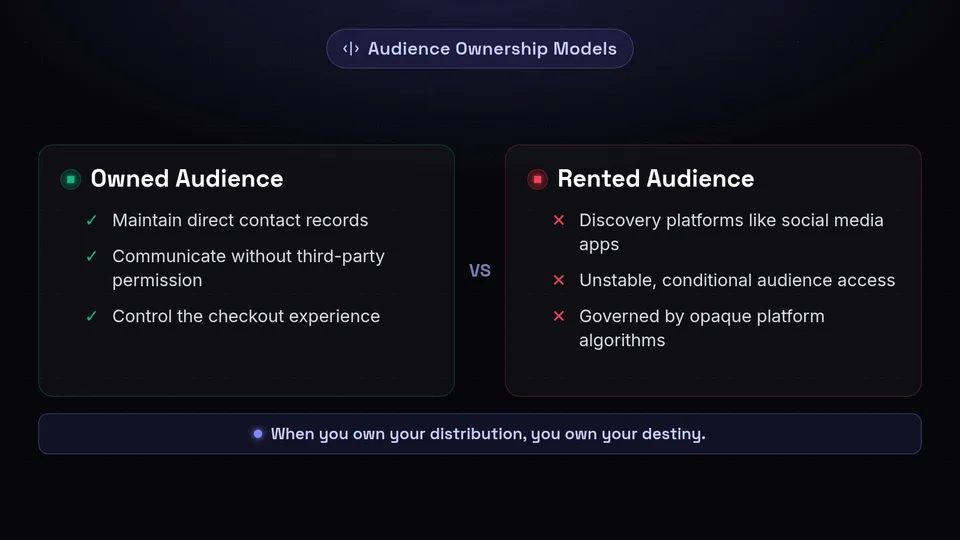
To navigate the modern digital ecosystem, we must first categorise the spaces in which we operate. In September 2026, community platform Circle published a framework defining what it truly means to own your audience. According to their analysis, an owned audience requires maintaining direct contact records—such as email addresses—that allow you to communicate with your community without requiring permission from a third-party platform. Crucially, it also involves controlling the checkout experience.
Conversely, rented channels are discovery platforms like TikTok and Instagram. When you build an audience on these networks, you are essentially building a business on someone else's property. As digital marketing strategist Nick Eubanks, Chief Marketing Officer at Digistore24, succinctly noted in his June 2026 analysis:
When you own your distribution, you own your destiny. When you rent it, you're just a tenant waiting to be evicted.
This sentiment is echoed across the industry. A February 2026 report by Sonikit highlighted this dynamic specifically for creators and artists, outlining how social media followers, streaming listeners, and short-form video viewers represent unstable, conditional access. Your ability to reach these individuals is entirely governed by opaque platform algorithms, making your connection to them precarious at best.
The Escalating Reality of Platform Risk
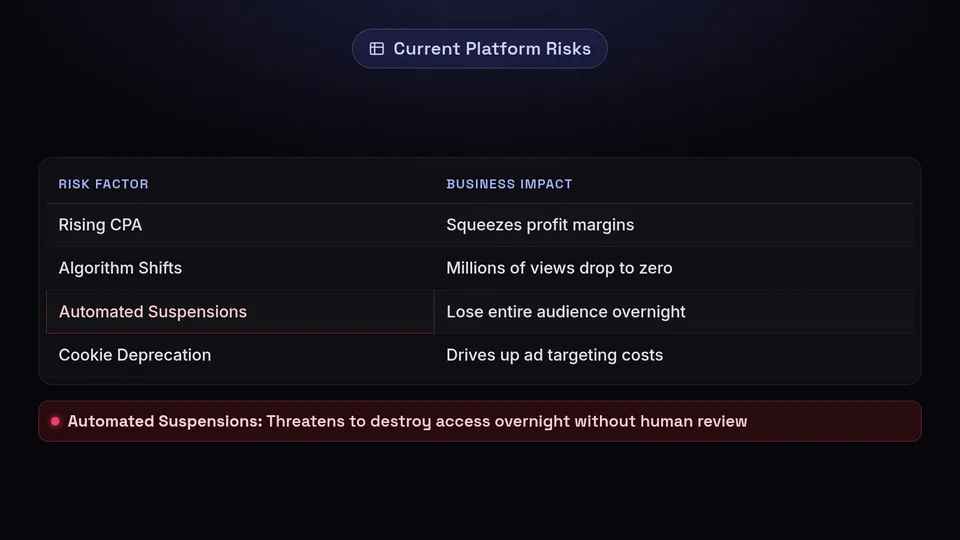
The dangers of relying too heavily on rented land are not hypothetical; they are actively reshaping how businesses operate. Platform risk is the exposure a business faces when a third-party service changes its rules, algorithms, or pricing structures in a way that damages the business's bottom line.
A September 16, 2026, report by VentraIP detailed the severe platform dependence risks currently hiding in modern marketing stacks. Across giants like Meta, Google, and TikTok, businesses are facing a barrage of challenges:
- Rising Cost Per Acquisition: As platforms mature and competition increases, the cost to acquire a customer through rented advertising channels continues to climb, squeezing profit margins.
- Algorithmic Organic Reach Shifts: Platforms routinely update the algorithms that decide what content users see. A strategy that generates millions of views today might yield nothing tomorrow.
- Account Suspensions Without Appeal: Perhaps the most terrifying platform risk is the threat of automated account suspensions. Businesses can lose access to their entire audience overnight, often with no clear path for appeal or human review.
- Third-Party Cookie Deprecation: The ongoing loss of third-party tracking cookies makes it increasingly difficult to target ads effectively on rented platforms, further driving up costs.
Furthermore, the rise of artificial intelligence is introducing new layers of volatility. According to a December 2025 report by Omeda, 62% of marketing leaders are actively adjusting their strategies due to the fragmentation of search engines and the introduction of AI search features. Digistore24's analysis specifically pointed to Google AI Overviews displacing traditional organic search results, meaning that even organic search traffic—once considered a highly stable acquisition channel—is now a volatile rented space.
Email vs Social Audience: The Numbers Speak
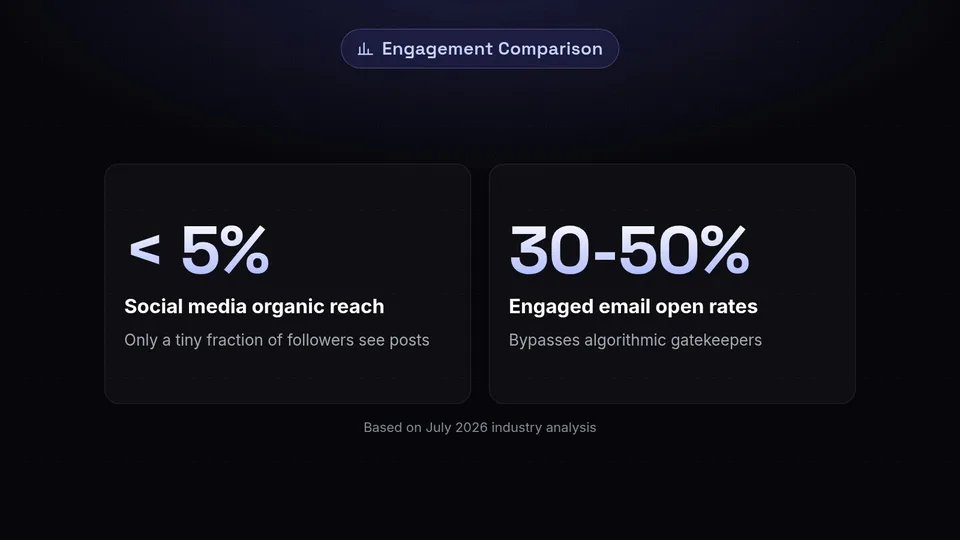
When comparing an email vs social audience, the data paints a clear picture of why ownership matters. While social media platforms excel at discovery and brand awareness, their utility for guaranteed distribution is waning.
In July 2026, EcoSend published an analysis comparing these two channels, revealing a stark contrast in engagement. According to their findings, organic reach on major social platforms currently sits in the low single digits. If you have 10,000 followers on a rented platform, only a tiny fraction of them will ever see your posts unless you pay to boost them.
In contrast, engaged email open rates routinely run between 30% and 50%. Because email relies on direct contact records, it bypasses the algorithmic gatekeepers that throttle social media reach. When you press send on an email campaign, you have a near guarantee that your message will at least reach the recipient's inbox, making it a vastly superior tool for retention and direct sales.
The Myth of Absolute Ownership
However, it is crucial to approach this landscape with a sober mindset. While email is widely championed as the ultimate owned asset, it is not entirely immune to secondary platform risk.
An industry analysis published in December 2025, titled "The Myth of Audience Ownership," highlighted that even email marketers must contend with powerful intermediaries. Inbox providers (like Gmail and Apple Mail) still exert significant control over the relationship between a sender and a recipient. They manage this through:
- Auto-Unsubscribe Prompts: Making it easier than ever for users to silently opt out of communications.
- Tabbed Inbox Ranking: Funnelling marketing emails into "Promotions" tabs where they may be ignored.
- Privacy Filtering: Implementing strict privacy measures that obscure open rates and tracking data.
- AI-Generated Summaries: Using artificial intelligence to summarise emails, meaning the recipient might never actually open or read your carefully crafted copy.
Therefore, while email is significantly closer to true ownership than a social media following, it is still subject to the rules of the infrastructure providers. True ownership is a spectrum, not a binary state.
Building a Balanced Strategy
Given these realities, how should a modern brand structure its audience strategy? The key lies in diversification and understanding the distinct role that each platform plays in your wider ecosystem.
A digital marketing strategy guide from July 2026, titled "The 'Rented Land' Delusion," offered a practical rule of thumb for mitigating platform risk: businesses should diversify their channels so that no single rented social platform accounts for more than 30% to 40% of their total traffic or revenue. If a platform changes its algorithm, suspends your account, or implements unilateral commission changes, your business must be able to survive the impact.
The Discovery-to-Retention Pipeline
The most effective approach is to use rented audiences for what they do best: discovery. Social media platforms, with their vast user bases and viral algorithms, are unparalleled tools for finding new prospects. However, the ultimate goal of any social media campaign should be to migrate those rented followers onto your owned channels as quickly as possible.
By offering high-value lead magnets, exclusive community access, or newsletter subscriptions, you can convert a fragile social media follower into a robust, owned contact record. You use the rented land to capture attention, but you bring them back to your owned assets—your registered domains, your website, and your email capabilities—to build the actual relationship.
How SchedulifyX Fits Into Your Audience Strategy
Navigating the balance between an owned vs rented audience requires the right set of tools. We must be entirely transparent: platforms dedicated to email marketing and customer relationship management (CRM) are inherently stronger for long-term audience retention and checkout control than a social media scheduling tool. Email providers are built specifically to manage your owned assets, and they excel at it.
However, SchedulifyX plays a vital role at the top of your marketing funnel. Because social media remains a rented space, you need to be efficient, consistent, and highly strategic to extract value from it without exhausting your resources. SchedulifyX is an AI-powered social media scheduling platform designed to help you maintain a persistent presence across multiple rented channels simultaneously.
By automating your social publishing and using AI to optimise your posting schedule, SchedulifyX ensures that you are continuously driving discovery and funnelling new prospects toward your owned email lists and websites, all while keeping your operational costs low. It allows you to successfully farm on rented land so you can afford to build your own house.
Ready to streamline your rented channel strategy and start driving more traffic to your owned assets? Discover how AI-powered scheduling can transform your workflow with SchedulifyX today. (Note: Platform algorithms and pricing models change frequently; always confirm the latest capabilities directly on vendor websites.)
Sources
Facts checked against the sources below on September 21, 2026.
- Owning Vs Renting Your Audience — circle.so
- youtube.com
- Owned Audience Vs Rented Followers — influencetargetingmarketing.com
- Rent Vs Own — ecosend.io
- Owned Vs Rented Audience — digistore24.com
- Owned Audience Vs Rented Audience The Marketing Concept Every Artist Should Understand — sonikit.com
- Renting Audience Vs Owning Audience — omeda.com
- The Myth Of Audience Ownership — audienceinsiders.com