Writing Social Media Alt Text for Reach and Accessibility
SchedulifyX Team · September 28, 2026
Learn how writing descriptive social media alt text can improve your content's reach while ensuring you create fully accessible social posts for all users.
When crafting the perfect social media post, marketers often spend hours selecting the right image, writing an engaging caption, and researching the most relevant hashtags. Yet, one of the most crucial elements of a successful post is frequently overlooked entirely: social media alt text. While traditionally viewed solely as an accessibility feature, alternative text has evolved into a powerful tool for content discoverability.
By taking the time to describe your images accurately, you not only ensure your content is inclusive for all users, but you also provide social media algorithms with the vital context they need to categorise and serve your posts to a wider audience. In this comprehensive guide, we will explore the dual benefits of alternative text, delve into the mechanics of Instagram alt text SEO, and provide actionable tips for creating truly accessible social posts.
What is Social Media Alt Text?
Alternative text, commonly referred to as alt text, is a brief written description of an image. Originally designed for web pages, this HTML attribute ensures that if an image fails to load, a text description appears in its place. More importantly, alt text is the primary mechanism by which screen reading programmes interpret visual content for users with visual impairments.
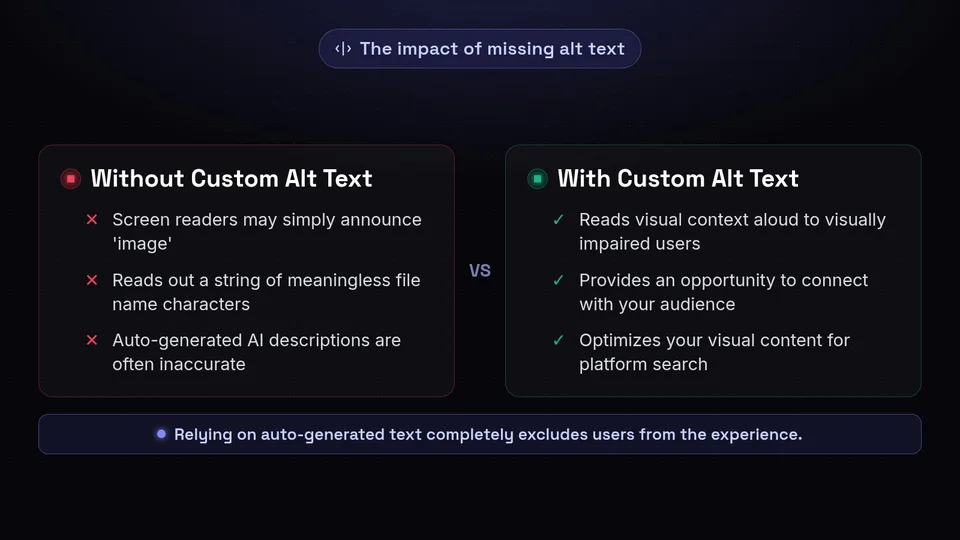
On social platforms, social media alt text functions in much the same way. When a user relying on a screen reader scrolls through a feed on platforms like Instagram, X, LinkedIn, or Facebook, the software will read the alt text aloud, allowing the user to understand the visual context of the post. Without this text, the screen reader might simply announce "image" or read out a string of meaningless file name characters, completely excluding the user from the experience.
While many platforms now use artificial intelligence to auto-generate alt text for images, these automated descriptions are often vague, lacking context, or entirely inaccurate. Relying on auto-generated text means missing out on a critical opportunity to connect with your audience and optimise your content for search.
The Link Between Alt Text and Social Media Reach

Beyond accessibility, social media alt text plays a fundamental role in how algorithms understand and distribute your content. Social media platforms are essentially massive search engines. To serve the right content to the right users, their algorithms must accurately categorise every post.
While image recognition technology is highly advanced, algorithms still rely heavily on text-based metadata to confirm what an image is about. When you provide clear, descriptive alt text, you are directly telling the platform's algorithm exactly what your content contains. This text acts as a hidden layer of context.
If a user searches for a specific topic, platforms will scan captions, hashtags, and alt text to deliver the most relevant results. Therefore, well-crafted alt text can directly influence your visibility in search results and explore feeds, helping your content reach users who are actively looking for the topics you post about, even if they do not follow your account.
Mastering Instagram Alt Text SEO

Instagram has transitioned from a purely chronological feed to a highly sophisticated, algorithm-driven platform with robust search capabilities. Users no longer search just by hashtags or account names; they search using standard keywords. This shift has made Instagram alt text SEO a vital component of any modern social media strategy.
When you upload a photo to Instagram, the platform allows you to add custom alt text in the advanced settings before publishing. By strategically including relevant keywords in this description, you increase the likelihood that your post will surface when users search for those terms.
How Instagram Uses Alt Text
Instagram's algorithm uses a combination of visual recognition and text analysis to categorise content for the Explore page and search results. If your image features a modern home office setup, and your alt text describes "a modern home office setup with a wooden desk, dual monitors, and a small potted plant," Instagram gains high confidence in the subject matter. When a user types "home office setup" into the search bar, your post is much more likely to appear than a similar image lacking descriptive alt text.
Balancing SEO with Natural Language
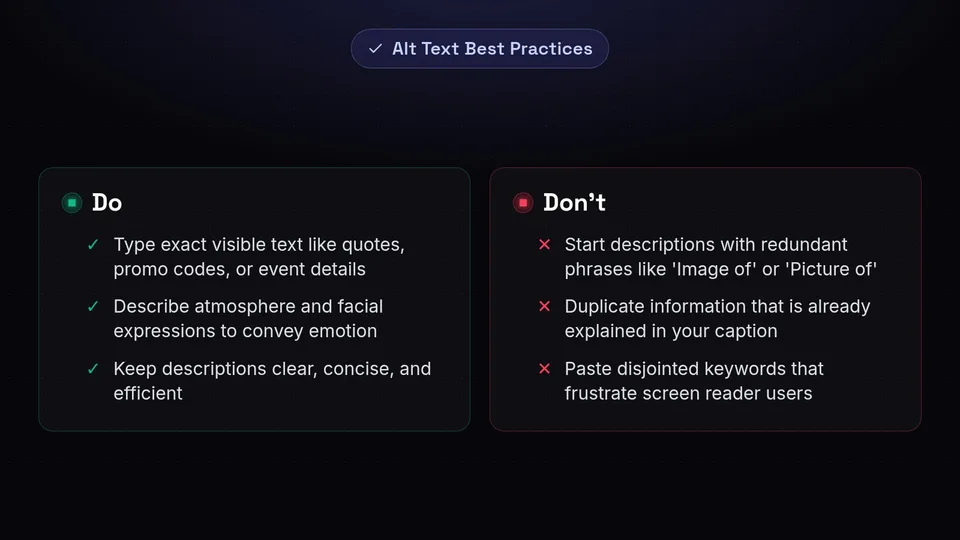
The key to effective Instagram alt text SEO is balance. Your primary goal must always be accessibility. You should naturally weave your target keywords into a coherent, descriptive sentence rather than simply pasting a list of search terms. Algorithms are designed to recognise and penalise keyword stuffing, and a list of disjointed keywords creates a frustrating, confusing experience for screen reader users.
How to Write Alt Text for Accessible Social Posts
Creating accessible social posts requires a thoughtful approach to how you describe visual information. The goal is to provide a user who cannot see the image with the same core message and emotional impact as a user who can. Here are practical guidelines for writing effective social media alt text:
- Be descriptive but concise: Aim for a clear description that conveys the essential details without becoming an overly long essay. Most screen readers allow users to interrupt the reading, but it is best to provide the most important information efficiently.
- Do not start with "Image of" or "Picture of": Screen readers automatically announce that the element is an image. Starting your alt text with "Image of" is redundant and wastes valuable time. However, if the medium is important to the context (e.g., "An oil painting of" or "A black and white photograph of"), it is appropriate to include it.
- Include visible text: If your image contains text that is crucial to understanding the post—such as a quote, a promotional code, or event details—you must type that exact text into the alt description.
- Convey context and emotion: Describe the atmosphere or the expressions of the people in the photo if it adds to the meaning of the post. Instead of "A man sitting at a desk," write "A man smiling warmly while typing on a laptop at a brightly lit desk."
- Consider the caption: Alt text should complement your caption, not duplicate it. If your caption already explains the entire context of the image, your alt text can focus purely on the visual details.
Common Alt Text Mistakes to Avoid
As you integrate alt text into your social media workflow, be mindful of common pitfalls that can hinder both accessibility and reach.
Keyword Stuffing
As mentioned earlier, cramming your alt text with irrelevant keywords is detrimental. If your alt text reads "coffee shop barista latte espresso cafe london marketing digital," it provides zero visual context for a screen reader user and may be flagged as spam by platform algorithms. Always prioritise human-readable sentences.
Being Too Vague
Single-word alt text, such as "dog" or "building," fails to provide meaningful context. A better approach would be "A golden retriever running through a grassy park with a red tennis ball in its mouth." This level of detail serves both the visually impaired user and the search algorithm.
Relying Solely on Auto-Generated Text
While AI is improving, it cannot understand the nuance, brand context, or specific intent behind your image. Always review and overwrite auto-generated alt text to ensure accuracy and to apply your Instagram alt text SEO strategy.
Make Alt Text Part of Your Publishing Workflow
Writing descriptive social media alt text is not just a best practice; it is a fundamental requirement for modern digital marketing. By committing to accessible social posts, you demonstrate respect for all members of your audience while simultaneously giving your content the best possible chance to be discovered through organic search.
To ensure this crucial step is never missed, alt text creation should be a mandatory part of your content approval and scheduling process. When you plan your posts in advance, you have the time to craft thoughtful, keyword-optimised descriptions rather than rushing them at the moment of publication.
With SchedulifyX, you can seamlessly organise your content calendar and streamline your publishing routine, giving your team the bandwidth to focus on creating high-quality, inclusive content. Visit SchedulifyX.com today to learn how our AI-powered platform can help you manage your social media strategy more effectively.