Warning Labels Head to Court as TikTok's AI Ads Get Longer
SchedulifyX Team · November 17, 2026
17 November 2026: NetChoice sues New York over social media warning labels, TikTok's AI ads reach 30 seconds and YouTube turns podcast episodes into Shorts.
This is the SchedulifyX industry briefing for 17 November 2026, covering the week from 9 November. The theme is labels and formats: what users are told about the content in front of them, and which new formats platforms are handing to marketers. In the US, the tech industry's best-known trade group has gone to court to stop New York's warning labels on social apps. TikTok's AI video ads now run to 30 seconds, YouTube can turn a podcast episode into vertical Shorts in a few clicks, and LinkedIn has brought its streaming TV ads to the UK. In the EU, the deadline for machine-readable marks on AI-generated content is just over two weeks away.
New York's social media warning labels head to court
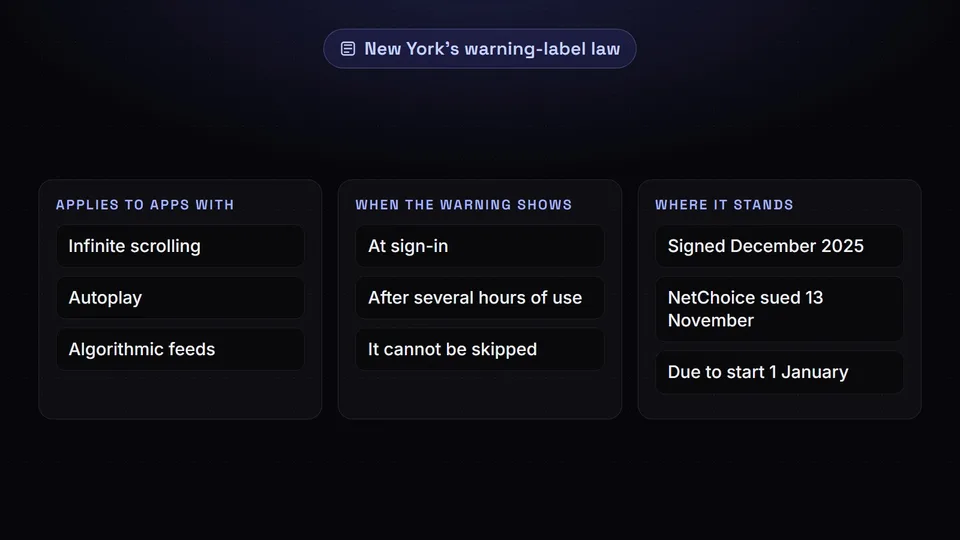
On Friday 13 November, NetChoice, an internet trade group whose members include Google, Meta, Snap and TikTok, filed a complaint in federal court asking a judge to block New York's law requiring warning labels on social media, Reuters reported. The state attorney general's office, which enforces the law, declined to comment immediately.
The law was signed by Governor Kathy Hochul last December. It applies to platforms with infinite scrolling, autoplay and algorithmic feeds, and requires a warning attributed to the US Surgeon General: "excessive use may be associated with significant mental health harms". The wording is modelled on the 2023 findings of the former Surgeon General, Vivek Murthy. According to NetChoice, the warning appears when people sign in and again after several hours of use, and it cannot be skipped. The law is due to take effect on 1 January.
NetChoice argues that the law compels its members to repeat the state's "preferred message" about online safety, in breach of the First Amendment. In its words, "unlike a static warning on a product label, these warnings repeatedly interrupt users and block access to protected speech."
The case has precedents. A federal judge blocked a similar law in Colorado in November 2025 on First Amendment grounds, and Colorado is appealing. NetChoice also sued California over a comparable law last month. For brands and creators, the labels would change the experience of using an app rather than the reach of any single post: the interruption arrives at sign-in and during long sessions. Whether New Yorkers see it from January depends on how quickly the court rules.
TikTok's AI video ads now run to 30 seconds
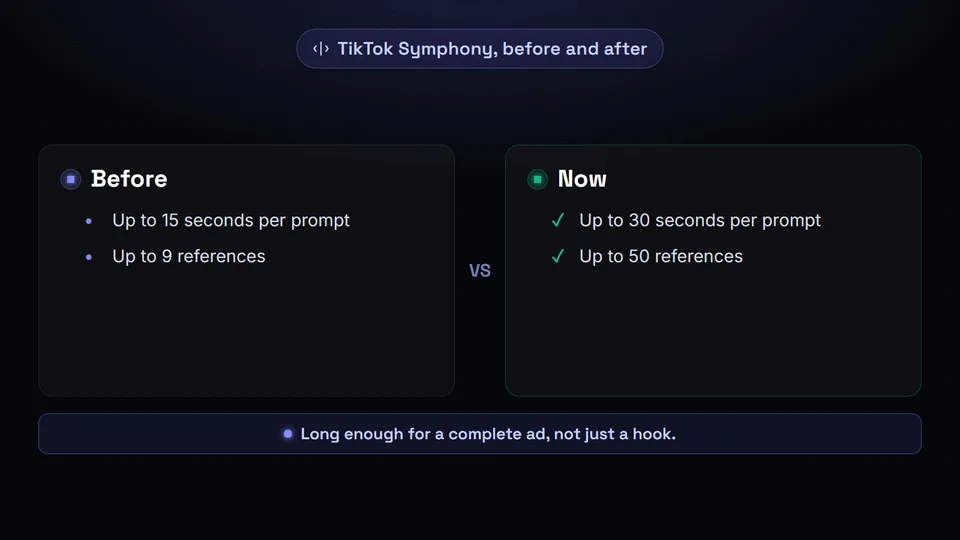
TikTok has updated Symphony, its AI creative suite for advertisers. The latest Dreamina Seedance model can now generate up to 30 seconds of video from each prompt, up from 15, and advertisers can upload up to 50 references (images, video and audio) instead of nine, Social Media Today reported on 9 November, citing TikTok's own announcement. TikTok says the model produces sharper imagery, better lighting and more consistent characters from frame to frame.
Two changes affect how advertisers get at these tools. An updated Symphony API lets them generate content with Symphony's tools inside their own creative management software. And from 9 November, advertisers outside North America can buy BytePlus tokens to use the Seedance models through Symphony. BytePlus is the enterprise technology arm of ByteDance, TikTok's parent company.
Thirty seconds is long enough for a complete ad, with a problem, a demonstration and a call to action, rather than just an opening hook. More references mean you can supply real product shots, brand audio and existing footage instead of relying on the model to invent them. The usual caution applies: every generated video needs a human review before it runs, both for accuracy and for how a product is shown.
YouTube turns podcast episodes into vertical Shorts
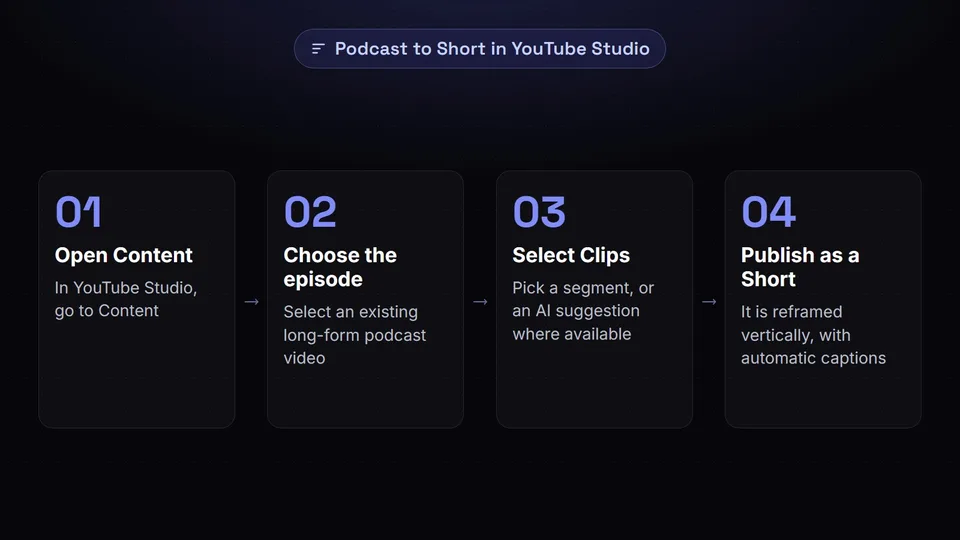
On 12 November YouTube extended the clips tool in YouTube Studio to Shorts, PPC Land reported, citing YouTube's post in its Help Community. Creators can pick a segment of a long-form podcast episode and publish it as a vertical Short with automatic captions. In YouTube's words, "your 16:9 podcast episode will be transformed into a verticalized video".
The AI-powered parts, suggested segments and transcript outlines, are limited to creators in Brazil, Canada, France, Germany, India, Mexico, South Korea, Spain, the UK and the US, working in English, French, German, Hindi, Korean, Portuguese or Spanish. The manual clips tool works for creators elsewhere: in YouTube Studio, open Content, choose an existing video and select Clips.
For anyone publishing a video podcast, this takes most of the effort out of a familiar workflow: one long episode becomes several short clips for the Shorts feed, each pointing back to the full conversation. It also fits a sensible approach to reuse, which we cover in how to recycle social content without looking repetitive: each clip should stand on its own rather than feel like an offcut.
LinkedIn brings its streaming TV ads to the UK
On 12 November LinkedIn expanded its CTV Ads to the UK. These are ads shown on ad-supported streaming television, and the UK launch names LG, Paramount+ and Titan OS among its partners. Advertisers choose an audience in LinkedIn Campaign Manager using LinkedIn's own professional data, such as role, industry and seniority. LinkedIn then matches that audience with eligible viewers on the TV platforms, and results are managed and measured inside LinkedIn. CTV Ads are now available to target buyers in the US, Canada and the UK.
LinkedIn says people who saw a brand's CTV ad first cost 30% less to turn into sales leads. That figure comes from its own 2025 data on US and Canadian campaigns, not from UK results, so treat it as LinkedIn's claim rather than a benchmark for your account.
For business-to-business marketers, the practical change is a television-screen option at the top of the funnel that uses the same targeting as feed campaigns. That makes it easier to run a sequence, a TV ad first and feed ads afterwards, to one defined audience, and to judge it with the measurement you already use.
What to watch: EU marking rules for AI content from 2 December
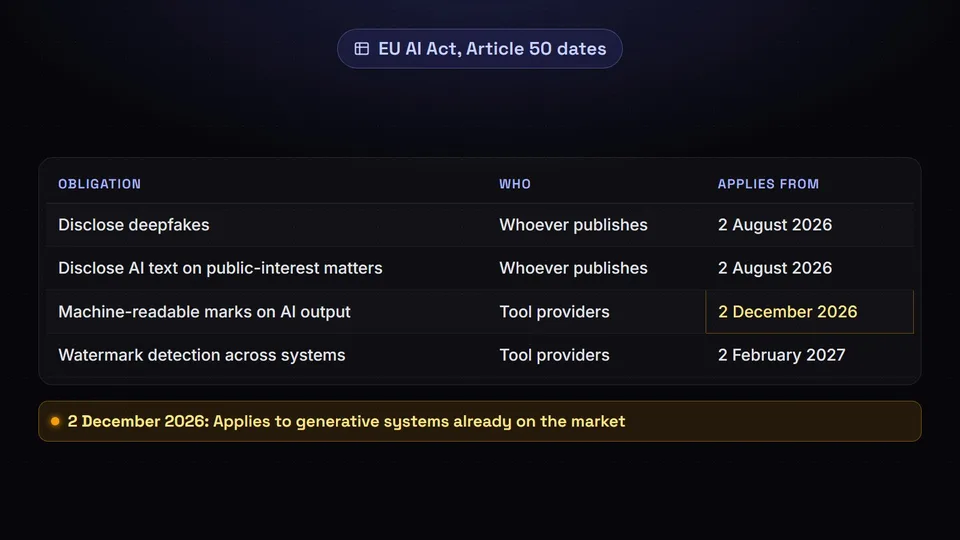
Most of the transparency obligations in Article 50 of the EU AI Act have applied since 2 August 2026. Anyone who uses AI to create deepfakes must disclose that the content was generated or manipulated by AI. The same goes for AI-generated text published to inform the public on matters of public interest, unless it has been reviewed or edited by a person who takes responsibility for it. For artistic or creative work, the disclosure can be limited to noting the manipulation in a way that does not spoil the work.
A second obligation falls on the providers of generative AI systems: they must mark what their systems produce in a machine-readable way, so it can be detected as AI-generated. For systems already on the market, the Digital Omnibus deferred that marking requirement to 2 December 2026, according to a Paul, Weiss analysis of the Commission's final guidelines, published on 20 July. Rules on making watermark detection work across systems follow from 2 February 2027. Fines for breaching these obligations can reach €15 million or 3% of worldwide turnover, whichever is higher.
For marketers, the split matters. The marking duty sits with the tool makers, but the duty to disclose deepfakes sits with whoever publishes them. An AI tool that marks its output does not remove the need to label a deepfake in an ad or post shown in the EU.
A short audit before 2 December covers most of it. List the tools your team uses to generate images, video, audio or text. Ask each vendor whether and how its output is marked as AI-generated, and keep the answer on file. Then agree who on the team decides when a piece of content counts as a deepfake, and how the label appears in a post or an ad, so the decision is not made in a hurry on publishing day.
What this means for your content
- Follow the New York case before 1 January. If the law takes effect, sessions on the largest apps in New York will include a warning at sign-in and after long use.
- Test TikTok's longer AI ads with your own material. Use real product shots and audio as references, and review every generated video before it goes live.
- Turn your best podcast moments into Shorts. The clips tool now does the vertical reframing and captions, so the remaining work is choosing segments that make sense on their own.
- If you sell to UK businesses, look at LinkedIn's CTV Ads. They use the same audience targeting as your feed campaigns, which makes a TV-then-feed sequence simple to set up.
- Check your AI labelling for the EU before 2 December. Label deepfakes you publish, and ask the tools you use how they mark their output.
Conclusion
This week's pattern runs in two directions. Platforms are putting more AI into how content is made and repackaged, from 30-second generated ads to podcast clips reframed for Shorts. Regulators, meanwhile, are pressing on what people are told about what they see, from New York's warning labels to the EU's marks on AI-generated content. None of it changes tomorrow's posts, but both trends will shape how ads and short videos are produced and labelled over the coming months.
SchedulifyX publishes this briefing every week. If you manage several platforms, scheduling in SchedulifyX gives you one calendar to review against changes like these before anything goes live.
Sources
Facts checked against the sources below on November 17, 2026.
- New York sued over law requiring social media 'warning label' (Reuters, via The Star)
- TikTok updates its AI video ad tools (Social Media Today)
- TikTok Symphony AI creative suite (TikTok for Business)
- YouTube Studio now turns 16:9 podcast segments into vertical Shorts (PPC Land)
- LinkedIn expands CTV Ads to the UK (LinkedIn)
- EU finalises transparency rules for AI-generated content (Paul, Weiss)
