EU Targets TikTok's Feed as the Digital Fairness Act Lands
SchedulifyX Team · November 11, 2026
11 November 2026: the EU's preliminary finding on TikTok's For You feed, the Digital Fairness Act proposal, Thailand's advertiser ID checks and Meta's terms.
This is the SchedulifyX industry briefing for 11 November 2026, covering the week from 4 November. The theme is regulation and compliance affecting social platforms and advertisers. Two developments in the EU dominate: the European Commission's preliminary finding that TikTok's For You feed breaks the Digital Services Act, and its proposal for a Digital Fairness Act, presented today. Thailand's new identity checks for advertisers are now in force, and Meta's revised business terms take effect next week.
EU says TikTok's For You feed breaches the DSA
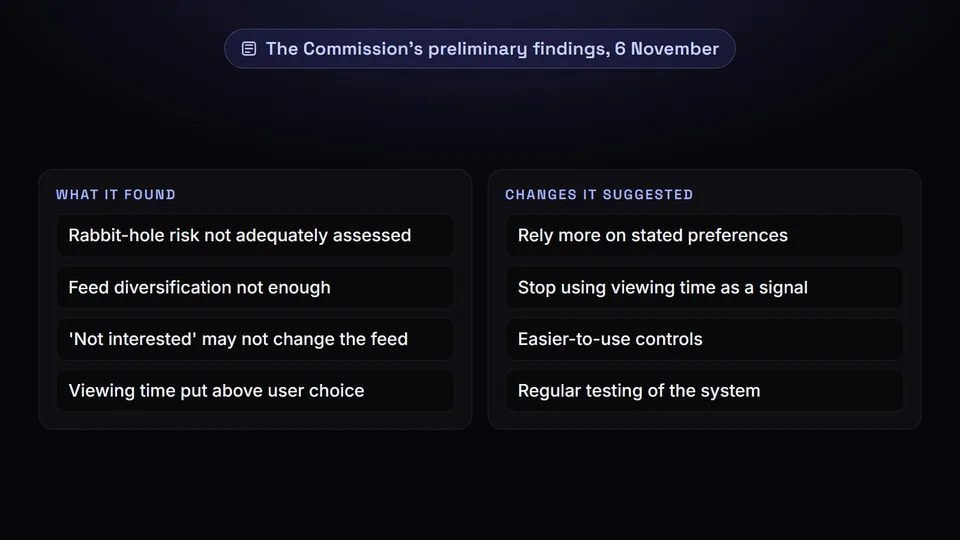
On 6 November the European Commission preliminarily found TikTok in breach of the Digital Services Act over the "rabbit hole" effect of its For You feed. In the Commission's description, the feed shows a continuous stream of personalised videos, and the more someone engages with one type of content, the more similar content they are shown. That becomes harmful when the content is about sadness, isolation or body image, with vulnerable adults and minors most at risk.
The findings cover both halves of TikTok's obligations: the Commission's view is that TikTok did not adequately assess this risk, and that its mitigation measures are not effective. According to PPC Land's account of the Commission's announcement, measures meant to diversify the feed do not reduce repetition enough, the "not interested" control may not be enough to change what someone sees, and the system gives viewing time priority over a user's choice to see less of something.
The Commission says TikTok needs to change the design of the feed. Its examples include relying more on preferences users state explicitly, no longer using viewing time as a signal for recommending content, making controls easier to find and use, and testing the system regularly. These are preliminary findings: TikTok can see the file and respond in writing, the European Board for Digital Services is consulted, and only a final non-compliance decision could bring a fine, of up to 6% of TikTok's worldwide annual turnover. They follow earlier preliminary findings against TikTok on addictive design in February and on the protection of minors in July, all part of formal proceedings the Commission opened in February 2024. Taken together, the three findings describe a regulator working through the feed piece by piece: how it keeps people scrolling, how it treats younger users, and now how it chooses what to show next.
For brands and creators, nothing changes yet. But the For You feed is where most organic reach on TikTok comes from, and watch time is one of the strongest signals it uses today. If the final decision requires TikTok to stop ranking by viewing time in the EU, what travels on the platform there could change. We look at what drives TikTok distribution now in Do Hashtags Still Work on TikTok?
The Digital Fairness Act proposal arrives
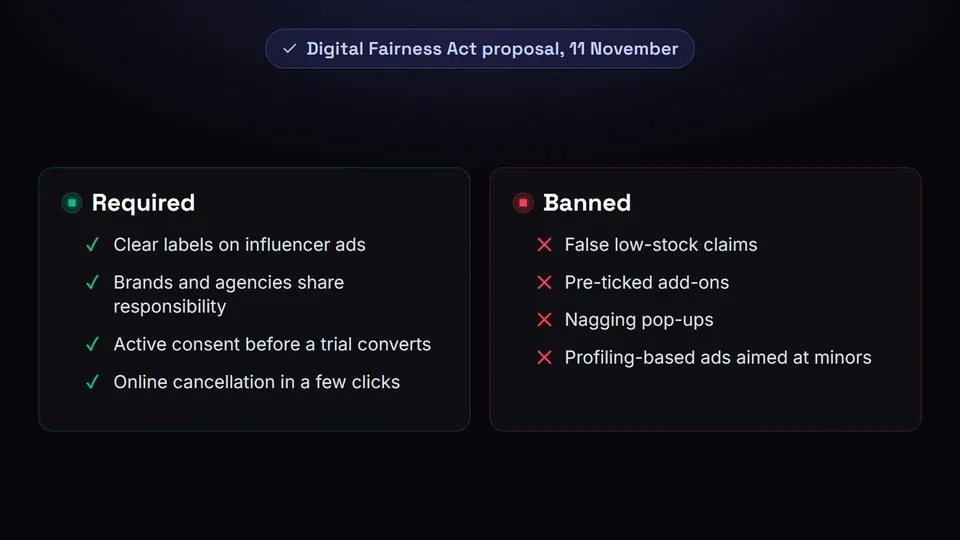
Today the European Commission proposed the Digital Fairness Act, its overhaul of consumer protection online, as The Next Web reported. It would replace the 2005 Unfair Commercial Practices Directive with a regulation that applies directly in every member state, and the most relevant parts for social teams concern influencer marketing, interface design and subscriptions.
On influencer marketing, influencers would have to disclose commercial content clearly, and the brands and agencies behind them would share responsibility when they do not. EUobserver, which reported on a leaked draft on 10 November, said sponsored posts would need labels such as "advertisement" or "commercial collaboration", and could not be presented as personal endorsements.
On design, the proposal combines a general ban on manipulative interfaces with a blacklist of practices banned in all circumstances, such as false low-stock claims, pre-ticked add-ons and nagging pop-ups, which the Commission could extend later. Adults would get a way to switch off features designed, or reasonably foreseen, to encourage compulsive use. Advertising based on profiling would be banned where it targets minors or exploits sensitive personal data in harmful ways.
On subscriptions, free trials could not turn into paid plans without the customer actively accepting, renewals would come with reminders, and cancelling would have to work online in a few clicks. Paid loot boxes would be banned for under-18s. Fines could reach 6% of global turnover. This is a proposal: it now goes to the European Parliament and the member states, and years of negotiation are likely before anything applies.
Brands do not need to change anything today, but the direction is clear. If you work with creators, build clear disclosure into your briefs and approvals now, because under this proposal an unlabelled sponsored post would be your problem as well as theirs.
In practice, shared responsibility rewards teams that can show their working. A brief that states the required label, a contract clause that makes disclosure a condition of payment, an approval step that checks the label before a post goes live and a record of what was approved would all help demonstrate that a brand took its part seriously. The switch from a directive to a regulation matters too: a directive is written into each country's law separately, while a regulation applies in the same words everywhere, so a campaign running across several EU markets would face one set of rules rather than many.
Thailand now requires identity checks for advertisers
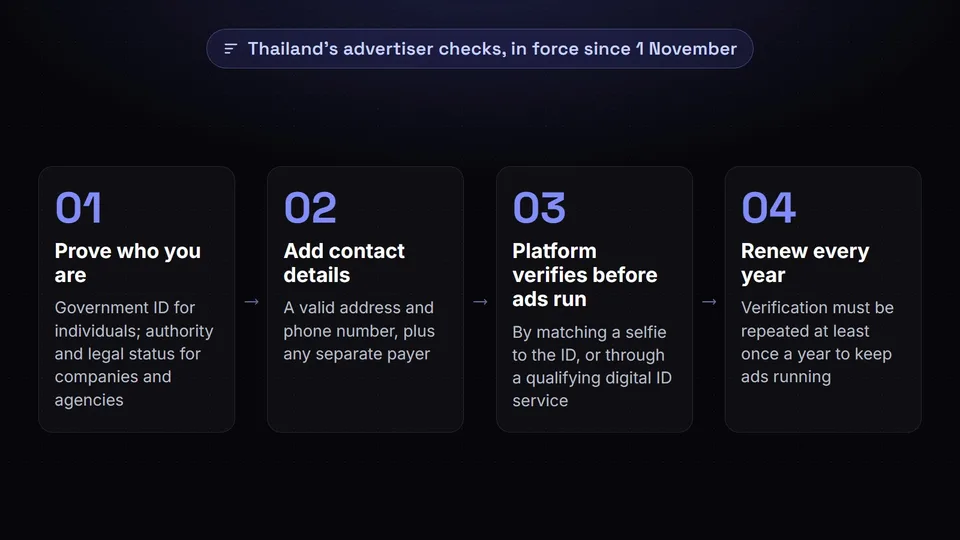
Since 1 November, social media platforms that take payment for adverts shown in Thailand must verify each advertiser's identity before the ads run, The Nation reported. The rule covers services including Facebook, TikTok, LINE and X, and comes from a notification of Thailand's Electronic Transactions Committee published in the Royal Gazette on 5 May 2026. Its stated aim is to curb scams run through social media advertising, by making sure every paid advert can be traced to a verified person or business.
Individuals must provide government-issued identification such as a national ID card or passport. Companies and agencies must provide proof of the representative's identity and authority and proof of the business's legal status, and every advertiser must give a valid address and phone number. Platforms must also collect details of a separate payer where there is one, keep the records for at least 90 days after the advertising ends, and repeat the verification at least once a year. Checks can be done by comparing a selfie with the ID photo or through a qualifying digital identity service.
If you or your agency run campaigns that reach audiences in Thailand, expect verification prompts in each ad account and plan for the annual renewal, so a lapsed check does not stop a campaign mid-flight.
What to watch: Meta's new business terms on 20 November
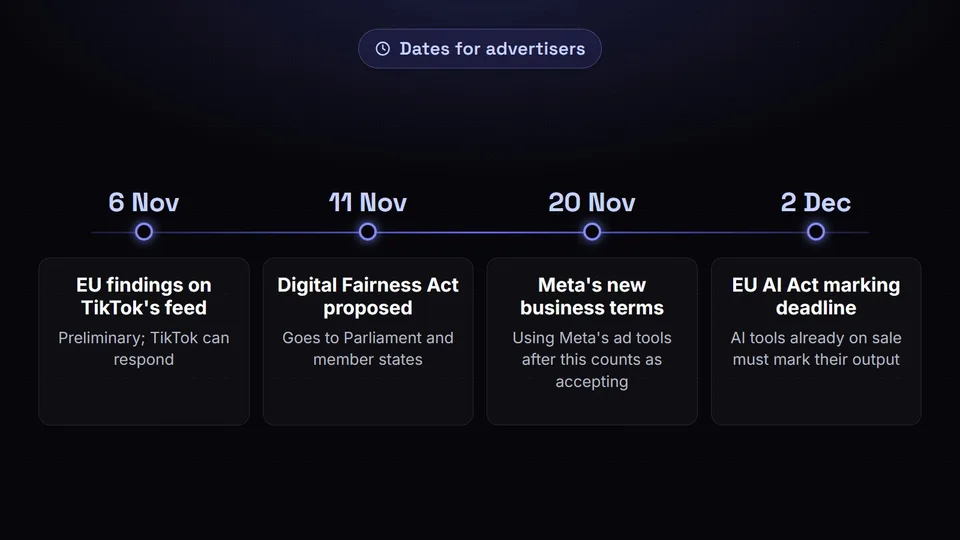
Meta's revised Commercial Terms and Self-Serve Ad Terms take effect on 20 November, after Meta moved the date from 30 October following complaints from publishers to competition authorities in the EU and the UK, PPC Land reported. The terms apply to every business that uses Meta's commercial products, including advertisers and Page owners, and continuing to use those products for business after the effective date counts as accepting them.
The most debated clause lets Meta, and others acting for it, collect content from any domain, page or URL associated with your products or services, in connection with its advertising and business products. A sentence about training AI on that content was removed from the draft in October. The terms do not promise to honour robots.txt, though Meta has said content owners can still use it. They also leave businesses solely responsible for outputs from Meta's AI features, and for US businesses they open a 30-day window after first acceptance to opt out of arbitration.
Read the final text before 20 November, particularly if your website hosts content you would not want collected, and diarise the arbitration opt-out if it applies to you.
Two other dates are close. Ofcom has said the largest regulated services in the UK, those in Categories 1 and 2A, should publish summaries of their risk assessments around November 2026, a date it still marks as to be confirmed. And on 2 December the last grace period under the EU AI Act's transparency rules ends, which we covered in yesterday's briefing on AI rules.
What this means for your content
- Do not build your TikTok plan around today's ranking signals alone. The EU wants changes to the For You feed, and watch time is one of the signals in question.
- Put disclosure into every creator brief. The Digital Fairness Act would make brands and agencies share responsibility for unlabelled sponsored posts.
- Check identity verification on ad accounts that reach Thailand, and note when each one must be renewed.
- Read Meta's new terms before 20 November, because continuing to advertise counts as accepting them.
Conclusion
This week's pattern is regulators moving from general principles to specific designs: how a feed ranks videos, how a sponsored post is labelled, how a subscription is cancelled and how an advertiser proves who they are. None of it changes your posting tomorrow, but each change will shape what works on these platforms over the next few years.
SchedulifyX publishes this briefing every week. If you manage several platforms, scheduling in SchedulifyX gives you one calendar to review against changes like these before anything goes live.
Sources
Facts checked against the sources below on November 11, 2026.
- Commission preliminarily finds TikTok's 'For You' feed in breach of Digital Services Act for harmful 'rabbit holes' effect (European Commission)
- TikTok faces fine of up to 6% over For You feed 'rabbit holes' (PPC Land)
- Digital Fairness Act: EU moves to outlaw dark patterns and subscription traps (The Next Web)
- Digital Fairness Act: EU cracks down on influencer ads and manipulative app design (EUobserver)
- Thailand requires advertiser ID checks to curb social media scams (The Nation)
- Meta delays website-crawling terms to Nov 20 after publisher complaints (PPC Land)
- Important dates for Online Safety compliance (Ofcom)
