Do Hashtags Still Work on TikTok? What Actually Drives Reach
SchedulifyX Team · November 11, 2026
Barely, and not the way most people think. What TikTok has said about the For You feed, why #fyp does nothing, and what hashtags are actually useful for.
Do hashtags still work on TikTok? Barely, and not in the way most people think. A hashtag tells TikTok a little about what a video is about, and it gives search one more piece of text to match. It does not push a video onto anyone's For You feed, and no combination of tags will rescue a video that people swipe past in the first second.
That is not a guess about a secret algorithm. TikTok has described in public what its recommendations weigh, and hashtags are a small part of it. This guide covers what TikTok has said, why tags like #fyp do nothing, what hashtags are genuinely useful for, and where your effort is better spent.
What TikTok has said about the For You feed
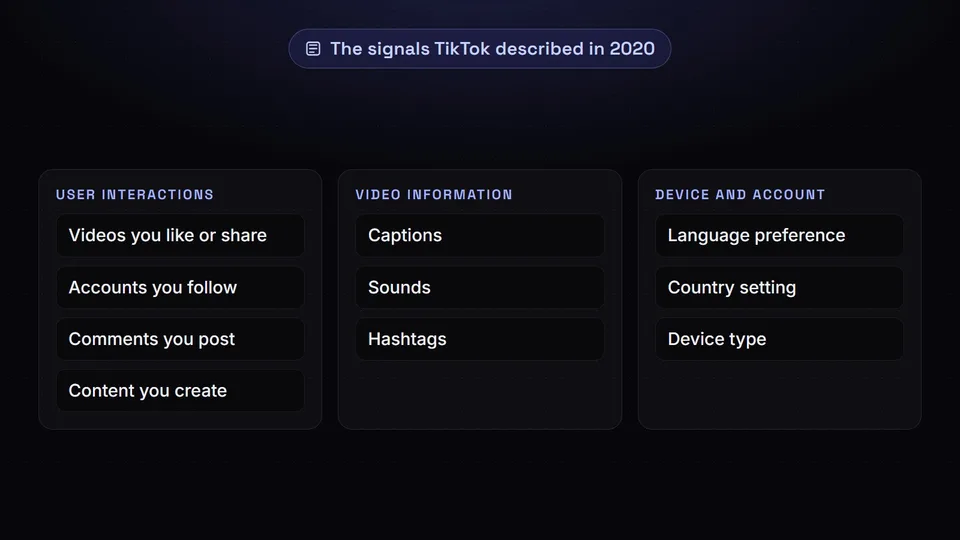
In June 2020 TikTok published an explanation of how it recommends videos for the For You feed, and the broad shape it described still matches how the platform talks about recommendations. It named three groups of signal. The first is user interactions: the videos you like or share, the accounts you follow, the comments you post and the content you create. The second is video information, such as captions, sounds and hashtags. The third is device and account settings, such as language preference, country setting and device type, which TikTok said receive lower weight because people do not actively choose them as preferences.
Two further points in that explanation matter more than the list. TikTok said signals are weighted by how strongly they indicate interest, giving the example that whether someone finishes watching a longer video from beginning to end counts for more than a weak signal such as viewer and creator being in the same country. And it said that neither follower count nor a history of high-performing videos is a direct factor in recommendations.
Read together, those statements put hashtags in perspective. They sit in the video information group, next to the caption and the sound, as one way of describing a video. What decides how far the video travels is how the people who see it react, and the strongest reaction TikTok named is watching to the end.
Why #fyp does nothing
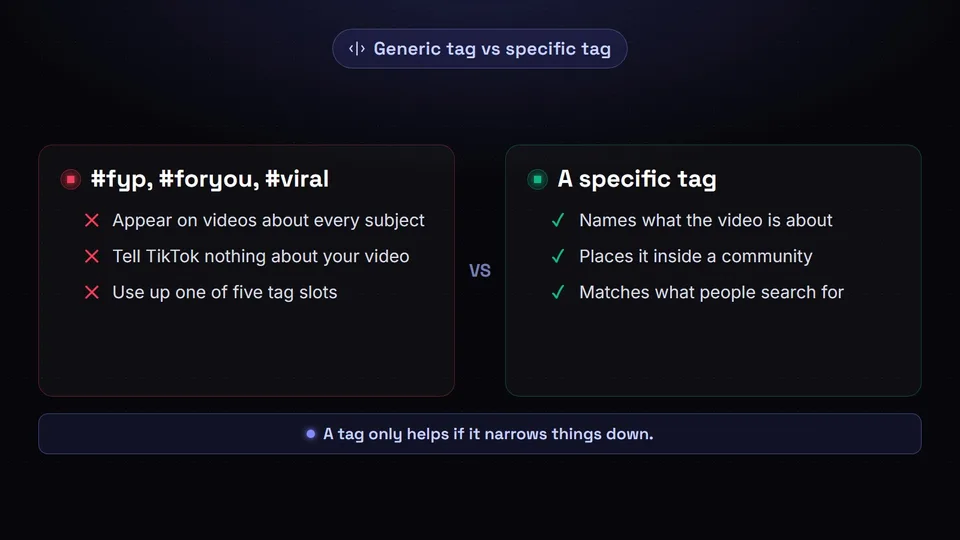
The For You page is a feed, not a tag. Every video on TikTok is a candidate for it, and TikTok has never said that tagging a video #fyp, #foryou or #foryoupage changes whether it is recommended. Nothing in its description of the system suggests it would.
The logic is simple. A hashtag is useful as video information only if it tells the system something specific about the video. #fyp appears on videos about cooking, football, make-up, politics and everything else, so it narrows nothing down. The same goes for #viral, #trending and #explore. They describe every video equally, which means they describe none.
The myth survives because of survivorship. Plenty of videos that went viral carried #fyp, so it looks as though the tag helped. So did a vast number of videos that nobody watched. There is also a small cost now: since August 2025 many accounts have seen a prompt in the app limiting a post to five hashtags, so a generic tag takes a slot that a specific one could have used.
What hashtags are actually for
Hashtags still have three real jobs on TikTok, and all of them are about description rather than distribution.
Categorisation. A specific tag such as #sourdoughstarter or #carmaintenance helps TikTok understand a video when the video alone is ambiguous. That matters most for new accounts, which have no history to go on, and for niche subjects where the footage could be about several things.
Niche signalling. Communities on TikTok have names, and their tags work as a shared vocabulary. A book review tagged #booktok places itself inside that community's conversation. It is a signal to viewers as much as to the system: the tag tells someone scrolling past that the video is for them.
Search and campaigns. Many people use TikTok to search for things, and hashtags are one of the pieces of text attached to a video that search can match, alongside the caption and on-screen text. Branded hashtags also give a campaign or challenge somewhere to collect entries, which is useful for measuring participation even when it does nothing for reach.
What actually drives the For You feed
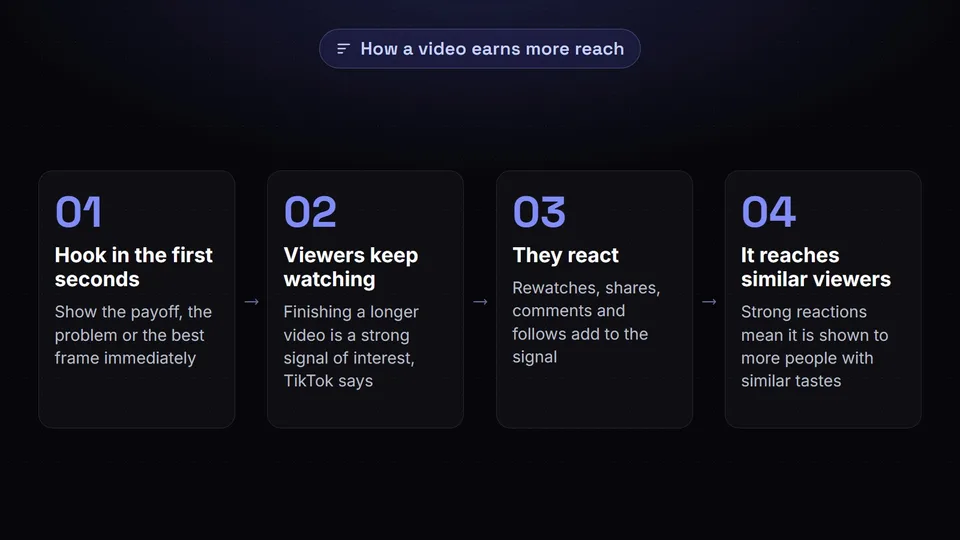
If hashtags are a low-leverage variable, the high-leverage ones are the hook and how much of the video people watch. A video that holds attention earns stronger signals of interest, and those signals decide whether it reaches more people with similar tastes. A video that loses people in the first second sends the opposite signal, whatever tags it carries.
The hook is the first thing to fix. TikTok's own creative guidance for advertisers tells them to lead with their hook or main proposition in the first few seconds, and the same principle holds for organic posts: show the payoff, the problem or the most interesting frame immediately, and cut anything that delays it. After the hook comes pacing. Videos that people watch to the end, rewatch, share or comment on are telling TikTok that the people who saw them were interested.
One development to keep an eye on: on 6 November 2026 the European Commission preliminarily found that TikTok's For You feed breaches the EU's Digital Services Act by pulling users into harmful "rabbit holes", and among the changes it suggested was that TikTok stop using viewing time as a signal for recommending content. Nothing has changed yet, and the findings are not final, but if watch time counted for less in the EU, distribution there could shift. We cover the details in this week's regulation briefing.
How many hashtags to use on TikTok
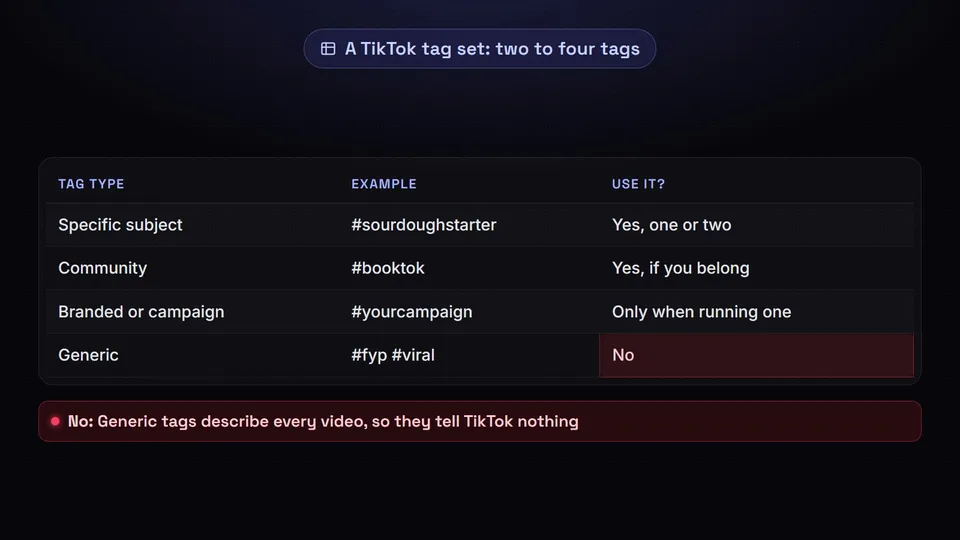
Two to four is plenty. Use one or two that name the subject precisely, and one community tag if the video genuinely belongs to a community. Add a branded or campaign tag only when you are running one. Leave out generic tags entirely. Hashtags count towards the caption's character limit like any other text, and the app's five-tag cap means each one should earn its place.
For how this compares with Instagram, LinkedIn, X and the rest, see our guide to how many hashtags to use on each platform.
Do hashtags help you go viral on TikTok?
No hashtag makes a video go viral. Trending hashtags can help a video that genuinely belongs to the trend, because they connect it with what people are already watching and searching. Attaching a trending tag to an unrelated video does the opposite: it describes the video wrongly, so the people it is shown to are more likely to swipe away, which is the signal you least want to send.
If you want to ride a trend, make a video that is part of it. Use the sound, the format or the joke, and then the tag is accurate. If the trend does not fit your account, skip it. A video that serves your existing audience well is worth more than one that briefly borrows someone else's.
Write the caption around the tags
Because hashtags are only one piece of text, the caption deserves more attention than the tag list. Describe the video in the words people would search for, put the key idea in on-screen text as well, and keep the caption short enough that it reads at a glance. Tags go at the end, where they cost nothing in readability.
A caption can also carry some TikTok-native personality. TikTok converts certain bracketed shortcodes into its own set of emoji that do not appear on a normal keyboard; our list of TikTok's hidden emoji codes has every one, ready to copy.
Check what works for your account
General rules are a starting point, and your own analytics are the test. TikTok's video analytics show how long people watched, how many watched the whole video and where the views came from, including the For You feed and search. If almost all of a video's views come from the For You feed, the tags were not what moved it.
A simple test settles the question for your account. Over a few weeks, keep your tags small and specific on some posts and leave them off others with similar content, and compare watch time and views from search. Most accounts find the difference is small, and that the videos that travel are the ones with a strong start.
If you post to several platforms, keeping tags tidy is easier with a system. The SchedulifyX Hashtag Manager lets you save small, specific tag sets for TikTok separately from your sets for Instagram or LinkedIn, insert them into a post as you write it, and see how often you use each tag and how it scores.
Conclusion
Hashtags still work on TikTok, but only as a modest way of describing a video to the system and to search. #fyp and its relatives do nothing, the app now caps posts at five tags for many accounts, and the For You feed is driven by how people react to what they see. Use two to four specific tags, then put the rest of your effort into the first seconds and into a video worth watching to the end.
When you plan TikTok posts alongside your other channels, SchedulifyX keeps your hashtag sets next to your scheduling, so the right small set goes on each post without a scramble.
