How Many Hashtags Should You Use? Per Platform, With Reasons
SchedulifyX Team · November 10, 2026
A hashtag limit is the most a platform accepts, not the number to use. Here are both numbers for each major platform, with the reasoning behind each one.
Ask how many hashtags to use and you will usually be given a limit: thirty for Instagram, for most of its history, and five today. A limit is the most a platform will accept. It says nothing about how many tags a post should carry, and treating the two as the same number is how captions end up stuffed with tags that do no work.
This guide separates the two numbers for each major platform: the technical limit, stated as a fact you can check, and the number worth using, with the reasoning behind it. The short version is that the right number is smaller than the limit almost everywhere, and on two platforms the limit and the advice have now met.
Limits and recommendations are different numbers
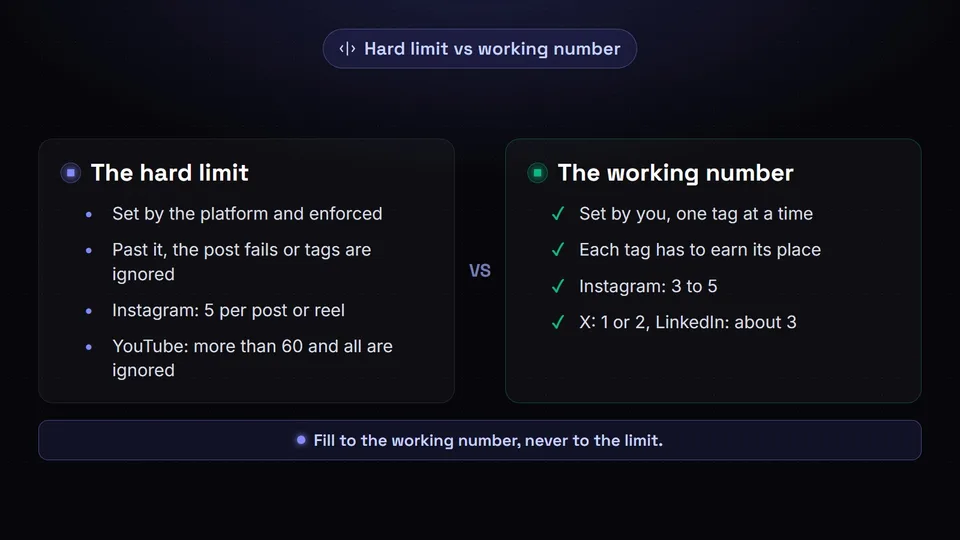
A hard limit is enforced by the platform. Go past it and something happens: the post will not publish, the extra tags are refused, or the platform ignores every tag on the post. These numbers live in help centres and change rarely, which is why they get repeated so often.
A recommended number is a judgement. It depends on how the platform uses tags today, how much space the caption has, and what readers on that platform expect a post to look like. It changes as platforms change how they discover content, and it is usually well below the limit.
The two get confused for three reasons. The limit is the only figure a platform states precisely, so it becomes the answer by default. Tools and templates built around Instagram's old cap of thirty taught a generation of social teams to fill every available slot. And cross-posting encourages one caption, with one set of tags, for every network, so the count that suits the most permissive platform travels everywhere.
The useful habit is to know both numbers and write to the smaller one.
Instagram: five is the ceiling now
Instagram allowed up to thirty hashtags on a post for most of its history. In December 2025 it began reducing that to five per post or reel, and five is now the limit. The change matched what Instagram had been saying for some time: hashtags are no longer a primary way to grow reach, because the platform understands a post from the image, the video, the audio and the caption itself. Its own advice to creators had suggested three to five tags for years before the cap arrived.
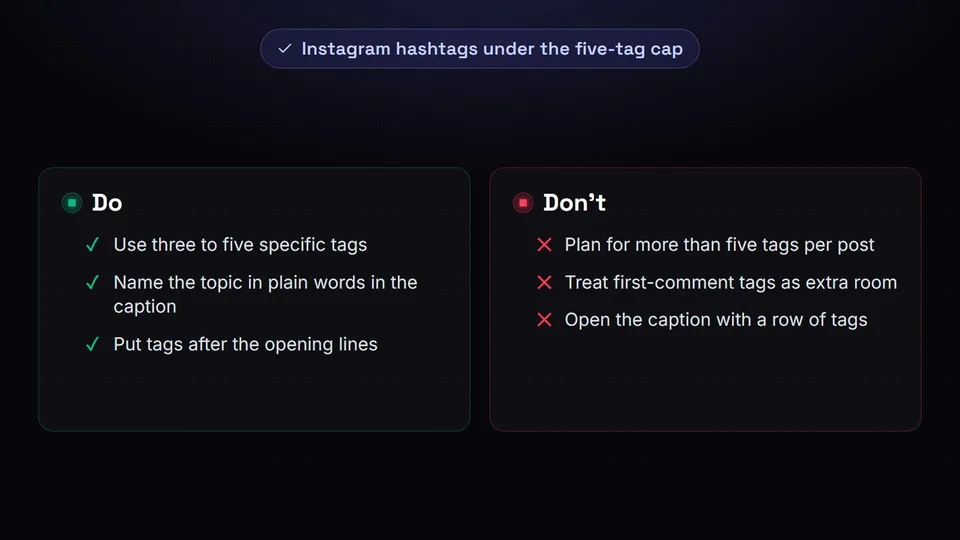
With five as the ceiling, the recommendation and the limit have nearly met. Three to five is the working range. Use fewer when the caption already names the topic in plain words, because Instagram search reads captions as well as tags. Use all five only when the post genuinely belongs to five distinct, specific topics, which is rarer than it sounds.
Two details are worth knowing. Instagram has not said clearly whether tags added in a first comment are counted separately, so treat five as five per post, wherever the tags sit. And because the feed shows only the opening line or two of a caption, tags placed at the end cost nothing in readability, while tags at the start push your hook out of view. For more on working within the cap, see our guide to the five-tag limit and social search.
TikTok: the count barely matters
TikTok has never published a hashtag limit in its help centre. Hashtags count towards the caption's character limit like any other text, and since August 2025 many creators have seen a prompt in the app limiting a post to five hashtags. TikTok has not explained the prompt or documented the number, so the safest reading is that five is the most the app may accept from you, and the behaviour could differ between accounts.
The more important point is how little the count affects distribution. TikTok has described its For You recommendations as weighing several kinds of signal: how people interact with videos, video information such as captions, sounds and hashtags, and device and account settings. The video itself does most of the work: what is shown, what is said, the on-screen text and the audio. A hashtag adds a topic hint, which can help a new account or an ambiguous video find its first audience, but stacking more tags does not multiply that effect.
A sensible working number is two to four: one or two that name the subject specifically, and one broader tag if the video belongs to a recognisable community. Skip generic tags such as #fyp. They describe every video on the platform, so they tell the system nothing about yours.
LinkedIn: three is plenty
LinkedIn publishes no hard limit on hashtags. The constraint is the post itself, which can run to 3,000 characters, and the reader, who is scanning a feed of text posts at work. A long row of tags under a considered post reads as an attempt to game reach, and on a platform where people judge the author as much as the content, that costs more than the tags could earn.
Three is a good working number: one for the broad subject, one for the industry or audience, and one specific to the post, such as an event or a series you run. Write hashtags in camel case, such as #ContentStrategy, so they are easy to read and screen readers can pronounce the words. If a tag does not help someone find or file the post, leave it out.
X: one or two, inside 280 characters
X sets no separate hashtag cap. The limit is the post: 280 characters for standard accounts, with longer posts available to Premium subscribers. Every tag spends part of that budget, and in a 280-character post a few tags can take a real share of the space you have for the point itself.
X's own help pages have long recommended no more than two hashtags per post, and that is still the right number. One tag that joins a live conversation, such as an event or a trending topic you genuinely have something to add to, is worth more than several that merely label the post. Hashtags on X work best as a way into a conversation that is already happening, not as a filing system.
Pinterest: the description does the work
Pinterest behaves like a visual search engine. People find Pins by searching in plain words for a recipe, a room style or an outfit for an occasion, and Pinterest works out what a Pin is about from its title, its description, the board it is saved to and the image itself. Hashtags are allowed in descriptions, but they act as keywords at best, and Pinterest does not publish a hashtag limit. The description's own character limit is the only real constraint.
The working number is small, and often zero. A clear title and a description written in the words your audience would type into the search bar do the job hashtags were meant to do. If you use tags at all, two or three specific ones at the end of the description are plenty. Spend the effort on the description instead: name the thing, the style, the occasion and who it is for.
YouTube and Threads: the rules are written down
Two platforms state their rules precisely, which makes them easy to follow.
YouTube's help centre says that if a video has more than 60 hashtags, YouTube ignores every hashtag on it, and that over-tagging can lead to a video being removed from search. Up to three hashtags that YouTube considers most engaging appear by the video's title. In practice, two or three relevant hashtags in the description are enough; the title and description carry far more weight for search than any tag.
Threads allows one topic tag per post. Here the limit and the recommendation are the same number, so the only decision is which topic describes the post best. Choose the one a reader is most likely to follow or search for.
The numbers side by side
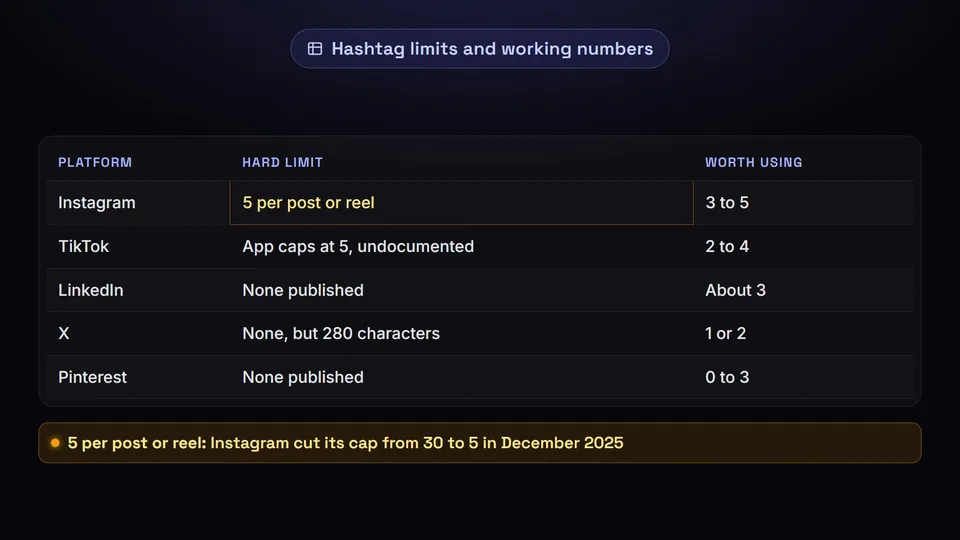
Put together, the pattern is consistent: the number worth using is small everywhere, and the limits matter only as a ceiling you should rarely approach.
- Instagram: limit of five per post or reel; use three to five.
- TikTok: no documented limit beyond the caption, though the app shows a five-tag cap to many accounts; use two to four.
- LinkedIn: no published limit; use about three.
- X: no separate limit, but 280 characters for a standard post; use one or two.
- Pinterest: no published limit; use none to three, and put the effort into the description.
- YouTube: more than 60 and all are ignored; use two or three.
- Threads: one topic tag per post; use one.
Limits change, as Instagram showed in December 2025, so check the platform's help centre before you build a process around a number. The working numbers change more slowly, because they follow from how each platform reads a post.
Choosing tags once you know the number
Knowing the count is half the job. The other half is choosing tags that earn their place. A reliable pattern for most posts is one specific tag that names exactly what the post is about, one community or audience tag that real people follow or search, and, where it applies, one branded or campaign tag you use consistently. That fits inside every working number above except Threads and, often, X.
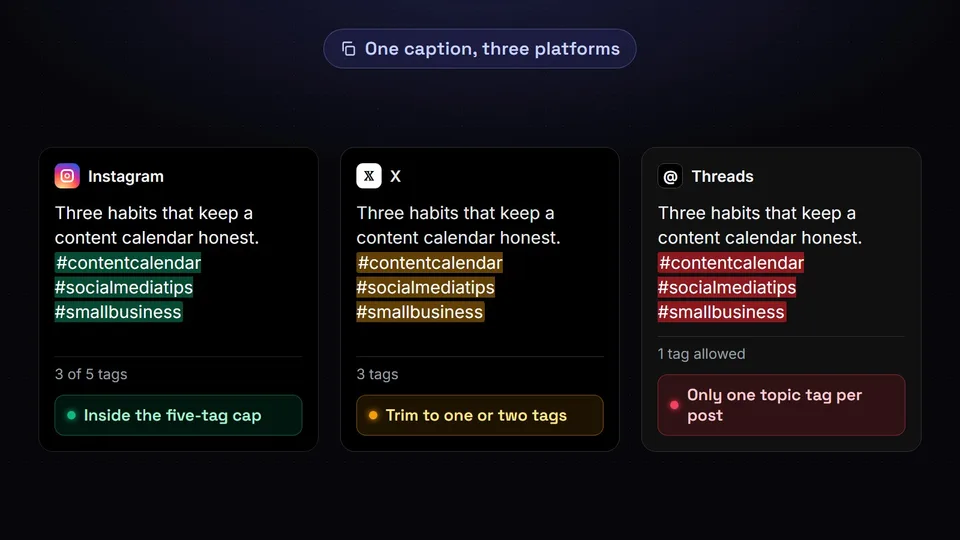
Cross-posting is where most tag problems start. A caption written for Instagram with five tags is over budget on X and breaks the one-tag rule on Threads. Adjust tags per platform rather than per post: keep a small set for each network and swap it in when you adapt the caption.
The SchedulifyX Hashtag Manager is built for that habit. You can generate suggestions from a topic or a caption, pick a strategy such as niche or broad, save tags as named sets by platform or campaign, and insert a set straight into a post. Its analytics show how often you use each tag, when you last used it and a performance score, so your sets get sharper over time instead of longer.
Before you publish, check the caption itself. Tags count towards every platform's character limit, and the point where a feed truncates your caption matters more than the hard limit. Our free Character Counter checks a caption against every major platform at once and shows where each one cuts it off.
Conclusion
"How many hashtags should I use?" has a different answer from "how many hashtags can I use?", and the first is the one that matters. Use three to five on Instagram, two to four on TikTok, about three on LinkedIn, one or two on X, two or three on YouTube, one on Threads, and very few on Pinterest, where the description does the work. Fill to the working number, never to the limit.
If you post to several platforms, keep a tag set for each and check every caption before it goes out. SchedulifyX puts the Hashtag Manager next to your scheduling, so you can insert the right set for each network as you plan the post. Start at app.schedulifyx.com.
