Instagram Hashtags in 2026: Navigating the 5-Tag Limit & Social SEO
SchedulifyX Team · October 28, 2026
Discover how Instagram's new 5-hashtag limit changes everything. Learn why Social SEO, keyword-rich captions, and niche tags are replacing the 30-tag wall.
For over a decade, the strategy for getting discovered on Instagram was an open secret: cram as many tags as possible into your caption or first comment, cross your fingers, and wait for the algorithm to do its magic. Creators spent hours hunting down popular instagram hashtags, building massive lists of thirty tags, and deploying them like a net to catch any passing engagement. But as of late 2025, that era has officially ended. The rules of engagement have fundamentally changed, and relying on outdated tactics is no longer just ineffective—it actively harms your reach.
Welcome to the new era of Instagram discovery. Driven by massive updates to Meta's AI recommendation engine and an official platform-wide cap on hashtag usage, the focus has shifted entirely from quantity to quality. Today, your success relies on mastering Social SEO, understanding the weight of plain-language captions, and selecting a highly targeted, minimalist tag set.
In this comprehensive guide, we will break down exactly what changed with the recent platform updates, why enormous generic tags are now a liability, and how you can adapt your strategy to find the best hashtags for instagram in a landscape dominated by keyword search. We will also explore real-world examples of well-built tag sets by niche, bypassing the useless lists of generic tags that dominate older marketing blogs.
The Official 5-Hashtag Limit: What Changed in December 2025?
The writing had been on the wall for a long time, but the final blow to the traditional hashtag strategy came during the monumental announcements of late 2025. Between December 18 and 19, 2025, Meta—via Instagram's official @Creators account and Head of Instagram Adam Mosseri—officially announced a universal 5-hashtag cap per post or Reel. This was a drastic reduction from the previous allowance of 30 tags.
The mechanics of this new limit are strict: you can physically type more than five tags into your caption, but the algorithm completely ignores any tags included beyond the first five. Adding a sixth or twentieth tag provides zero algorithmic benefit and simply clutters your content. As the official Instagram statement clarified: "Instagram will gradually update the number of hashtags that you can include in a caption for a reel or post to five. We find that using fewer (up to 5) more targeted hashtags, rather than many generic ones, can improve both your content's performance and people's experience on Instagram."
The Prelude: Removing Hashtag Following
To fully understand why Meta made this move, we have to look back slightly earlier. On December 13, 2024, Instagram quietly removed the ability for users to follow hashtags. For years, users could follow a tag like #interiordesign, and top posts featuring that tag would automatically populate their home feed. By eliminating this feature, Instagram effectively killed hashtags as a direct home-feed distribution mechanism.
This signaled a massive shift in how Meta's engineers viewed hashtags on instagram. They were no longer seen as user-facing content channels, but rather as backend metadata—tiny signals meant to help the AI categorize a post rather than directly distribute it to users.
The Philosophy Behind the Change
Adam Mosseri addressed what he called the "hashtag myth" head-on during the rollout. He stated unequivocally: "Contrary to popular belief, hashtags are not a way to get more reach." He further noted that "a few specific tags actually perform better than a long list of generic ones. Quality over quantity is key."
This philosophy is not isolated to Instagram. Meta's sister app, Threads, enforces an even stricter limit of just 1 tag per post. This aggressive limitation across Meta's ecosystem is designed to prevent artificial engagement gaming and force creators to rely on the actual quality and context of their content, rather than exploiting metadata loopholes.
Why Enormous Generic Tags Are Dead
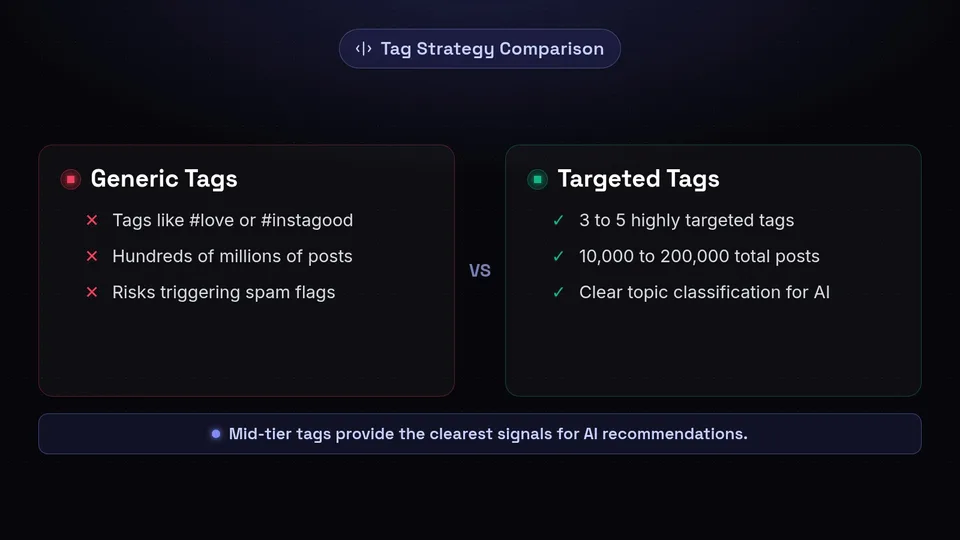
If you search the internet for hashtag advice, you will inevitably find outdated articles listing the most trending instagram hashtags—words like #love, #instagood, #photooftheday, or #fashion. Under the old 30-tag system, creators would throw these massive tags into their mix, hoping to catch a fraction of a percent of the millions of eyes browsing those feeds.
Under the new 5-tag cap, using these enormous, generic tags is one of the worst strategic mistakes you can make. Here is why the era of the "mega-tag" is over:
The AI Categorization Engine
Instagram's modern algorithm is fundamentally an AI recommendation engine. Its primary goal is to understand exactly what your post is about so it can serve it to the Explore page and Reels feed of users who have shown interest in that specific topic. When you use a tag like #photography (which has hundreds of millions of posts), you are giving the AI a remarkably weak, diluted signal. It tells the system almost nothing about the actual content of the image or video.
Furthermore, enormous generic tags do not increase reach; in fact, they actively risk triggering spam flags. Because spammers and bots heavily abuse tags like #instagood, associating your carefully crafted content with these tags can accidentally lump your account into low-quality algorithmic buckets.
The 10k to 200k Sweet Spot
So, what should you use instead? Creators and social media managers are now advised to use 3 to 5 highly targeted hashtags per post. The goal is to find specific, niche tags with moderate post volumes. Industry data suggests that tags containing between 10,000 and 200,000 total posts provide the clearest topic classification signals for AI recommendations.
These mid-tier tags are active enough to prove that a community cares about the topic, but small enough that the AI can clearly map the context of your post. By feeding the algorithm precise, narrow data points, you help it confidently place your Reel or carousel in front of your ideal target audience.
Social SEO: Captions vs. Hashtags
With hashtags relegated to light categorization metadata, what has taken their place as the primary driver of reach? The answer is Social SEO (Search Engine Optimization), powered heavily by keyword-rich captions.
Historically, the caption was a place for a quick quip or an array of emojis, followed by a wall of tags. Today, Instagram's AI indexes plain language to understand user search intent. The algorithm has evolved to read and interpret multiple layers of your content, including:
- Plain Language Captions: The actual sentences and paragraphs you write.
- On-Screen Text (OCR): The text you overlay onto your Reels or images using Instagram's native editor.
- Audio: The spoken words in your video, which the AI transcribes in the background.
- Alt Text: The hidden descriptive text you can add to images for accessibility.
The Caption as a Discovery Engine
Because the AI is so adept at reading plain language, your captions now act as the primary discovery engine. When a user goes to the Instagram search bar and types "easy vegan dinner recipes," the algorithm does not just look for the tag #easyvegandinnerrecipes. It scans the platform for posts where the caption naturally includes those keywords, where the on-screen text says "Vegan Dinner," and where the creator speaks those words in the audio.
This means that strategically seeding your captions with contextually relevant keywords is vastly more important than stressing over your 5 allotted hashtags. The hashtags are merely the cherry on top of a robust Social SEO sundae.
Mastering the 2,200 Character Limit and the 125 Character Hook
Instagram allows up to 2,200 characters in a single caption. While this gives you plenty of room to tell a story, provide a recipe, or share a detailed tutorial, you must be acutely aware of how the platform displays this text to users.
In the home feed and Reels feed, previews cut off after approximately the first 125 characters. Everything after that is hidden behind a "... more" button. Therefore, your primary hooks and most vital keywords must be positioned in line one. If you bury your main topic at the bottom of a 2,000-character essay, you will lose the scrollers, and you may dilute the immediate keyword signal the AI is looking for.
To ensure your hooks are tight and your character counts are optimized, we highly recommend running your drafts through a dedicated tool. You can easily check your lengths and limits using our Character Counter tool before you hit publish.
How to Build and Rotate a Winning Tag Set
Adapting to the 5-tag limit means you can no longer afford to be lazy with your metadata. You cannot simply copy and paste the same block of text onto every post. You need a deliberate, methodical approach to building and rotating your tag sets.
The 3-to-5 Tag Methodology
While the hard cap is five, official guidance suggests using between 3 and 5 tags. Do not feel pressured to use all five if only three truly fit the context of your specific post. The breakdown of a perfect 5-tag set should generally look like this:
- One Broad Industry Tag: A tag that defines your overall niche (e.g., #WeddingPhotography), but strictly avoiding hyper-massive tags (avoid #photography).
- Two Hyper-Specific Content Tags: Tags that describe exactly what is happening in the specific photo or video (e.g., #GoldenHourPortraits, #CandidBridalMoments).
- One Location or Community Tag: A tag tying the content to a physical place or a specific sub-culture (e.g., #MumbaiWeddings).
- One Brand or Campaign Tag (Optional): Your own unique identifier, if applicable.
The Importance of Rotation and Testing
One of the biggest mistakes creators make is changing their strategy too quickly. The algorithm needs time to learn who your audience is. Therefore, creators are advised to consistently test a specific set of 3–5 targeted hashtags across similar posts for 2–3 months before updating or rotating the sets.
If you change your tags every single day, you prevent the AI from establishing a baseline of data for your account. Pick your highly targeted tags, commit to them for a fiscal quarter, analyze your Insights to see which posts gained the most non-follower reach, and then refine your sets based on that data.
Managing multiple specific tag sets for different content pillars can get messy if you are relying on the Notes app on your phone. To keep your custom sets structured, stored, and ready for deployment, utilize advanced organizational tools like our Hashtag Manager. This ensures you are always deploying the exact right metadata for the right content pillar without running afoul of the 5-tag cap.
Niche Strategy: Real Examples of 5-Tag Structures
To truly understand how to implement the best hashtags for instagram in 2026, we need to move away from theoretical advice and look at practical, real-world applications. The internet is full of articles that simply list the top 100 tags. As we have established, that helps nobody. Instead, let's examine how to build a 5-tag structure across three different distinct niches.
Example 1: The NYC Food & Dining Niche
Imagine you run a food blog focused on the New York City dining scene. In the past, you might have loaded your posts with #food, #foodie, #pizza, #yum, and #dinner. Today, those tags are useless noise.
The Modern Approach:
Caption Keyword Focus: "The best wood-fired pepperoni pizza in Brooklyn..."
The 5-Tag Set:
- #nycpizza (Niche location + specific food type)
- #nyceats (Established local foodie community tag)
- #brooklynfoodie (Hyper-local community tag)
- #woodfiredpizza (Specific technical descriptor)
- #nycfood (Broader, but still location-bound category)
Why it works: This set uses niche location and specific dish tags instead of broad generic tags. It tells the AI exactly who to show this to: people in New York who engage with pizza content.
Example 2: The Photography Context
Photographers often struggle with the new limits because the temptation to use massive tags like #photooftheday is deeply ingrained in the culture of the platform.
The Modern Approach:
Caption Keyword Focus: "Shooting 35mm film portraits during golden hour in the studio..."
The 5-Tag Set:
- #behindthescenes (Describes the format of the video/reel)
- #portrait (Categorizes the style of art)
- #lightandshadow (Describes the technical aesthetic)
- #goldenhour (Situational context)
- #35mm (Technical equipment context)
Why it works: This relies on specific situational and technical tags rather than the high-volume #photography. A user searching for or engaging with #35mm is highly invested in film photography, making them a much higher-quality viewer than someone scrolling a generic art feed.
Example 3: The Local Service Niche
Service providers (plumbers, wedding planners, real estate agents) rely on Instagram to generate actual local leads, not just global vanity metrics.
The Modern Approach:
Caption Keyword Focus: "Looking for a wedding photographer in Mumbai who specializes in candid moments..."
The 3-Tag Set (Remember, you don't always need 5):
- #MumbaiWeddings (Location + Industry)
- #WeddingPhotography (Broader industry metadata)
- #CandidWeddingMoments (Specific service style)
Why it works: The heavy lifting here is actually done by the caption keyword focus ("wedding photographer in Mumbai"). The plain language acts as the primary search engine hook, while the targeted metadata simply confirms the AI's understanding of the text. This pairing of Social SEO and minimalist tagging is the gold standard for 2026.
The First Comment Debate: Where Should Your Tags Go?
For years, a fierce debate raged among social media managers: should hashtags go in the caption, or should they be hidden in the first comment? The "first comment" strategy was born out of a desire for clean aesthetics. Creators felt that a wall of 30 tags ruined the visual flow of their carefully written captions.
With the new 5-tag limit, does this debate still matter? Here are the facts based on the latest algorithmic behavior.
Aesthetics vs. Algorithm
Placing hashtags in the first comment or beneath a series of line breaks (the classic "dot dot dot" method) still maintains a clean caption aesthetic. If you prefer the look of a pristine caption with zero blue hyperlinked text, you can absolutely still place your 5 tags in the first comment.
However, you must understand the algorithmic reality: tags placed in the comments still count against the exact same total 5-tag cap. You cannot put 5 tags in the caption and another 5 in the comments to trick the system into giving you 10. The AI will simply ignore the overflow.
No Distribution Boost
Furthermore, extensive testing and official guidance confirm that tags in comments offer no additional algorithmic distribution boost over caption tags. They are treated exactly the same by the categorization engine. In fact, because captions are now heavily indexed for Social SEO, keeping your tags seamlessly integrated into the bottom of your caption text is often the safest way to ensure the AI processes all your metadata in one clean sweep.
Ultimately, whether you put your 3 to 5 tags at the bottom of your caption or in the first comment is entirely a matter of personal visual preference. Just remember that the strict limit applies regardless of where they live.
Auditing Your Current Strategy for the New Era
If you have been operating under the old rules, transitioning to the 5-tag limit and a Social SEO mindset requires a deliberate audit of your current practices. You cannot simply flip a switch; you need to retrain yourself and, to some extent, help retrain the algorithm on how to view your account.
Step 1: Stop the Spam Immediately
Your first step is to immediately cease using blocks of 30 tags. If you use scheduling software that automatically appends a saved list of 30 tags to every post, go into your settings today and delete those lists. Continuing to blast out 30 tags signals to the platform that you are using outdated, potentially spammy automation tactics.
Step 2: Keyword Research Over Hashtag Research
Shift your research time away from hashtag volume checkers and toward keyword intent. When planning a post, ask yourself: "What would my ideal customer type into the Instagram search bar to find this exact video?" Write those exact phrases down. Those are your new primary keywords. Weave those keywords naturally into the first 125 characters of your caption, say them aloud in your video, and put them in your on-screen text.
Step 3: Curate Your Micro-Sets
Once your Social SEO foundation is laid, curate 4 or 5 different micro-sets of hashtags (3 to 5 tags each) tailored to your specific content pillars. Remember the 10k to 200k volume rule. Ensure these sets are highly specific to the visual content of the posts they will accompany.
Step 4: Monitor and Rotate
Commit to your new micro-sets for at least two to three months. Dive into your Instagram Insights periodically to monitor the "Reach from Explore" and "Reach from Reels" metrics. While Instagram no longer shows "Reach from Hashtags" as a distinct, prominent metric (a side effect of the platform's shift away from hashtag reliance), overall non-follower reach will tell you if your AI categorization signals are working.
Embracing the Future of Instagram Discovery
The death of the 30-hashtag wall is not something to mourn; it is something to celebrate. For too long, the platform was cluttered with irrelevant content gaming the system through massive metadata dumps. The enforcement of the 5-hashtag cap, alongside the removal of hashtag following, represents a maturation of Instagram's search and discovery infrastructure.
By forcing creators to rely on the actual substance of their content—through plain language, spoken audio, and highly specific contextual tags—Meta has leveled the playing field. The accounts that will thrive in 2026 and beyond are those that respect the user's search intent, prioritize quality over quantity, and understand how to communicate clearly with the AI recommendation engine.
Adapting to these changes requires precision, organization, and a commitment to testing. You can no longer "set it and forget it" with your metadata. To seamlessly transition into this new era of Social SEO, you need tools designed for modern platform limits. Start by organizing your highly targeted micro-sets with SchedulifyX's Hashtag Manager, and ensure your keyword-rich hooks always hit the mark using our Character Counter. The algorithm has evolved—it is time your strategy evolved with it.
Sources
Facts checked against the sources below on October 28, 2026.
- Instagram 5 Hashtag Limit 2026 — creatorlanehq.com
- Instagram Implements New Limits On Hashtag Use — socialmediatoday.com
- Instagram Now Limits You To Five Hashtags Per Post — digitaltrends.com
- Instagrams New 5 Hashtag Limit Why It Happened And How To Adapt — vierasocialmedia.com
- snappa.com
- timesofindia.indiatimes.com
- Captions Vs Hashtags Instagram 2026 — lamplightcreatives.com
- Whats Your Keyword Strategy For Instagram — cohnmarketing.com
- What Instagrams New Hashtag Limits Mean And How To Improve Your Reach — shopyourlikes.com
- Why Brands Are Shifting From Hashtags To Keyword Optimized Captions — growthwayadvertising.com
