The Ultimate Guide to X SEO: How to Rank on Twitter and Google
SchedulifyX Team · October 16, 2026
Master X SEO and learn how to optimize your profile, threads, and handle to rank on both X search and Google. Discover practical tips to boost visibility.
When you hit "post" on X (formerly Twitter), your content enters a fleeting, high-velocity stream. For many creators and brands, the lifespan of a post feels like it is measured in minutes. However, a well-optimized post does not just disappear into the algorithmic void—it becomes a permanent, searchable asset. Mastering X SEO (Search Engine Optimization for X) is the secret to ensuring your content and profile continue to surface long after the initial timeline rush has faded.
Understanding how to rank on Twitter and how your X content surfaces on Google requires moving beyond generic SEO advice. Slapping a few hashtags on a post is no longer enough. The algorithms governing X's native search and Google's indexing of X have evolved significantly. Today, true Twitter search optimization involves strategic keyword placement in your bio, understanding the heavy searchable weight of thread openers, and adapting to how Google processes social media firehoses.
In this comprehensive guide, we will break down the mechanics of Twitter SEO. We will explore exactly how X posts and profiles surface in both native search and Google, providing you with actionable, specific tactics to maximize your organic reach and build lasting topical authority.
The Dual Engine: X Search vs. Google Indexing
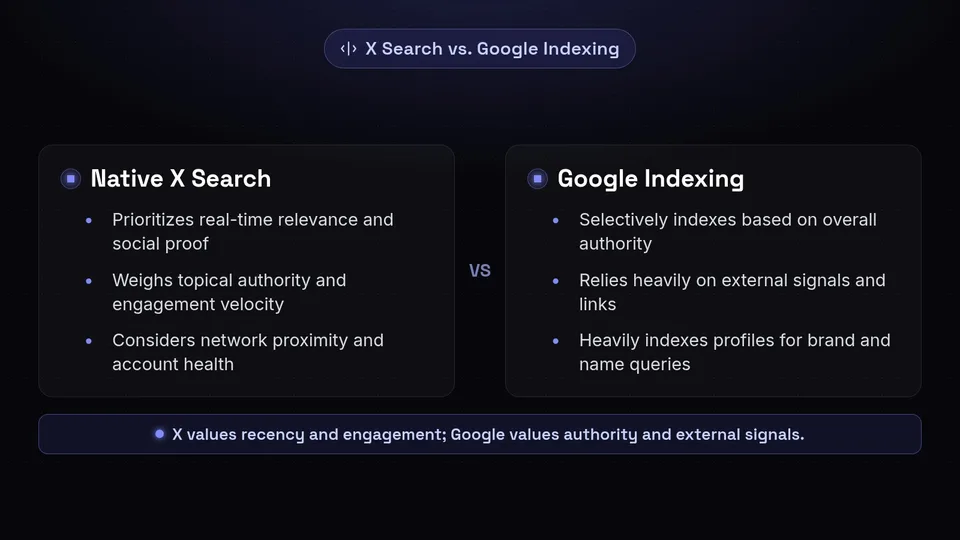
Before diving into specific tactics, it is crucial to understand that when you optimize for X, you are actually optimizing for two entirely different search engines: X's native search algorithm and Google.
The Native X Search Algorithm
X's native search is designed for real-time relevance and social proof. When a user types a query into the X search bar, the platform does not just look for exact keyword matches. It weighs a complex matrix of signals to determine what to show in the "Top" tab versus the "Latest" tab. These signals include:
- Topical Authority: Does this account frequently post about this subject?
- Engagement Velocity: How quickly did the post accumulate likes, replies, retweets, and bookmarks?
- Network Proximity: Is the searcher connected to the poster (e.g., mutual followers)?
- Account Health: Is the account verified (X Premium), and does it have a history of healthy engagement without spam penalties?
For native X search, recency and engagement are the ultimate accelerators, but keyword relevance is the ignition key. Without the right words in the right places, even a viral post might miss out on sustained search traffic.
Google's Indexing of X Content
Google treats X differently than it treats a standard website. While Google has access to the X "firehose" (a direct stream of platform data), it does not index every single post. The sheer volume of content makes that impossible. Instead, Google selectively indexes X content based on authority and external signals.
Historically, Google's indexing of X has experienced turbulence, especially during platform API changes. However, as of 2026, Google relies heavily on the overall authority of the X profile. If your profile is deemed authoritative, Google is more likely to index your individual posts and surface them in the "Twitter Carousel" on the Search Engine Results Page (SERP). Google also heavily indexes X profiles for brand and name queries, making your bio and handle critical SEO real estate.
Profile Optimization: Ranking for Name Queries
Your X profile is your digital storefront. When someone searches for your brand, your industry, or your name on Google or X, your profile should be the first thing they see. But what actually makes a profile rank for a specific name query?
The Handle vs. The Display Name
Your handle (the @username) and your display name carry the heaviest weight for profile ranking. If you want to rank for a specific term, incorporating it into one of these fields is non-negotiable.
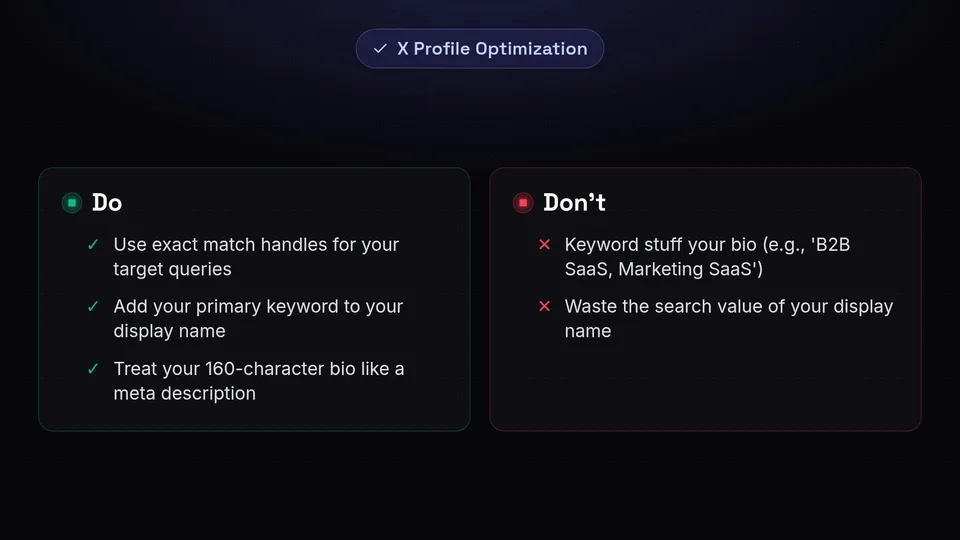
- The Handle: This is your unique identifier. Exact match handles are incredibly powerful for X SEO. If your handle is @MiamiRealEstate, you have a massive advantage for that specific query. However, finding a clean, keyword-rich handle can be difficult. If you are struggling to find the perfect handle, use our username generator to brainstorm available, SEO-friendly options that align with your brand.
- The Display Name: This is where you have more flexibility. If your handle is your brand name (e.g., @SchedulifyX), your display name can include your primary keyword (e.g., "SchedulifyX | AI Social Media Scheduler"). X's search engine indexes the display name heavily. Adding a descriptive keyword here immediately signals to both X and Google what your account is about.
Strategic Keyword Placement in the Bio
Your bio is limited to 160 characters, making every word count. Generic advice often suggests "telling people who you are," but for Twitter search optimization, your bio needs to be treated like a meta description.
X indexes the words in your bio to understand your topical relevance. If you want to rank for "B2B SaaS Marketing," that exact phrase should be in your bio. However, avoid keyword stuffing. A bio that reads "B2B SaaS Marketing, Marketing SaaS, B2B Marketing" will look like spam to users and may trigger algorithmic suppression.
"The most optimized X bios seamlessly blend primary keywords with social proof and a clear call-to-action, satisfying both the algorithm and the human reader."
Furthermore, Google frequently uses your X bio as the meta description when your profile surfaces in its search results. A well-crafted bio with a clear value proposition increases the click-through rate (CTR) from Google, which in turn reinforces your profile's authority.
Why Some Profiles Outrank Others
If two accounts have similar names and bios, why does one outrank the other for a name query? The tie-breakers include:
- Verification Status: X Premium accounts receive an algorithmic boost in native search.
- Follower Velocity and Quality: It is not just about total followers; it is about how many authoritative accounts in your niche follow you.
- Profile Completeness: Having a location, a link, and a header image signals a legitimate, active account.
Ensure your profile is fully fleshed out to give yourself the best chance of dominating name queries.
The First-Post Rule: Why Thread Openers Carry the Weight
Threads are one of the most effective ways to share deep, valuable content on X. They keep users engaged, increase dwell time, and often generate massive reach. However, when it comes to X SEO, not all tweets in a thread are created equal.
The Searchable Weight of the Head Tweet
X's algorithm treats the first post of a thread (the "head tweet") as the primary indexable entity. While subsequent tweets in a thread can be indexed, their search visibility is drastically lower. If you bury your primary keyword in the seventh tweet of a thread, it is highly unlikely that the thread will surface when a user searches for that keyword.
Think of the first tweet as the title and meta description of a blog post. It must contain the core premise, the hook, and the target keywords. If you are writing a thread about "Twitter SEO strategies," that exact phrase needs to appear naturally in the very first post.
Optimizing the First 280 Characters
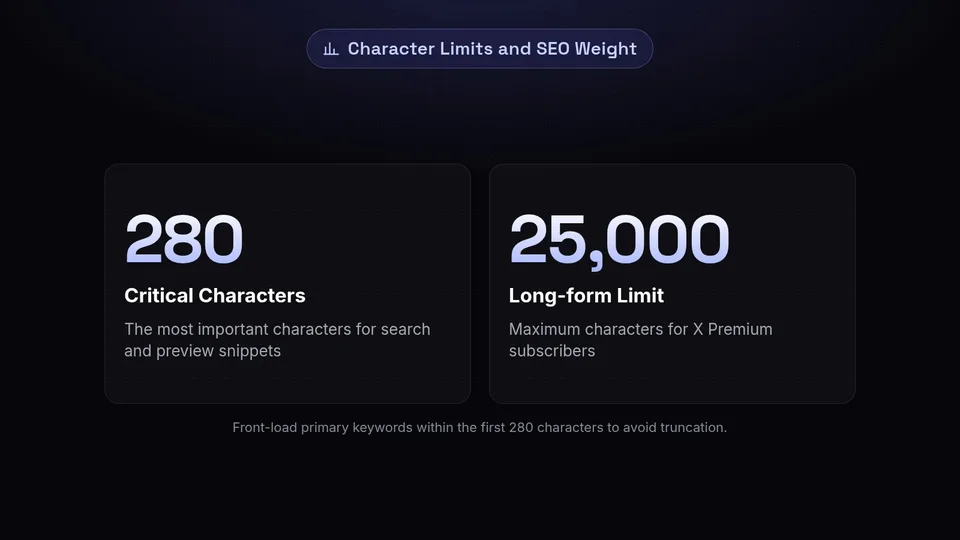
Even if you are an X Premium subscriber with the ability to post long-form content (up to 25,000 characters), the first 280 characters remain the most critical for search and preview snippets. When Google indexes a long-form post, or when X displays it in search results, it truncates the preview.
Your primary keywords and the core value proposition must be front-loaded. To ensure your hook is tight, impactful, and contains your keywords within the traditional limit, use our character counter tool before you publish. This guarantees your most important SEO signals aren't hidden behind a "Show more" button.
How Google Indexes X Content Today

Google's relationship with X content is dynamic. In the past, Google indexed a massive percentage of tweets. Today, Google is much more selective, prioritizing high-signal content that serves user intent.
The Twitter Carousel
For many brand, news, and trending queries, Google displays a "Twitter Carousel"—a horizontal scroll of recent, relevant posts. Getting your content into this carousel is the holy grail of Twitter SEO for Google.
To increase your chances of appearing in the carousel:
- Post Consistently on Specific Topics: Google relies on entity recognition. If Google associates your profile with "AI scheduling tools," your posts about that topic are more likely to be pulled into the carousel when someone searches for it.
- Drive External Links to Your Posts: Google still operates on links. If a post is embedded in high-traffic blog articles or linked from other websites, Google's crawlers find it faster and assign it higher authority.
- Use Rich Media: Posts with high-quality images or native video are favored for the carousel because they are more visually engaging on the SERP.
Indexing of Long-Form Posts vs. Threads
With the introduction of long-form posts on X, Google's indexing behavior has shifted slightly. Google tends to index long-form X posts more like traditional web pages, parsing the entire text for long-tail keywords. If you are aiming for Google search traffic, a well-structured long-form post with H-style formatting (using bold text for headers) can occasionally rank for niche, long-tail queries directly on Google.
Advanced Tactics for Twitter Search Optimization
Beyond the basics of profile and post optimization, there are several advanced tactics you can employ to ensure you know exactly how to rank on Twitter.
Semantic Search Over Hashtag Stuffing
In the early days of Twitter, hashtags were the only way to categorize content. Today, X's search engine is highly semantic. It understands natural language, synonyms, and context.
Instead of cluttering your post with #TwitterSEO #Marketing #Growth, weave those concepts naturally into your sentences. "If you want to master Twitter SEO and drive organic marketing growth..." is a much stronger signal to the modern algorithm than a list of disconnected hashtags. Use 1-2 highly relevant hashtags at most, and rely on natural keyword integration for the rest.
Engagement as a Ranking Factor
In X's native search, engagement is a massive ranking factor. A post with exact keyword matches but zero engagement will almost always be outranked by a post with partial keyword matches and high engagement.
Specifically, X values "meaningful" engagement. Bookmarks and detailed replies carry more weight in the search algorithm than passive likes. To boost your X SEO, explicitly ask your audience to bookmark the post for future reference, or end your post with a compelling question that drives deep, conversational replies.
Optimizing Visual Content with Alt Text
One of the most overlooked aspects of Twitter search optimization is image alt text. X allows you to add descriptive text to your images for accessibility. However, this alt text is also crawled by both X's native search and Google.
If you upload an infographic about social media growth, do not leave the alt text blank. Describe the image in detail and naturally include your target keywords. This not only makes your content accessible to visually impaired users but also gives the search algorithms more context about your post, increasing the chances of your image appearing in Google Image Search.
Conclusion: Mastering X SEO for Long-Term Growth
Mastering X SEO is a continuous process of aligning your content with both the fast-paced nature of the X timeline and the long-term indexing behaviors of Google. By strategically placing keywords in your handle, display name, and bio, you build a foundation for profile discoverability. By understanding the searchable weight of the first post in a thread and front-loading your value in the first 280 characters, you ensure your content is parsed correctly by algorithms.
Remember that generic SEO advice reskinned for social media will not cut it. You must play by the specific rules of the platform: prioritizing semantic language over hashtag stuffing, driving high-quality engagement, and leveraging the power of external links to boost your Google visibility.
Executing a flawless Twitter search optimization strategy requires consistency. You cannot post randomly and expect to build topical authority. That is where SchedulifyX comes in. Our AI-powered social media scheduling platform helps you plan, optimize, and publish your X content at the exact right times. With built-in analytics, you can track which posts are generating the most search visibility and double down on what works. Start building your searchable X presence today with SchedulifyX, and watch your organic reach compound over time.