AI vs Social Media Manager: Where Each Actually Wins
SchedulifyX Team · September 4, 2026
Discover the reality of AI vs social media managers. We explore automation tradeoffs, recent data, and how combining human creativity with AI scheduling wins.
Introduction: The Great Debate of 2026

In the rapidly evolving world of digital marketing, the conversation surrounding the ai vs social media manager dynamic has reached a fever pitch. Brands are constantly seeking ways to optimise their workflows, reduce overheads, and maximise engagement. However, the promise of completely autonomous artificial intelligence handling all aspects of community building has met with the complex reality of human social dynamics.
Are we truly on the verge of replacing the creative professionals who have historically driven brand narratives? Or are we simply entering a new era where the role of the social media manager is augmented and elevated by intelligent scheduling tools? To answer these questions, we must look past the theoretical hype and examine the hard data emerging from recent industry experiments, platform updates, and shifts in consumer behaviour.
This comprehensive guide explores the ongoing battle of automation vs human oversight, the very real AI content tradeoffs marketers face today, and how a hybrid approach—pairing human ingenuity with an AI-powered scheduler—ultimately delivers the best results for modern brands.
The Current Landscape: Automation vs Human
To understand the current state of social media management, we have to look at how marketing teams are actually adopting artificial intelligence. The narrative often pushed by tech evangelists is one of total replacement, but the reality on the ground tells a much more nuanced story.
In April 2026, industry analysis highlighted a bold prediction from Sam Altman, who stated that "95% of creative marketing tasks will eventually be done by AI." While this vision of the future is provocative, the market's reaction to complete automation has been mixed at best. A poignant cautionary tale comes from Klarna. After fully replacing a significant portion of its customer service staff with AI in 2023, the company quietly began rehiring human agents by early 2026 due to a noticeable drop in customer satisfaction. This highlights a fundamental truth: efficiency does not always equate to effectiveness, particularly when human connection is at stake.
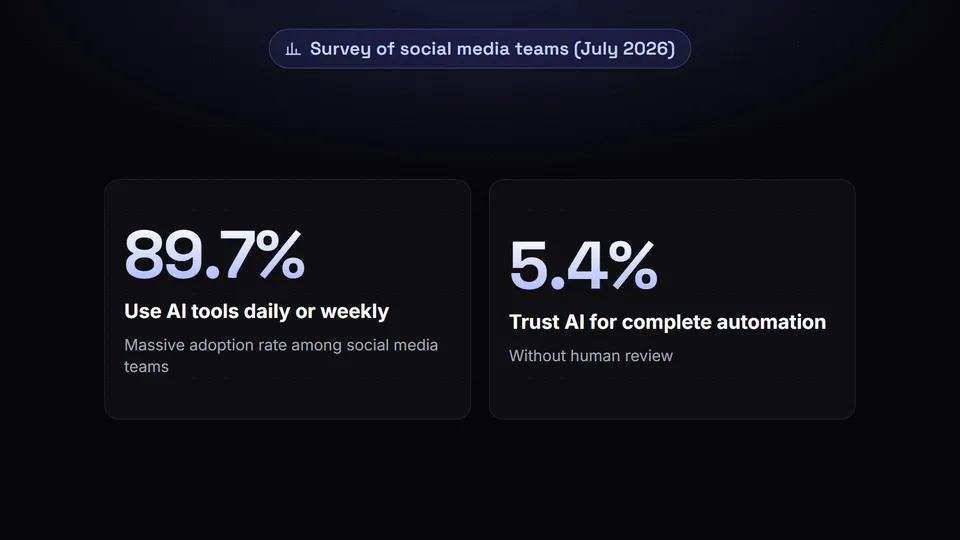
This sentiment is strongly echoed in the social media sector. According to survey data published by Improvado on July 24, 2026, an overwhelming 89.7% of social media teams now use AI tools daily or several times per week. The adoption rate is undeniably massive. However, the same survey revealed a critical caveat: a mere 5.4% of these professionals trust AI for complete automation without human review.
"While nearly 90% of teams integrate AI into their daily workflows, only a tiny fraction are willing to let the machine take the wheel completely. The human review process remains the ultimate safeguard for brand reputation."
This staggering gap between daily usage and absolute trust defines the modern automation vs human debate. Marketers are eager to use AI to draft, brainstorm, and schedule, but they are acutely aware that handing over the keys to the kingdom can lead to tone-deaf messaging, unforced PR errors, and a loss of the authentic brand voice that audiences crave.
Where the Human Social Media Manager Triumphs
If AI is so prevalent, why do human managers remain indispensable? The answer lies in the nuances of audience interaction, cultural context, and the unpredictable nature of internet culture. A fascinating experiment published by Planable on September 02, 2026, provides concrete evidence of the human advantage.
The Fictional Chocolate Brand Experiment
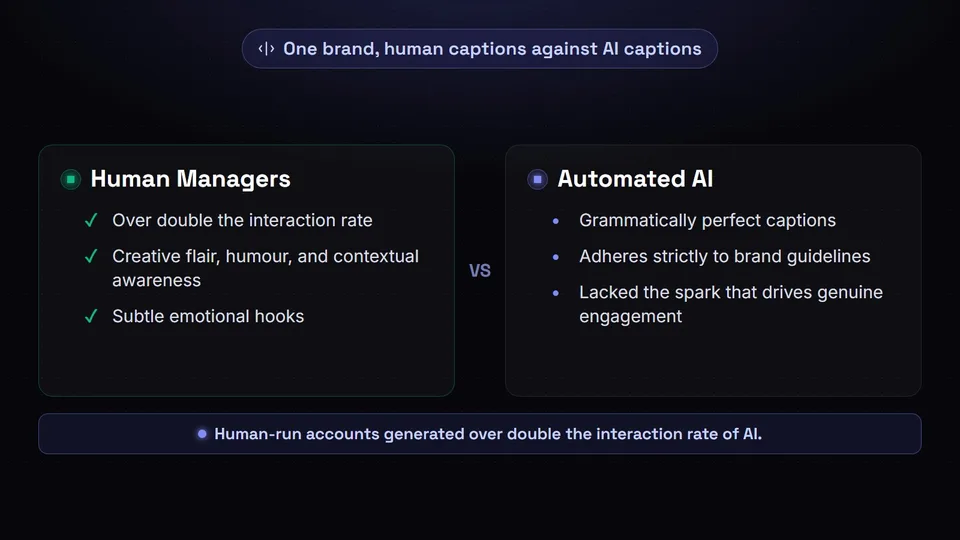
Planable conducted a rigorous multi-account Instagram experiment using fictional chocolate brands to evaluate the performance of human social media managers against large language models (specifically Claude and ChatGPT). The goal was to see if fully automated LLM accounts could match the community-building prowess of experienced human marketers.
The results were decisive: the human-run accounts generated over double the interaction rate of the fully automated AI accounts. Despite the AI's ability to generate grammatically perfect captions and adhere strictly to brand guidelines, it lacked the spark that drives genuine human engagement.
Nuance and Prompt Engineering
Interestingly, the Planable study also yielded a surprising insight into how humans and AI interact. The researchers found that shorter prompts actually yielded better results for the AI models than long, highly complex briefs. When given overly detailed instructions, the AI tended to produce convoluted, unnatural copy.
This finding reinforces the value of the human social media manager. Rather than spending hours writing encyclopaedic prompts to force an AI to sound human, the most effective workflow involves a human manager giving the AI a brief, simple instruction to generate a baseline draft, and then applying their own creative flair, humour, and contextual awareness to the final product. The human manager excels at reading the room, reacting to real-time trends, and injecting the subtle emotional hooks that compel a user to stop scrolling, like, and comment.
Where the Scheduler-Plus-AI Model Excels

While humans undoubtedly win the engagement battle, AI is fundamentally transforming the operational side of social media. The traditional workflow of staring at a blank screen, manually resizing graphics, and copying and pasting captions across multiple platforms is rapidly becoming obsolete. This is where the Scheduler-Plus-AI model truly shines.
The Evolution of the Workflow
On August 05, 2026, Postrillo published a detailed breakdown comparing traditional human social media workflows against AI-assisted automation. The traditional method—characterised by manual caption writing, bespoke graphic design for every post, and tedious manual publishing—was found to be highly time-consuming and prone to bottlenecks.
In contrast, the AI-assisted workflow leverages technology for the heavy lifting: rapid ideation, writing assistance, and intelligent scheduling, all operating alongside human oversight. This hybrid model allows the social media manager to transition from a pure content producer to a strategic editor.
Conversational Agents and Brand Voice
The tools facilitating this shift have evolved significantly. On July 24, 2026, Velocity published an autonomy taxonomy that distinguished between traditional scheduling tools and the new wave of conversational AI agents. Conversational agents allow a manager to draft, reformat, and schedule multiple posts across various platforms directly from a single text prompt, drastically reducing the friction of content distribution.
Furthermore, platforms are becoming much better at sounding like the brands they represent. On July 10, 2026, Cloud Campaign highlighted a feature called "Cloud Studio," an AI fulfillment tool designed specifically to ingest a client's unique brand voice guidelines. By absorbing these guidelines, the AI can generate scheduled content directly from initial concepts that requires far less human editing than generic LLM outputs.
This is the exact operational space where platforms like SchedulifyX operate. By acting as a powerful AI-assisted scheduling engine, SchedulifyX empowers human managers to scale their output without sacrificing their creative energy. The AI handles the formatting, the timing, and the initial drafting, leaving the human free to focus on strategy and community engagement.
Navigating AI Content Tradeoffs and Platform Rules
Adopting AI is not without its risks. As the volume of machine-generated content increases, platforms and audiences are pushing back, creating a complex web of AI content tradeoffs that marketers must navigate carefully.
The Sea of Sameness on LinkedIn
One of the most significant tradeoffs of over-relying on AI is the loss of originality. When everyone uses the same foundational models to write their posts, platforms can quickly become saturated with homogeneous content. According to a July 10, 2026 report from AI detection provider Pangram, LinkedIn now accounts for nearly two-thirds of all AI-generated content detected across major social media platforms.
For B2B marketers, this presents a unique challenge. If your target audience is scrolling through a feed dominated by the predictable cadence and vocabulary of AI-generated thought leadership, your brand risks blending into the background. To stand out in an environment saturated with synthetic text, the human element—personal anecdotes, contrarian opinions, and raw, unpolished insights—becomes your most valuable differentiator.
Strict Platform Regulations: The Instagram Mandate
Beyond audience fatigue, social media networks are actively implementing rules to govern the use of AI, particularly concerning synthetic media. On August 31, 2026, Instagram announced a sweeping change to its policies regarding AI-generated personas.
The platform introduced a mandatory "AI-generated profile" label requirement for accounts that feature synthetic humans. This new, strict requirement replaced the previous, more lenient, optional "AI creator" tag. Crucially, Instagram specified that accounts featuring AI-generated personas without applying the new mandatory label will face severe limits on their organic reach.
This regulatory shift underscores a vital point in the ai vs social media manager debate: transparency is no longer optional. Brands attempting to fully automate their presence using synthetic influencers must navigate strict compliance rules, risking algorithmic demotion if they fail. Human managers, representing real human brands, do not face these specific algorithmic penalties, further cementing the value of authentic human representation online.
Traditional Tools vs AI-Powered Platforms
As the industry matures, the software stack available to social media teams is dividing into distinct categories. Understanding the difference between legacy systems and modern AI-driven platforms is crucial for building a future-proof marketing strategy.
The Legacy Heavyweights
Traditional scheduling tools, such as Buffer, Hootsuite, and Sprout Social, have dominated the market for over a decade. As noted in the Velocity taxonomy from July 2026, these platforms were built primarily around manual input, calendar management, and post-publishing analytics.
It is important to note that, as of 2026-09-04, traditional platforms like Sprout Social and Hootsuite currently remain stronger than SchedulifyX when it comes to facilitating massive, multi-tiered enterprise approval workflows and integrating deeply with legacy enterprise customer relationship management (CRM) systems. For immense global corporations that require dozens of legal and compliance sign-offs before a single tweet goes live, these legacy systems offer the rigid, structured environments necessary for those specific manual workflows.
The AI-First Approach
However, for agile brands, agencies, and creators who prioritize speed, content generation, and intelligent automation, AI-first platforms offer a distinct advantage. Rather than simply acting as a digital calendar where you paste your finished work, an AI-powered platform acts as a co-pilot throughout the entire creative process.
By integrating AI directly into the scheduling environment, platforms can take a single core idea and automatically reformat it for Twitter, expand it for a LinkedIn article, and generate a visual prompt for Instagram—all while maintaining the specific brand voice ingested by the system. This drastically reduces the time between ideation and publication, allowing the human manager to do what they do best: engage with the audience.
Please note that as of 2026-09-04, platform features, capabilities, and pricing models across all mentioned vendors change frequently; always confirm current details directly on the vendor's own official website.
Conclusion: Finding the Perfect Balance
The debate between the ai vs social media manager is ultimately not a zero-sum game. The data from 2026 paints a clear picture: attempting to fully replace human marketers with artificial intelligence leads to a drop in engagement, algorithmic penalties for unlabelled synthetic content, and a loss of the vital nuance that drives real community building. As Planable’s chocolate brand experiment proved, humans still drive more than double the interaction rate.
Conversely, clinging to entirely manual workflows is a recipe for burnout and inefficiency. The sheer volume of content required to maintain a presence across modern social networks demands the speed and scale that only AI can provide.
The winning strategy lies in the middle ground: the Scheduler-Plus-AI model. By embracing automation for ideation, drafting, and cross-platform formatting, while strictly reserving human oversight for strategy, final editing, and community engagement, brands can achieve both unprecedented scale and deep, authentic connections.
The future of social media does not belong to the fully automated bot, nor does it belong to the overwhelmed manual poster. It belongs to the empowered human marketer, armed with the right intelligent tools.
Ready to find the perfect balance for your brand's digital presence? Discover how SchedulifyX can streamline your workflow, augment your creativity, and give your social media team the AI-powered support they need to thrive today.
Sources
Facts checked against the sources below on September 4, 2026.
- Denver Social Media Marketing Agency Looks At Ai Vs Human Media Management — figadvertising.com
- Instagram Will Demote Ai Generated Influencers If They Dont Clearly Label Their Account — engadget.com
- Ai Vs Traditional Social Media Marketing — postrillo.com
- Will Ai Replace Social Media Managers — improvado.io
- Social Media Ai Agents Vs Social Media Management Tools 2026 — velocity.li
- youtube.com
- youtube.com
- youtube.com