Authentic Automation: Scheduling Without a Robotic Brand Voice
SchedulifyX Team · October 16, 2026
Discover how to balance scheduled vs live posting to achieve authentic automation, avoiding a robotic brand voice while maintaining ethical AI practices.
The landscape of social media management has undergone a profound transformation, driven largely by the rapid integration of artificial intelligence into daily workflows. We are no longer simply planning content; we are generating, refining, and distributing it at an unprecedented scale. However, this surge in capability has brought forth a critical challenge: maintaining the human element in an increasingly automated ecosystem. The pursuit of efficiency must not come at the cost of genuine connection.
Recent industry data highlights a stark reality regarding how marketing teams are adopting these new technologies. On October 14, 2026, Anniston Ward, USA PR, Events, and Education Manager at Metricool, presented revealing survey findings at the Digital Marketing World Forum (DMWF) North America 2026. Polling over 700 social media professionals, the data showed that a staggering 95% of respondents now use AI for their social media work. Furthermore, 75% utilise it on a daily basis, with 37% integrating it as a standard, foundational part of their daily operations.
Yet, alongside this massive adoption lies a concerning governance gap: a mere 12% of teams have established clear, formal policies and guardrails for AI usage. This lack of regulation often leads to disjointed strategies, ethical missteps, and the dreaded robotic brand voice. To navigate this new era successfully, organisations must embrace authentic automation—a strategic approach that leverages technology for distribution while fiercely protecting human creativity and live engagement.
The Ethics of Social Media Automation
Before deploying any automated workflow, it is vital to understand the ethical boundaries that separate legitimate marketing tools from deceptive practices. Audiences engage with brands on social platforms with the underlying assumption that there is a human presence guiding the interaction. When that assumption is broken through deceptive automation, trust evaporates rapidly.
On September 3, 2026, IONOS published a detailed analysis defining the ethical distinction between standard scheduling tools and artificial bot behaviour. This framework is essential for any team looking to scale their operations responsibly.
Standard Scheduling vs Bot Behaviour
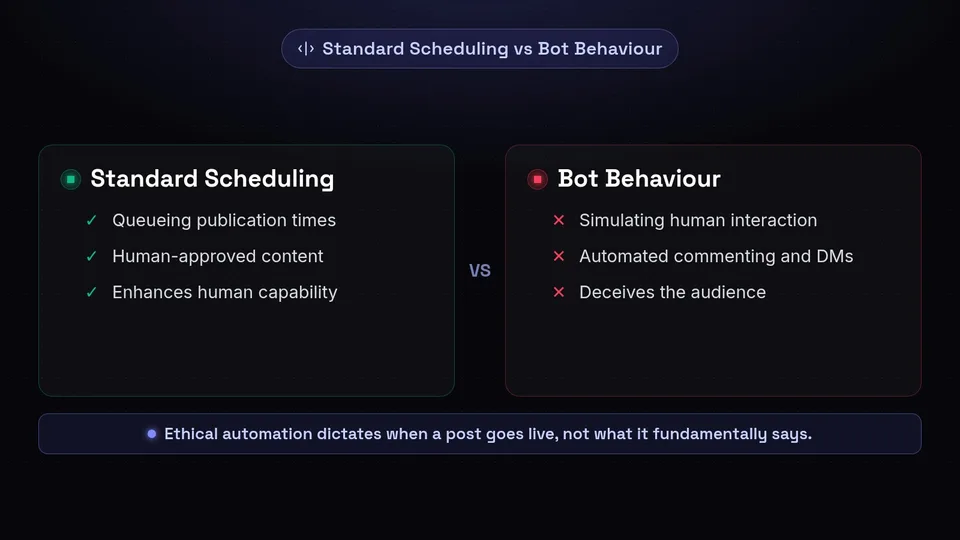
According to the IONOS guidelines, legitimate scheduling involves the preparation of finished, human-approved content and the queueing of publication times. It is a logistical tool. The technology simply dictates when a post goes live, not what the post fundamentally says or how it interacts with individual users. This form of automation is entirely ethical, as it does not deceive the audience about the nature of the communication.
Conversely, artificial bot behaviour crosses an ethical line. This consists of software simulating human interaction at scale. Examples include automated commenting on other users' posts, automated liking based on hashtags, or the broadcasting of unsolicited direct messages. These practices are deceptive because they mimic spontaneous human engagement. An automated comment saying, "Great post!" on a tragic news story because a bot was programmed to target a specific keyword is not just an operational failure; it is a reputational disaster.
Ethical automation enhances human capability; it does not attempt to impersonate human spontaneity.
Diagnosing the Robotic Brand Voice

Even when teams avoid deceptive bot behaviour, they often fall into another trap: producing content that sounds distinctly artificial. The phenomenon of the robotic brand voice is becoming increasingly common as teams lean heavily on generative AI without proper oversight.
On September 29, 2026, an analysis published by Bibby explored exactly why automated social media content so often sounds robotic. The findings revealed that the issue rarely stems from the technology itself, but rather from how teams instruct and manage it.
The Danger of Vague Tone Guidelines
Bibby's analysis points out that a robotic brand voice is frequently the result of vague tone guidelines. When a brand simply instructs a team (or an AI tool) to be "professional and friendly," it lacks the specific parameters required to create a distinct personality. The analysis stresses that to avoid sounding generic, guidelines must include highly specific rules regarding:
- Sentence Structure: Should the brand use short, punchy sentences, or longer, more narrative structures?
- Formality: Is the tone strictly corporate, or conversational and colloquial?
- Emoji Usage: Are emojis encouraged, strictly forbidden, or limited to specific contexts?
Without these granular rules, automated content defaults to a sterile, middle-of-the-road tone that fails to resonate with human readers.
Context-Free Prompts and Generic Output
Building on this, workflow guidelines published by Bolta.ai on September 20, 2026, noted that AI-generated posts sound inherently generic when they are built from context-free prompts. For instance, instructing a tool to "Write a LinkedIn post about entrepreneurship" will yield a post that sounds like every other generic post on the subject. It lacks the lived experience that makes content compelling.
To combat this, Bolta.ai recommends a clear division of labour: use automation for distribution tasks—such as scheduling, reformatting content for different platforms, and managing the overarching content calendar—but fiercely retain human control over opinions, judgements, and personal experiences. A machine cannot have a genuine opinion; attempting to automate one is the fastest route to a robotic brand voice.
The Operational Split: Scheduled vs Live Posting
Achieving authentic automation requires a structural change in how social media teams operate. You cannot schedule everything, nor can you rely entirely on manual, live posting if you wish to scale. The solution lies in a strategic division of tasks.
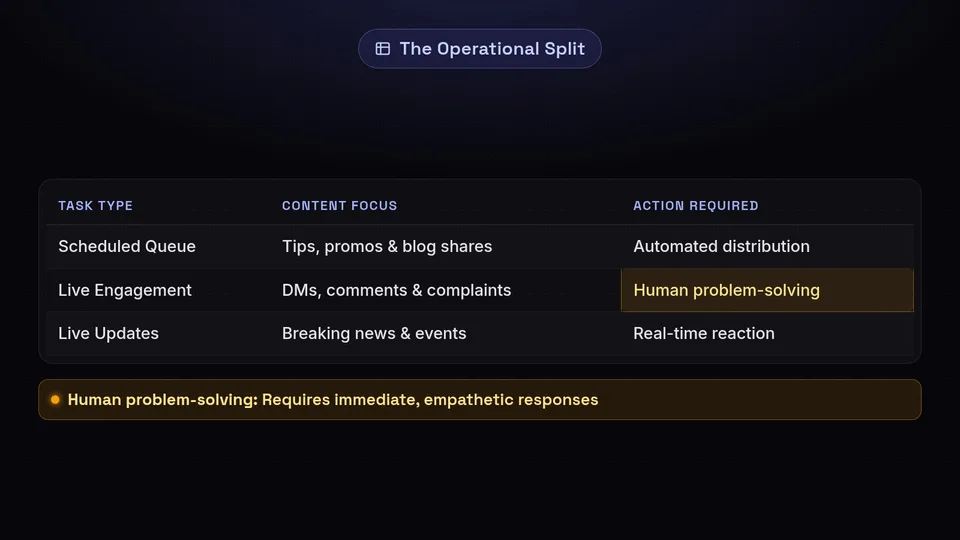
On October 6, 2026, NovaReach published comprehensive guidelines on authentic automation, establishing a clear operational split between scheduled vs live posting. This framework allows teams to maintain high output without sacrificing genuine engagement.
What Belongs in the Scheduled Queue
According to NovaReach, scheduled automation should be strictly reserved for routine, predictable posts. These are pieces of content that do not rely on real-time context and provide evergreen value to the audience. Examples include:
- Tips and Educational Content: Industry insights or how-to guides that remain relevant regardless of the daily news cycle.
- Promotional Offers: Planned campaigns, product launches, or seasonal discounts that have fixed dates.
- Customer Reviews and Testimonials: Showcasing positive feedback that has already been vetted and approved.
- Blog Shares: Distributing long-form content or company announcements that have been carefully drafted in advance.
By automating these predictable elements, social media managers free up vast amounts of time and cognitive energy.
The Necessity of Live Human Engagement
The time saved through scheduling must be reinvested into areas where human empathy and context are irreplaceable. NovaReach's guidelines dictate that live humans must handle:
- Direct Messages (DMs): Where customers ask nuanced questions requiring bespoke answers.
- Comments and Community Management: Engaging with the audience in the comment section to build rapport and foster community.
- Complaints and Customer Service: Where a frustrated customer requires immediate, empathetic problem-solving—not an automated "We're sorry you feel that way" response.
- Live Updates: Reacting to industry events, conferences, or breaking news in real-time.
This operational split ensures that the brand remains active and consistent through scheduling, while remaining responsive and authentic through live human interaction.
Context and Timing: When Automation Fails

One of the greatest risks of a heavy reliance on scheduling is the failure to adapt to changing real-world contexts. The internet moves rapidly, and a post that seemed clever when it was scheduled two weeks ago might appear tone-deaf today.
The Acoustic Framework for Messaging
To understand the nuances of automated timing, we can look to a framework released by Acoustic on September 8, 2026. They differentiated automated messaging into three distinct categories:
- Scheduled Posts: Content tied to fixed calendar dates (e.g., a holiday greeting or a planned product launch).
- Triggered Messages: Content dispatched based on specific user actions (e.g., a welcome email when someone joins a mailing list).
- Adaptive Journeys: Content that is updated dynamically based on real-time user behaviour and context.
While scheduled posts are the most common form of social media automation, they are also the most rigid. As noted in Bibby's September 29 analysis, publishing pre-scheduled posts without adjusting for live industry developments is a primary contributor to a robotic, disconnected brand image.
The Urgency of Trend Participation
Furthermore, cultural moments and trends have an incredibly short shelf life. An evaluation of social media management published by Inflact on August 10, 2026, cited Sprout Social's Index data regarding consumer expectations. The data revealed that 27% of consumers consider a brand's participation in a trend to be effective only if it occurs within 24 to 48 hours of the trend emerging.
You simply cannot schedule trend participation weeks in advance. If your team is entirely reliant on a pre-planned queue, you will miss the 48-hour window, resulting in content that feels stale and out of touch. The Inflact report heavily emphasises that automated queues must not be "set and forget." They must be actively monitored by human managers who possess the authority to cancel, pause, or adapt scheduled posts when news breaks or live market conditions shift abruptly.
Formulating Guardrails for Your Team
Returning to the Metricool survey data presented at DMWF North America 2026, we are faced with a stark reality: 95% of professionals are using AI, but only 12% have established clear formal policies. To achieve authentic automation, your organisation must move into that 12%.
Creating guardrails involves documenting exactly how and when automation and AI are to be used within your team. A robust policy should include:
- A strict operational split: Clearly defining which categories of content can be scheduled and which must be handled live.
- Detailed tone of voice documentation: Moving beyond "be professional" to include specific rules on sentence structure, formatting, and emoji usage to prevent a robotic brand voice.
- Crisis management protocols: Establishing a clear chain of command for pausing all scheduled automation in the event of a global crisis or a major industry shift.
- Prompting guidelines: Forbidding context-free AI prompts and requiring that all generated content be grounded in the brand's unique opinions, judgements, and human experiences.
By formalising these rules, you empower your team to use automation as a powerful lever for growth, rather than a crutch that diminishes your brand's authenticity.
Conclusion
The future of social media marketing does not belong to those who automate everything, nor does it belong to those who reject automation entirely. The future belongs to teams that master authentic automation. By understanding the ethical boundaries of scheduling, actively working to prevent a robotic brand voice, and maintaining a strict operational split between scheduled vs live posting, you can scale your presence without losing your humanity.
Automation is a tool for distribution, not a substitute for genuine human connection. If you are looking for a platform that respects this balance, allowing you to efficiently manage your routine content queues while giving your team the space to engage authentically in real-time, consider integrating SchedulifyX into your workflow. SchedulifyX provides the robust calendar management and distribution tools required for modern social media, empowering your team to schedule the predictable, so they can focus on the personal.
Sources
Facts checked against the sources below on October 16, 2026.
- The Real State Of Ai In Social Media Are Marketers Actually Ready — marketingtechnews.net
- novareach.digital
- Why Most Social Media Automation Feels Robotic — gobibby.com
- Blog En Automate Social Media Without Losing Brand Voice — bolta.ai
- Automated Email Marketing — acoustic.com
- Social Media Automation Benefits And Risks — ionos.com
- Social Media Management Vs Automation — inflact.com