How to Go Viral on TikTok: The Algorithm & The Viral Trap
SchedulifyX Team · October 27, 2026
Learn how the TikTok algorithm really works, why chasing virality can ruin your account, and how to build a repeatable format for sustainable TikTok growth.
If you have ever stared at your phone after posting a video, refreshing the screen and hoping to see the view count skyrocket, you are not alone. The internet is flooded with creators and brands desperately searching for the secret of how to go viral on tiktok. We are sold a dream of overnight success, where a single video catapults an unknown creator into internet stardom, bringing millions of views, brand deals, and a flood of new followers.
But what if the very thing you are chasing is exactly what is holding your account back?
In this comprehensive guide, we are going to pull back the curtain on the tiktok algorithm. We will explain the mechanical realities of how TikTok distribution actually works—focusing on the metrics that truly matter: completion rate, rewatches, and the initial test audience. More importantly, we are going to make a difficult but necessary argument: chasing virality produces significantly worse outcomes than building a repeatable content format. If you want to know how to get famous on tiktok, the answer is not a viral lottery ticket; it is systematic, predictable consistency.
Let us dive into the mechanics of TikTok distribution, the psychology of the hook, retention editing, and why anyone selling you a guaranteed "viral formula" is selling you snake oil.
Understanding TikTok Distribution: The Initial Test Audience
Before you can understand how to go viral tiktok style, you have to understand how the platform decides who sees your content. Unlike legacy social media platforms like Instagram (in its early days) or Facebook, where your content was primarily distributed to people who already followed you, TikTok is a content graph, not a social graph. The algorithm does not care who you are; it cares about how people react to what you made.
The 200-View Jail and the Initial Test Audience
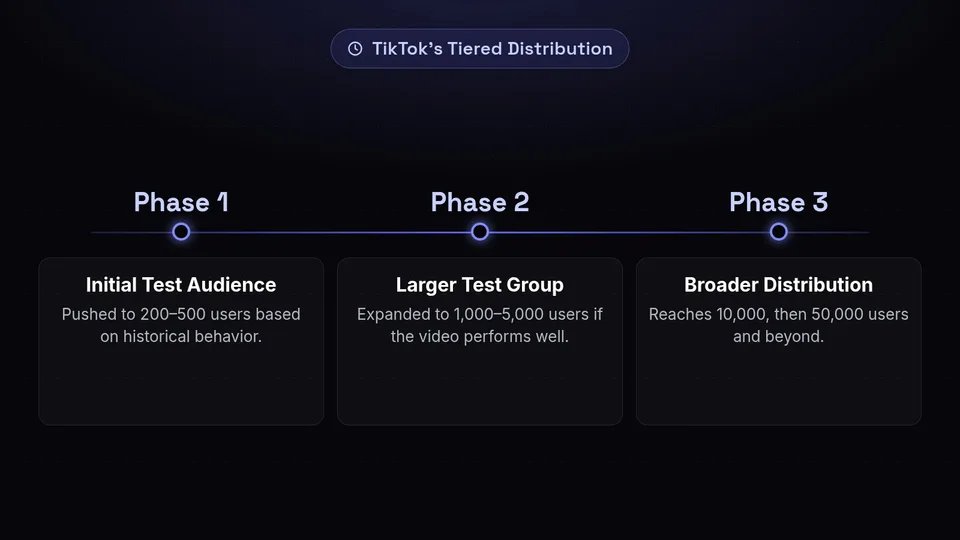
Every time you hit "post," TikTok does not immediately push your video to millions of users. Instead, it pushes your video to an initial test audience. This is typically a small cohort of users—often around 200 to 500 people—whose historical behavior suggests they might be interested in your video's topic, audio, or hashtags.
This initial test is a crucible. The algorithm is closely monitoring how this small group interacts with your video. Are they swiping away immediately? Are they watching it all the way through? Are they sharing it? If the video performs well with this initial cohort, TikTok expands the distribution to a larger test group (e.g., 1,000 to 5,000 users). If it passes that test, it goes to 10,000, then 50,000, and so on. This is the tiered distribution model.
Many creators complain about being stuck in "200-view jail." The harsh reality is that this is not a glitch or a shadowban; it is the algorithm working exactly as intended. Your video simply did not generate enough positive signals from the initial test audience to warrant broader distribution. To maximize your chances with this initial audience, you need to ensure you are posting when your target demographic is actually online and active. Utilizing tools to find your best time to post can give your video the initial momentum it needs during this critical testing phase.
The Metrics That Actually Drive the TikTok Algorithm
So, what exactly is the algorithm measuring during these test phases? While likes, comments, and shares are nice, they are not the primary drivers of massive distribution. The TikTok algorithm is optimized for one primary goal: keeping users on the app for as long as possible. Therefore, the metrics that matter most are the ones that indicate a user is captivated.
1. Completion Rate: The Holy Grail
Completion rate is the percentage of viewers who watch your video from the very first frame to the very last frame. This is the strongest signal you can send to the algorithm that your content is valuable. If a user watches a 60-second video all the way through, they have given up a minute of their life to your content. TikTok rewards this heavily.
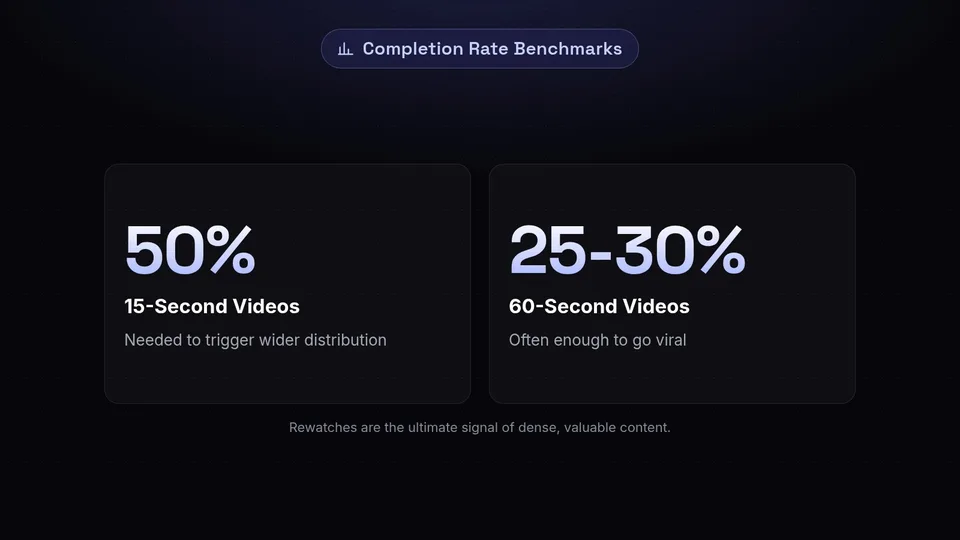
The benchmark for a "good" completion rate varies based on the length of the video. For a 15-second video, you might need a 50% completion rate to trigger wider distribution. For a 60-second video, a 25% or 30% completion rate might be enough to go viral. The longer you can hold someone's attention, the more the algorithm will favor you.
2. Rewatches: The Ultimate Signal
If completion rate is the holy grail, rewatches are the secret weapon. When a user watches your video, reaches the end, and lets it loop to watch it again, it sends a massive positive signal to the algorithm. It tells TikTok, "This content is so dense, so entertaining, or so valuable that watching it once was not enough."
This is why videos with seamless loops, dense informational content that requires a second listen, or fast-paced visual comedy tend to perform exceptionally well. A high average watch time (often exceeding the actual length of the video due to loops) is the hallmark of a viral video.
The Viral Trap: Why Chasing Virality is a Mistake

Now that we understand the mechanics, we arrive at the most counterintuitive part of TikTok strategy. Most creators believe that figuring out how to go viral on tiktok is the ultimate goal. They chase trending audios, participate in random dance challenges, or do controversial stunts just to get views.
Here is the hard truth: chasing virality produces significantly worse long-term outcomes than building a repeatable content format.
The Wrong Kind of Followers
Imagine you run a small business selling artisanal coffee. You decide to jump on a trending TikTok dance challenge. Miraculously, the video explodes. It gets 5 million views, and you gain 50,000 new followers overnight. You are ecstatic. You have finally figured out how to get famous on tiktok.
But the next day, you post a beautifully shot video about your new Ethiopian roast. It gets 200 views. What happened?
When you go viral for something outside your core niche, you attract followers who wanted that specific video, not your account. Those 50,000 new followers followed you because they liked your funny dance, not because they care about coffee. When TikTok pushes your next coffee video to a sample of your new followers, they immediately swipe away because it is not what they signed up for.
This sends a terrible signal to the tiktok algorithm. The algorithm thinks, "Wow, not even this creator's own followers want to watch this video. It must be terrible." Your massive follower count becomes a liability, actively suppressing the reach of your core content. This is the "Ghost Town Effect"—accounts with hundreds of thousands of followers but barely any views.
Repeatable Formats vs. The Viral Lottery
Instead of playing the viral lottery, successful creators build repeatable formats. A repeatable format is a specific style, structure, or theme of video that you can produce consistently, and that sets clear expectations for the viewer.
"A viral video builds an audience for a moment. A repeatable format builds an audience for a lifetime."
Think of successful creators. They don't reinvent the wheel every day. They have a series. They have a specific way of editing. They have a recurring character or a consistent setting. When you build a repeatable format, you attract an audience that actually wants to see what you post next. If one of these videos happens to go viral tiktok style, the followers you gain will be highly targeted and genuinely interested in your future content.
Mastering the Hook: The Two-Second Rule
Whether you are building a repeatable format or hoping a video takes off naturally, nothing matters if you cannot stop the scroll. On TikTok, the first two seconds of your video decide its fate. If you fail to capture attention immediately, the user swipes, your completion rate plummets, and the algorithm kills your distribution.
The Three Types of Hooks
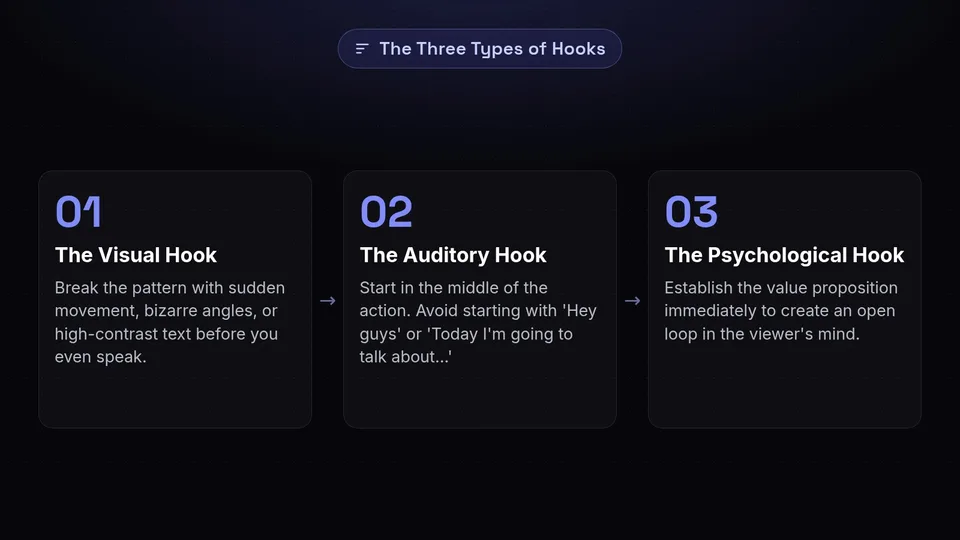
A strong hook is not just about yelling at the camera. It requires a multi-sensory approach. There are three primary types of hooks you must master:
- The Visual Hook: What is happening on the screen before you even speak? This could be a sudden movement, a bizarre camera angle, an interesting prop, or high-contrast text on the screen. The visual hook must break the pattern of whatever the user was watching previously.
- The Auditory Hook: The first words out of your mouth, or the sound effect you use. Avoid starting with "Hey guys" or "Today I'm going to talk about..." Start in the middle of the action. Use strong, polarizing, or curiosity-inducing statements.
- The Psychological Hook: Why should the viewer care? You must immediately establish the value proposition. Are you going to solve a problem? Make them laugh? Tell them a secret? The psychological hook creates an "open loop" in the viewer's mind that can only be closed by watching the rest of the video.
For example, instead of saying, "Here is a tutorial on how to clean your sneakers," a better hook would be visually scrubbing a filthy shoe while saying, "Stop throwing away your dirty sneakers—this $2 trick makes them brand new in 60 seconds."
Retention Editing: Keeping Eyes on the Screen
Getting past the first two seconds is only half the battle. To achieve the high completion rates and rewatches required by the tiktok algorithm, you must utilize retention editing. Retention editing is the practice of manipulating pacing, visuals, and audio to keep the viewer's brain constantly engaged, preventing them from losing interest and swiping away.
Techniques for High-Retention Videos
Modern audiences have incredibly short attention spans. You cannot afford a single second of "dead air." Here are the core principles of retention editing:
- Cut the Fluff: Remove every single pause, breath, "um," and "uh." The dialogue should be snappy and continuous. If a word does not add value, cut it.
- Pattern Interrupts: The human brain gets bored when looking at a static image for too long. You need to change what is on the screen every 2 to 3 seconds. This is called a pattern interrupt. You can achieve this by changing camera angles, zooming in or out, adding b-roll footage, or popping text onto the screen.
- Dynamic Captions: A large percentage of users watch videos with the sound off, or use captions to help them process information faster. Use dynamic, animated captions that highlight keywords. This gives the viewer's eyes something to track, increasing watch time.
- Sound Design: Do not just rely on trending music. Use sound effects (whooshes, pops, typing sounds) to emphasize visual changes or important points. Good sound design makes a video feel professional and highly engaging.
- The Seamless Loop: As mentioned earlier, rewatches are gold. If you can edit the end of your video so that it flows perfectly back into the beginning, you will trick many viewers into watching the first few seconds twice before they realize the video has restarted.
What to Do When a Video Actually Takes Off
Let us say you followed all the advice. You built a repeatable format, crafted an incredible hook, edited for retention, and suddenly, the algorithm blesses you. The views are climbing by the thousands every minute. You are experiencing what it means to go viral tiktok style. What do you do?
Most creators panic, or worse, they do nothing and let the opportunity slip away. A viral video is a massive influx of top-of-funnel traffic. Your job is to capture and direct that traffic.
1. Engage Heavily in the Comments
The comment section of a viral video is incredibly valuable real estate. Pin a comment that adds context, asks a follow-up question, or directs people to your profile. Reply to as many comments as possible in the first 48 hours. This signals to the algorithm that the video is generating active community engagement, which can extend the lifespan of the virality.
2. Reply with Video
This is the most powerful tool in your arsenal. When people ask questions or leave interesting comments on your viral video, use the "Reply with Video" feature. This creates a new piece of content that is directly linked to the viral one. People who see the new video will often click back to the original for context, and people watching the original will look at your profile to see the follow-up. It creates a localized ecosystem of views.
3. Analyze the Data
Do not just celebrate the views; analyze the quality of the engagement. Are these the right kind of followers? Is the engagement translating to your other videos? Use a tool like our engagement rate calculator to see if your overall account health is improving or if you just got a vanity spike. Understanding this data will help you refine your repeatable format for the next video.
4. Stay Consistent
The worst thing you can do after a viral hit is ghost your audience. The algorithm is currently favoring your account. Capitalize on this momentum by posting your next piece of formatted content as soon as possible. Show your new audience that the viral video was not a fluke, but a standard representation of the value you provide.
The Myth of the "Viral Formula"
As you navigate your TikTok journey, you will inevitably encounter "gurus" and self-proclaimed experts selling courses, ebooks, or consulting services that promise to teach you the ultimate "viral formula." They will claim they have cracked the code and can guarantee millions of views if you just follow their exact template.
We need to be brutally honest here: nobody can promise virality.
Anyone selling a guaranteed formula is selling you something you do not need. The tiktok algorithm is a highly complex, constantly evolving machine learning system. It is influenced by millions of data points, cultural trends, and unpredictable human behavior. What worked yesterday might not work today. What works for a teenage dancer in Los Angeles will not work for a B2B SaaS company in London.
While the principles we have discussed—understanding the test audience, optimizing for completion rate, crafting strong hooks, and building repeatable formats—will drastically increase your surface area for luck, they are not magic spells. They are foundational marketing and content production principles applied to short-form video.
True success on TikTok requires patience, iteration, and a willingness to fail. You have to post videos that flop in order to learn what resonates with your specific audience. You have to be willing to look at the analytics, swallow your pride, and adjust your strategy. It is hard work, which is why the promise of a "secret formula" is so appealing. But falling for that trap will only cost you time and money.
Conclusion: Build for the Long Term
Learning how to go viral on tiktok is an exciting pursuit, but it should never be your primary strategy. The dopamine hit of a million views is fleeting, and the wrong kind of virality can actively destroy the health of your account.
Instead of chasing trends and hoping to get lucky, focus your energy on understanding the true drivers of the tiktok algorithm: completion rate and rewatches. Respect the initial test audience by delivering immediate value. Spend your time crafting undeniable hooks in the first two seconds, and use retention editing to keep viewers glued to the screen. Above all, build a repeatable format that attracts a loyal, targeted audience who wants to see you, not just a fleeting trend.
Consistency is the ultimate growth hack. Managing a consistent posting schedule, analyzing your data, and refining your formats takes time and organization. That is where SchedulifyX comes in. By using our AI-powered social media scheduling platform, you can automate the tedious parts of content distribution, ensuring you hit your optimal posting times without being chained to your phone. Stop chasing the viral lottery, start building a sustainable media machine, and let SchedulifyX handle the rest.
