How to Make Viral Memes: The Ultimate Brand Marketing Guide
SchedulifyX Team · July 6, 2026
Learn how to create shareable memes for social media marketing. Discover trending templates, humor dos and don'ts, and free tools to boost brand engagement.
In the fast-paced world of digital marketing, capturing your audience's attention is harder than ever. Consumers are bombarded with thousands of ads daily, leading to ad fatigue and a general distrust of overly polished corporate messaging. Enter the meme. What started as inside jokes on niche internet forums has evolved into one of the most powerful communication tools of the 21st century. If you want to know how to make viral meme content that resonates, drives engagement, and builds brand loyalty, you are in the right place.
This comprehensive meme marketing guide is designed to take you from a casual scroller to a master of brand meme creation. We will explore the psychology behind why we share memes, how to leverage trending formats without coming across as out-of-touch, and the best tools to streamline your creative process.
Why Meme Marketing is Essential for Brands Today
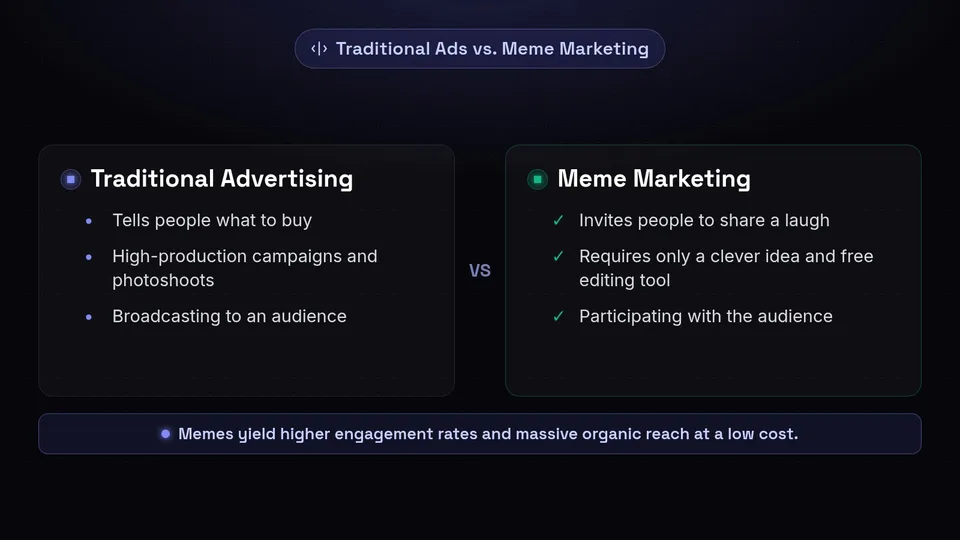
Before diving into the mechanics of meme creation, it is crucial to understand why memes have become a non-negotiable element of modern social media strategy. Traditional advertising tells people what to buy; memes invite people to share a laugh. This subtle shift from broadcasting to participating changes the entire dynamic between a brand and its audience.
High Engagement at a Low Cost
Memes are incredibly cost-effective. Unlike high-production video campaigns or elaborate photoshoots, memes often require nothing more than a clever idea and a free editing tool. Despite their low production cost, they frequently yield higher engagement rates than polished graphics. Users are more likely to tag a friend in a relatable meme than they are to share a promotional graphic about a weekend sale.
Humanizing Your Brand
Consumers want to connect with the humans behind the logo. Memes allow brands to show personality, self-awareness, and a sense of humor. When a brand participates in a trending joke, it signals to the audience that the company understands digital culture. It breaks down the corporate wall and says, "We get it, we are just like you."
Incredible Viral Potential
The very nature of a meme is to be replicated and shared. When you nail a meme, it doesn't just reach your followers; it reaches their followers, and their followers' followers. This organic reach is the holy grail of social media marketing, providing massive brand visibility without the hefty price tag of paid amplification.
The Psychology of Sharing: Why Social Media Memes Work
To master brand meme creation, you must first understand the psychology of why people share content online. Sharing a meme is rarely just about the joke itself; it is a form of social currency and identity signaling.
Relatability and Validation
When someone shares a meme, they are often saying, "This is exactly how I feel." Memes put complex, often mundane, everyday frustrations or joys into a single, easily digestible image. For a brand, tapping into the specific pain points or quirks of your target demographic creates an instant bond. For example, a software company posting a meme about the panic of forgetting to save a document resonates deeply with office workers.
In-Group Belonging
Memes act as cultural shorthand. Understanding a meme means you are part of the "in-group." When a brand successfully uses niche social media memes, it proves to the community that the brand truly belongs in that space. This is why generic memes often fall flat, while highly specific, industry-targeted memes thrive.
"A successful brand meme doesn't just make the audience laugh; it makes them feel seen, understood, and part of an exclusive community."
Understanding Popular Meme Formats and Templates
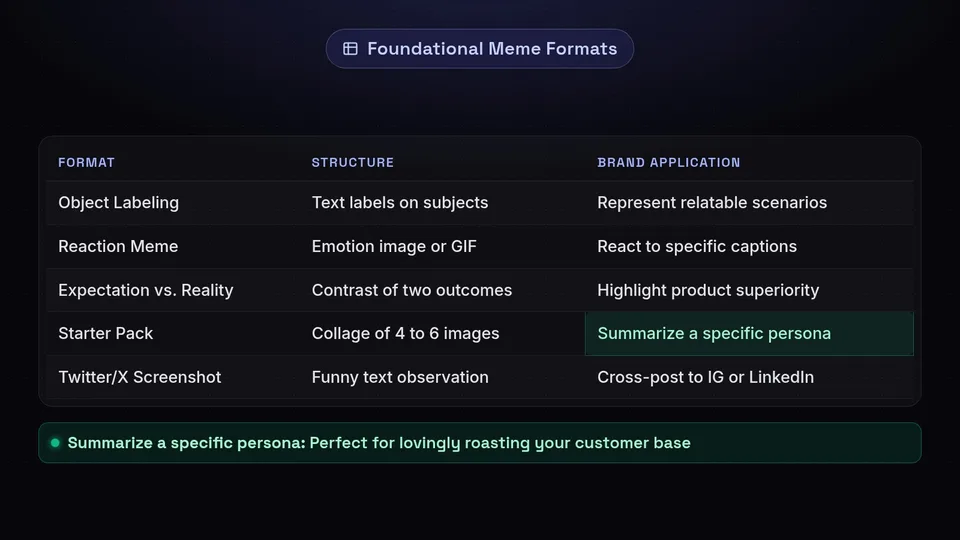
The internet moves fast, but certain meme structures have proven to have serious staying power. Understanding these foundational formats will help you select the right meme templates for brands.
1. The Object Labeling Meme
This is one of the most versatile and popular formats. It involves taking an image (often dramatic or historical) and placing text labels on the different subjects within the image to represent a relatable scenario. Example: The "Distracted Boyfriend" meme. A brand might label the boyfriend as "Our Customers," the distracted woman as "Our New Feature," and the ignored girlfriend as "The Old Way of Doing Things."
2. The Reaction Meme
Reaction memes use an image, GIF, or short video clip of a person or animal expressing a strong emotion to react to a specific caption. These are incredibly easy to produce. You simply need a setup text like, "Me waiting for my package to arrive even though I just ordered it 5 minutes ago," paired with a relevant reaction image.
3. The 'Expectation vs. Reality' Format
This format thrives on contrast. It highlights the difference between what we hope will happen and what actually happens. Brands can use this to highlight the superiority of their product (Reality) versus a competitor's (Expectation), or simply to poke fun at universal industry struggles.
4. The Starter Pack Meme
A "Starter Pack" is a collage of 4 to 6 images that perfectly summarize a specific archetype, persona, or situation. Brands can use this to lovingly roast their own customer base or highlight the essential tools needed for a specific task (subtly including their own product, of course).
5. Twitter/X Screenshot Memes
Sometimes the best memes are just funny text observations. Taking a screenshot of a clever tweet (either from your own brand account or a relevant, credited user) and posting it on Instagram or LinkedIn with a complementary background is a highly effective, low-effort meme format.
Step-by-Step Tutorial: How to Make a Viral Meme
Now that we understand the theory, let's dive into the practical application. Here is your step-by-step meme marketing guide to creating content that goes viral.
Step 1: Know Your Audience Inside and Out
The golden rule of learning how to make viral meme content is understanding exactly who you are making it for. A meme that is hilarious to Gen Z gamers will likely confuse Gen X corporate professionals. Before you open an image editor, ask yourself:
- What are my audience's daily frustrations?
- What industry jargon do they use?
- What pop culture references do they consume?
- What are their goals and aspirations?
Step 2: Identify the Core Message
What are you trying to say? Are you announcing a new product, acknowledging a common customer pain point, or just trying to stay top-of-mind? Your core message should be simple. Memes are not the place for nuanced, multi-paragraph explanations. Condense your message into a single, punchy concept.
Step 3: Source the Right Meme Templates for Brands
Once you have your message, you need the vehicle to deliver it. Look for trending meme templates for brands on platforms like Twitter, TikTok, or Reddit. The template must match the emotion of your message. If your message is about a sudden, pleasant surprise, find a template that visually represents that emotion.
Step 4: Write Snappy, Relatable Copy
The text is where the magic happens. Keep it concise. Use the exact language your audience uses. Avoid corporate speak at all costs. If you are a B2B brand, don't say "Synergizing cross-platform deliverables." Say, "Trying to explain what I do to my parents." The contrast between a professional brand and casual, relatable language is what makes brand memes funny.
Step 5: Review for Tone and Brand Safety
Before hitting publish, do a quick sanity check. Is the joke at someone else's expense? Does it rely on a template with problematic origins? Could it be misinterpreted? It is crucial to have a second set of eyes look at the meme to ensure it aligns with your brand values and won't cause an unintended PR crisis.
Humor Dos and Don'ts for Brand Meme Creation
Navigating humor as a brand can be a minefield. What works for a personal account might be disastrous for a corporate entity. Follow these essential dos and don'ts for successful brand meme creation.
The DOs of Meme Marketing
- DO be self-deprecating: Brands that can poke fun at their own flaws, long wait times, or known bugs are perceived as authentic and trustworthy.
- DO act fast: Meme lifespans are incredibly short. If you see a trend taking off on Monday, you need to have your version posted by Tuesday. Waiting a week means you missed the boat.
- DO keep it simple: If someone has to stare at your meme for more than three seconds to get the joke, it's too complicated.
- DO credit creators: If you are sharing a meme created by an independent artist or another user, always give them proper credit in the caption.
The DON'Ts of Meme Marketing
- DON'T force your product into the joke: The quickest way to kill a meme is to make it a blatant advertisement. The humor must come first; the brand connection should be secondary and subtle.
- DON'T use dead memes: Nothing screams "out of touch" louder than a brand using a meme format that hasn't been popular for three years. (Leave the 2012 Troll Face in the past).
- DON'T be offensive or edgy just for engagement: Avoid politics, religion, and controversial social issues unless they are directly tied to your brand's core mission. Shock value is not a sustainable marketing strategy.
- DON'T ignore context: Always research the origin of a meme template. Some popular images originate from controversial or tragic events. Using them out of ignorance can severely damage your brand's reputation.
How to Ride Trending Meme Formats Without Being Cringe
We have all seen it: a brand tries to participate in a viral trend, and it falls completely flat, resulting in collective second-hand embarrassment. This phenomenon, often referred to as "Silence, Brand" or "How do you do, fellow kids?", happens when companies fundamentally misunderstand the culture they are trying to co-opt. Here is how to avoid the cringe.
Understand the Meme Lifecycle
Memes have a distinct lifecycle. They are born in niche communities (Reddit, Discord, specific subcultures on TikTok), they break into the mainstream (Twitter, Instagram explore pages), they peak when everyone is using them, and they die when they reach late-night talk shows or out-of-touch corporate accounts. To avoid being cringe, you must catch the meme during its ascent or at its peak. If your parents are sharing it on Facebook, it is too late for your brand to use it.
Authenticity Over Forced Relevance
Not every meme is for every brand. If a trending format relies on slang that your brand has never used, forcing it will sound unnatural. It is better to sit out a trend than to participate in a way that feels forced. Only use trends that naturally align with your brand voice. If you are a high-end luxury brand, a chaotic, deep-fried Gen Z meme will likely confuse your audience. Stick to your established persona.
Add Value to the Joke
Don't just copy what everyone else is doing. If you are going to use a trending format, you must bring a unique, brand-specific spin to it. The joke should only make sense coming from *your* brand. If you could swap your logo with a competitor's logo and the meme still works perfectly, it's not specific enough.
Top Free Meme Creation Tools
You don't need expensive graphic design software to create top-tier social media memes. In fact, memes that look *too* polished often perform worse than those that look slightly amateurish. Here are the best free tools to streamline your workflow.
1. Canva
Canva is a powerhouse for social media managers. It has a massive library of meme templates for brands, easy-to-use text tools, and the ability to upload your own brand assets. It is perfect for creating clean, professional-looking memes, especially Twitter-screenshot style posts or Starter Packs.
2. Imgflip
Imgflip is the grandfather of meme generators. It might not have the most modern interface, but it boasts one of the largest databases of classic and trending meme templates. It allows you to quickly add classic Impact font text to any image in seconds. It is the go-to tool for traditional object-labeling and reaction memes.
3. Kapwing
If you want to create video memes or GIFs, Kapwing is unparalleled. It is a collaborative, web-based video editor that makes it incredibly easy to add text to videos, trim clips, and format content for TikTok, Reels, or Shorts. Video memes are currently dominating algorithms, making Kapwing an essential tool.
4. Mematic
For on-the-go meme creation, Mematic is one of the best mobile apps available. It is incredibly user-friendly, allowing you to quickly combine images and text directly from your smartphone. This is ideal for live-tweeting events or reacting to real-time industry news.
5. Twitter/X (Native App)
Sometimes the best tool is the platform itself. Drafting a clever text post on Twitter, taking a screenshot, and cropping it on your phone is a legitimate and highly effective way to create content for Instagram and LinkedIn.
Platform-Specific Strategies for Social Media Memes
A meme that goes viral on TikTok might flop on LinkedIn. Understanding the nuances of each platform is critical for your meme marketing guide.
Instagram is a highly visual platform. Memes here need to be aesthetically pleasing even if the joke is chaotic. Carousel posts work incredibly well for memes—you can tell a story across multiple slides or provide a "dump" of several related memes. Instagram Reels are also the perfect place for short, relatable video memes.
Twitter (X)
Twitter is the birthplace of most text-based and reaction memes. It moves at lightning speed. To succeed here, you must be witty, concise, and incredibly fast. Engaging with other brands' memes in the replies is also a great way to boost visibility.
Yes, memes work on LinkedIn! However, the context must be strictly professional. Focus on B2B struggles, office culture, remote work realities, and industry-specific pain points. Keep the humor clean and relatable to the working professional. A well-placed meme on LinkedIn can disrupt the feed of standard corporate milestones and yield massive engagement.
TikTok
TikTok memes are almost exclusively audio and video-based. Success here relies on jumping on trending "sounds" and adapting them to your brand's niche. The production value should feel native to the app—shot on a phone, slightly chaotic, and highly authentic. Don't over-edit; just be funny.
Conclusion and Next Steps
Learning how to make viral meme content is not an exact science; it is an art form that requires empathy, cultural awareness, and a willingness to take calculated risks. By understanding your audience, utilizing the right meme templates for brands, and adhering strictly to the dos and don'ts of internet humor, you can transform your social media presence from a stagnant corporate megaphone into a vibrant, engaging community hub.
Remember that consistency is key. Not every meme will go viral, and that is perfectly okay. The goal is to consistently provide value through entertainment, building a loyal audience that looks forward to your posts.
Once you have mastered brand meme creation, the next challenge is distribution. Managing multiple platforms, hitting the optimal posting times, and maintaining a consistent content calendar can be overwhelming. That is where SchedulifyX comes in. Our AI-powered social media scheduling platform takes the guesswork out of distribution. With SchedulifyX, you can seamlessly plan, schedule, and analyze your viral meme campaigns across all major platforms from one intuitive dashboard. Stop stressing about manual posting and start focusing on creating content that your audience will love. Sign up for SchedulifyX today and take your meme marketing strategy to the next level!