How to Get More Likes and Followers on Instagram
SchedulifyX Team · November 18, 2026
Likes and follows are earned in different places. How to get more likes and followers on Instagram: improve the post, the profile and two numbers to track.
Most advice treats likes and followers as a single goal: post more often, use the right hashtags, and both numbers will climb together. In practice they often move separately. A post can do well with the people who already follow you and bring in nobody new, while a Reel that reaches strangers can add followers without collecting many likes at all. That is not a glitch. A like and a follow are different decisions, often made by different people, for different reasons.
So the most useful answer to how to get more likes and followers on Instagram is to treat them as two jobs. Likes are earned by the post: whether it was worth reacting to for the people who saw it. Follows are earned by the promise: whether a new viewer expects your next posts to be worth their time. This guide covers what Instagram has said about how it ranks content, how to get more likes on the posts you already make, how to gain followers on Instagram by reaching new people and giving them a reason to stay, what to avoid, and the two numbers that tell you whether any of it is working.
Likes and follows are different decisions
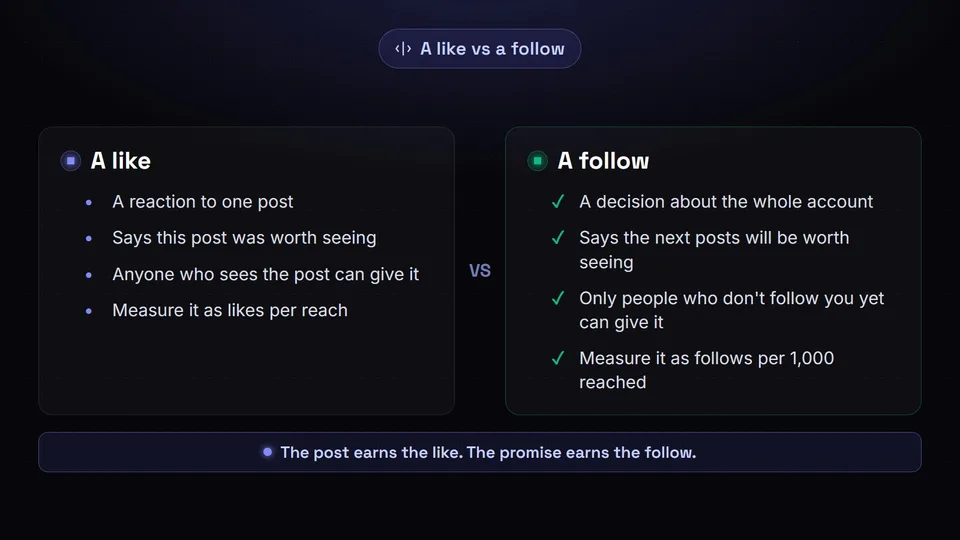
A like is a reaction to one post. It costs the viewer a single tap, it says the post was worth seeing, and it is a judgement about something that has already happened. A follow is a decision about the whole account. It says the viewer wants more, which makes it a bet on posts you have not made yet.
That difference shows up in who can give them. Anyone who sees a post can like it, including the people who already follow you. Only people who do not follow you yet can follow you, so follows depend on reaching new people first, and then on what those people find when they look at your account.
It also shows up in Instagram's own numbers. The insights for each post and Reel show how many accounts it reached, how many likes it got and how many follows it led to. A post can do well on one and poorly on the other, and the fix for each is different. If likes are low, the post did not land with the people who saw it. If follows are low, the post may have landed perfectly well, but nothing told a new viewer why the account was worth following.
Keeping the two apart stops you from fixing the wrong thing. An account with plenty of likes and few new followers does not need more hashtags; it needs to reach new people and give them a reason to stay. An account that is reaching new people but getting few likes needs better posts, not a new bio.
What Instagram says it ranks on
Instagram has explained its ranking in more detail than most platforms, and three of its statements are worth knowing before you change anything.
The first is that each part of the app ranks differently. In Instagram Ranking Explained, published in 2023, Adam Mosseri, the head of Instagram, wrote that Feed predicts how likely you are to spend a few seconds on a post, comment on it, like it, share it and tap on the profile photo. Reels predicts how likely you are to reshare a reel, watch it all the way through, like it and go to the audio page. In both Reels and Explore, he wrote, most of what people see comes from accounts they do not follow. That is why those two surfaces are where most new followers find you.
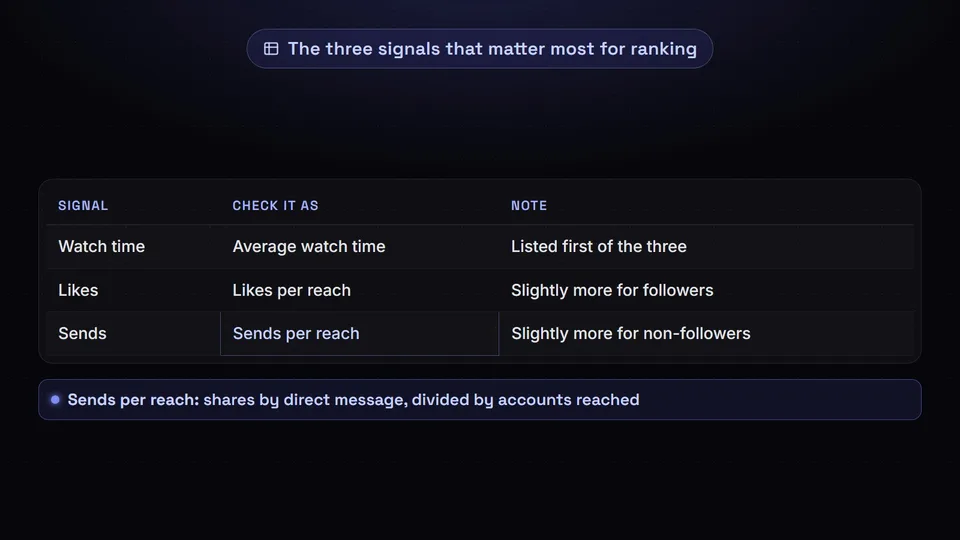
The second is a shorter list. In a video in January 2025, Mosseri said the three signals that matter most for ranking are watch time, likes and sends, meaning the shares people make by direct message. He added that likes are slightly more important for reaching people who already follow you, and sends slightly more important for reaching people who do not, and he told creators to pay close attention to average watch time, likes per reach and sends per reach in their insights, Social Media Today reported.
The third is about originality. The 2023 explainer said Reels that are low-resolution or watermarked, or that were already posted on Instagram, are made less visible. In April 2026 Instagram extended its originality rules from Reels to photos and carousels: accounts that mainly re-upload other people's work are no longer eligible to be recommended, and Instagram said 75% of recommendations in the US were coming from original posts. Original means you made it, or you changed someone else's material in a meaningful way, for example by adding context or new information. A border, a watermark, subtitles or a credit in the caption does not count. In November 2026 Instagram also brought Content Protection, a tool that finds copies of creators' original videos, from Facebook to Instagram.
Put together, the advice is plain. Make your own material, hold attention, give people something worth liking, and make things people want to send to someone.
How to get more likes on your posts
The number to improve here is likes per reach: a post's likes divided by the number of accounts it reached. Raw likes rise and fall with reach, so a post seen by a few hundred people and one seen by a few thousand cannot be compared on likes alone. Likes per reach can be compared, and it is one of the three numbers Mosseri told creators to watch.
Earn the first second
Watch time was the first of the signals Mosseri named, and on a Reel it is decided early. Open on the most interesting moment: the result, the problem, the reveal, not a logo or a slow introduction. On a photo or carousel the first image does the same job, and the opening words of the caption are what people read before it is cut off, so put the point there rather than in the last line.
Make posts for the people who already see you
Likes matter slightly more for reaching your followers, so the posts that earn the most likes are usually the ones your existing audience came for. Look back at which topics and formats earned the best likes per reach, and make more of those. Timing helps too: our guide to finding your own best times to post on Instagram shows how to read when your followers are active from your insights, and the best time to post calculator converts the commonly cited windows into your time zone as a starting point.
Give people a reason to tap
A like is easiest to give when a post has one clear point: a result, a useful tip, a strong opinion, a joke that lands. A post that tries to say five things usually says none of them well enough to react to. Asking for likes outright is a different matter. "Like if you agree" is engagement bait, which Meta has demoted on Facebook since 2017, and likes collected that way tell you more about the request than about the post.
Use sizes and formats that display properly
A photo cropped badly in the grid, or a Reel with its text hidden under the app's buttons, loses people before they decide whether they like it. Check the current dimensions on our Instagram image sizes page before you build a template, and keep text inside the area that stays visible.
Keep hashtags few and specific
Instagram now allows five hashtags per post and Reel. Hashtags help describe a post and connect it to related ones; they do not rescue a post nobody wanted to like. Our guide to Instagram's five-hashtag limit covers how to choose them.
Remember that like counts can be hidden
Since May 2021 anyone can hide like counts on their own posts, and on other people's posts in their feed. A like is less of a public scoreboard than it used to be. It still matters as a signal: likes were one of the three Mosseri named in 2025, whether or not anyone can see the number. Remember too that many people never like anything; the lurkers in your audience still watch, save and send.
How to gain followers on Instagram
Followers come in two steps. First a post has to reach people who do not follow you. Then something has to convince them that following is worth it. Most accounts that stall are missing one of the two.
Reach new people with Reels they want to send
Reels and Explore are where most people see accounts they do not follow, by Instagram's own description, so they are where most new followers start. Mosseri said sends matter slightly more for reaching people who do not follow you, which gives you a practical test for every Reel: would someone send this to a particular friend? A tip that friend needs, a joke about their job, something they would want to talk about later. A Reel made to be sent is built for exactly the audience you are trying to win.
Test ideas on non-followers first
Trial reels, introduced in December 2024, are shown to people who do not follow you first, and your followers do not see them in their feed or Reels tab. Instagram says the main engagement numbers appear about 24 hours after you share one, and you can choose to have a trial reel shared with your followers automatically if it performs well in its first 72 hours. That makes them a low-risk way to test a new format on the audience you want to win over, without filling your followers' feeds with experiments. Our guide to testing with trial reels covers how to read the results.
Collaborate with accounts your audience would follow
A collab post appears on the profile of each account on it and is shown to each account's followers, so it puts your work in front of people who already trust someone you have worked with. Choose partners whose followers would want what you post, not simply the largest accounts that will say yes, and make the post as useful to their audience as to yours.
Build a format people can expect
A follow is a bet on the future, and people can only make it if they can roughly predict what comes next. A repeatable format, the same kind of subject handled in the same way, gives them that picture. A numbered series does it even better, because part two implies part three. It is the same principle we covered in how to get more followers on TikTok: viewers follow when they can imagine the next ten posts and want to see them. For the longer view of an account's first thousand followers, see our honest guide to growing followers on Instagram organically.
Turn profile visits into follows
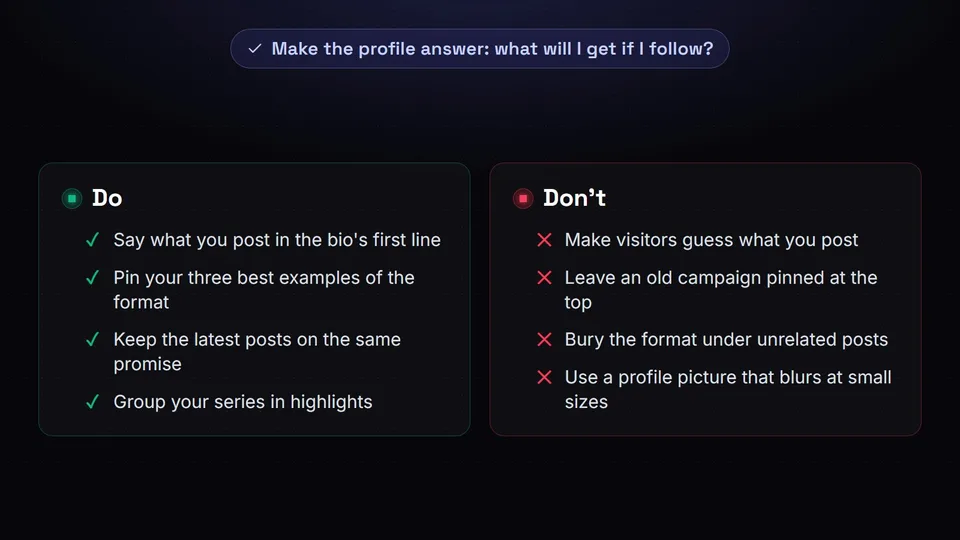
When a post makes someone curious, your profile is where they decide. The top of it does most of the work: your name and bio, your highlights and the first rows of your grid. All of them should answer the same question for a newcomer: what will I get if I follow?
- Say what you post in the first line of your bio. "Weeknight dinners in 20 minutes" tells a visitor more than a list of job titles. Our Instagram bio ideas and the mistakes to avoid in an Instagram bio go into more detail.
- Pin the posts that show your format. You can pin up to three posts or Reels to the top of your grid. Use them for your best examples of what you post now, not an old campaign or a one-off that went viral for reasons that have nothing to do with your account.
- Keep your latest posts on-promise. A visitor who arrives from a cooking Reel and finds a grid of unrelated posts has no reason to expect more cooking.
- Use highlights as a menu. Highlights sit above the grid, so they can group your series or your most useful Stories by topic for someone who has just arrived.
- Make your profile picture recognisable at a small size. It appears tiny next to every post and comment, so a clear face or a simple mark works better than a detailed image.
Then check the result. If a post sends plenty of people to your profile but few of them follow, they were curious and the profile did not convince them. That is a profile problem, not a content problem.
What not to do
Every shortcut to a bigger number has the same flaw: it adds likes or followers that do not come from people who chose them.
- Buying followers or likes. Meta's spam policy prohibits selling, buying or exchanging for engagement such as likes, shares, views and follows. In 2018 Instagram began removing inauthentic likes, follows and comments from accounts that use third-party apps to boost their popularity.
- Follow-for-follow and like-for-like. Exchanging engagement falls under the same policy, and an audience that followed only to be followed back has no interest in what you post.
- Apps that like and follow on your behalf. These are the kind of third-party apps Instagram's 2018 announcement was aimed at, and they put the account at risk for numbers that mean nothing.
- Reposting other people's content as your own. Under the originality rules, accounts that mainly re-upload other people's work are not eligible to be recommended, which cuts off the reach that new followers come from.
There is a measurement cost too. Followers who never watch drag down every rate you calculate per follower, and anyone who checks those rates, including a brand weighing up a partnership, will see the gap. Our guide to Instagram engagement rates explains how they are calculated.
Track two numbers every week
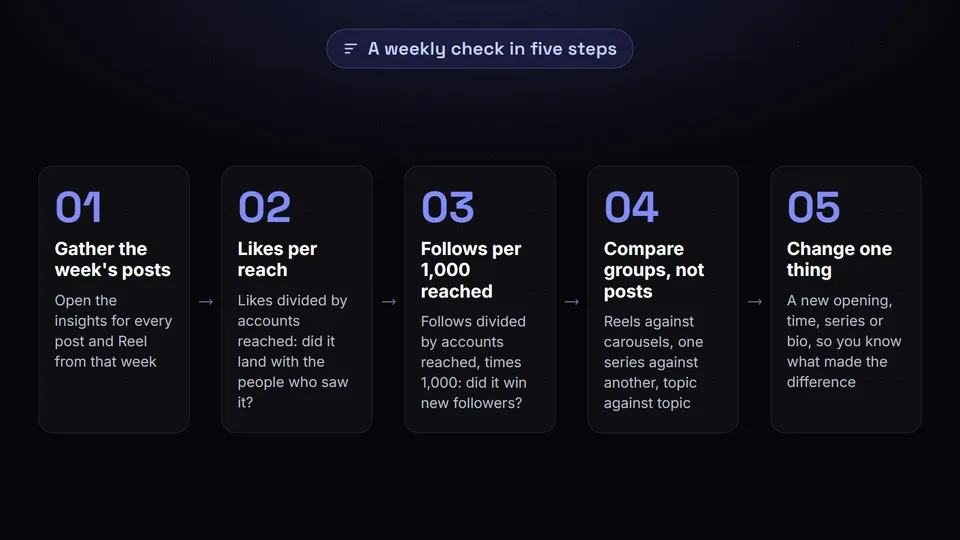
Because likes and follows are separate jobs, measure them separately. Once a week, take the posts and Reels you published that week and work out two numbers from their insights.
- Likes per reach: a post's likes divided by the accounts it reached. This tells you whether posts landed with the people who saw them.
- Follows per 1,000 accounts reached: a post's follows divided by the accounts it reached, multiplied by 1,000. This tells you whether posts turned new viewers into followers.
Single posts swing a lot, so compare groups rather than individual posts: this week's Reels against this week's carousels, one series against another, one topic against another. Keep doing more of whatever does well on both numbers, and treat a format that wins on one but not the other as a clue about which job it is failing.
Then change one thing at a time: a new opening, a different posting time, a new series, a rewritten bio. If you change five things in the same week, you will not know which one made the difference. For the wider picture, the engagement rate calculator works out your overall engagement rate from the same insights.
Conclusion
More likes and more followers come from different work. Likes come from posts that hold attention and give people something worth reacting to. Followers come from reaching people who do not know you yet, and from a profile that tells them what they will get if they stay. Instagram has been unusually clear about the signals it uses, watch time, likes and sends, and about rewarding original work, so the honest route is also the one its ranking favours.
To keep that plan running when you are busy, SchedulifyX schedules Instagram posts and Reels in advance, including Reels published as trial reels to non-followers first, with the cover frame you choose. Pair it with a weekly look at likes per reach and follows per 1,000 accounts reached, and you will know what to make more of.
