How to Get More Followers on TikTok, Not Just More Views
SchedulifyX Team · November 17, 2026
Views give you a chance; follows need a reason. How to get more followers on TikTok with a repeatable format, better completion and a plan for viral videos.
It is one of the most confusing moments on TikTok. A video reaches far more people than anything you have posted before, the views keep climbing, and the follower count barely moves. It feels as though something has gone wrong. Nothing has. TikTok recommends videos, not accounts, and a viewer can enjoy a video very much without wanting anything else from the person who made it.
That is why the honest answer to how to get more followers on TikTok is not "get more views". Views give you a chance at a follow. The follow happens when a viewer expects your next video to be worth their time, and you can build that expectation on purpose. This guide covers what TikTok has said about its recommendations, why a repeatable format matters more than any single video, why completion rate is the number to watch, what the evidence supports on posting frequency, and how to turn a video that takes off into followers.
What TikTok says decides who sees your videos
TikTok has explained its For You feed in some detail, and three points shape everything else in this guide.
The first is about follower count. In its 2020 explanation of how it recommends videos, TikTok said that neither follower count nor a history of high-performing videos is a direct factor in recommendations. A larger account tends to get more views because more people follow it, but the count itself does not push a video to strangers. TikTok's Creator Academy makes the same point more bluntly: you do not need a huge following to reach the For You feed.
The second is about what counts as a strong signal. TikTok said it weights signals by how strongly they indicate interest, and its example of a strong one was whether someone finishes watching a longer video from beginning to end. Its example of a weak one was the viewer and the creator being in the same country.
The third is easy to miss. TikTok's introduction to its recommendation system lists the interactions the system tries to predict for each viewer: whether they will like, share or comment, finish or skip, spend a certain amount of time watching, and follow the video's author or interact with their profile. TikTok says it combines those predictions into an overall score for each video. So the chance that a viewer will follow you is an input, not only an outcome.
Hashtags, captions and sounds describe a video too, but they are a small part of the picture; we covered that in our guide to whether hashtags still work on TikTok. The levers that matter for growth are what the video is, whether people watch it through, and whether it gives them a reason to want the next one.
Why followers still matter
If follower count is not a ranking factor, it is fair to ask why it is worth chasing. Most advice on how to gain followers on TikTok skips the question, but the answer shapes how you should grow. Followers matter for what they do, not for the number on your profile.
- They are the people who come back. Your videos appear in your followers' Following feed; TikTok's note on curating your following says removing a follower takes your videos out of it. TikTok also lists follow relationships among the factors that personalise each person's For You feed, so a follow tells the system something about what that viewer wants.
- Some features depend on them. TikTok's LIVE safety guide says that to go LIVE you must be at least 18 and have a certain number of followers, which varies by market. Its Playlist feature, which groups videos into sets that viewers can watch in a row, is currently available only to creators with more than 10,000 followers.
- They are the audience a format is built for. Strangers on the For You feed judge you one video at a time. Followers have already chosen your account, so they are the people your next episode is really for.
The goal, then, is not a big number but a group of people who reliably want your next video.
Build a repeatable format viewers can expect
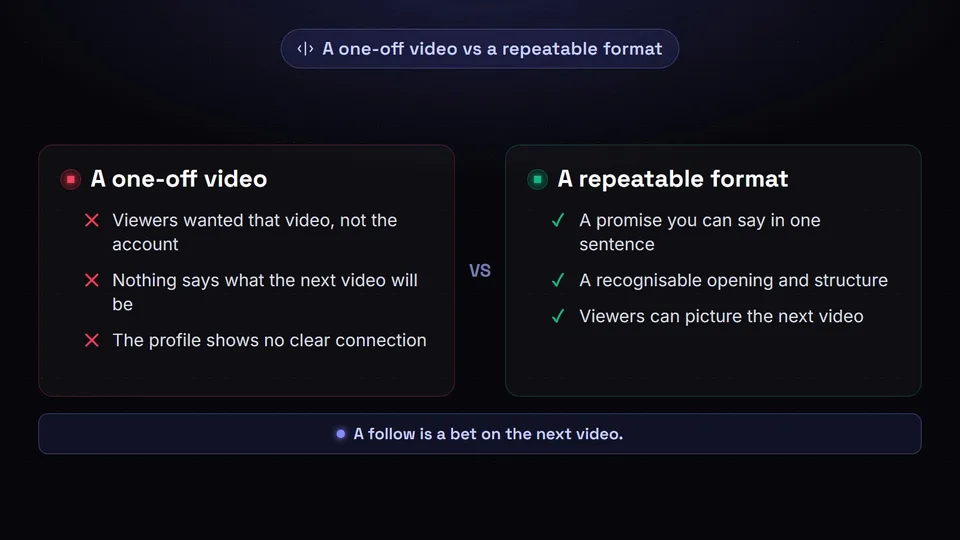
A follow is a bet on the future. When someone taps follow, they are saying they expect your next video to be worth watching, and they can only make that bet if they can roughly predict what the next video will be. That is the job of a format.
A format is a repeatable shape for your videos: the same kind of subject, handled the same way, usually with a recognisable opening and a consistent length. It is narrower than a niche. Home cooking is a niche. One store-cupboard dinner in under a minute, filmed from above, with every ingredient shown in the first shot, is a format. Someone who enjoys one of those videos can picture the next ten, and that picture is what makes following feel worthwhile. If you are asking how to get TikTok followers who stay, this is most of the answer.
What makes a format repeatable
- A promise you can say in one sentence. If you cannot describe your videos simply, a viewer cannot either.
- A recognisable opening. The same framing, line or visual cue tells a returning viewer whose video this is before they read the name.
- A structure you can repeat without strain. If each video takes days to make, the format will not survive your first busy fortnight.
- Variety inside the frame. The subject changes every time; the shape does not. That is what stops a format from feeling repetitive.
- Your own material. TikTok's originality policy says content copied from others, or largely repurposed from another source without creative edits, may be removed from the For You feed. A format built on other people's clips cannot build a following, because there is nothing of yours to follow.
Series give people a reason to come back
A series is the strongest kind of format because it leaves something open: part three implies part four. Number the parts on screen and in the caption, keep the opening consistent, and make each episode make sense on its own, because a viewer arriving from the For You feed may meet the series at any episode rather than the first.
Once you pass 10,000 followers, the Playlist feature takes on part of this job. TikTok says a video added to a playlist carries a link to the full set, so a viewer who enjoys one episode on the For You feed can tap through to the rest. Before that point, the same work falls to clear numbering and to your profile, where a visitor should be able to see the series at a glance.
Choosing a format also means saying no. Videos outside it can still do well, but they teach new viewers the wrong thing about what you post. Keep experimenting, and judge each experiment by the followers it brings in, not only by its views.
Completion rate is the number that drives everything else
If the format is the promise, completion is the proof that you kept it. TikTok chose finishing a longer video as its example of a strong signal of interest, and its analytics report the matching figure directly. Watched full video is what TikTok's guide to its analytics calls your finish rate: the percentage of people who watched until the last few seconds.
Completion drives everything else for a plain reason: every follow starts with a viewer who stayed long enough to decide they liked you. A video that loses people early tells the system they were not very interested, the signal least likely to carry it further, and it gives the viewers it keeps less time to form an opinion of you. A video people finish works the other way on both counts. Completion is not the only signal TikTok uses, but it is the one you control most directly.
Read the number in context
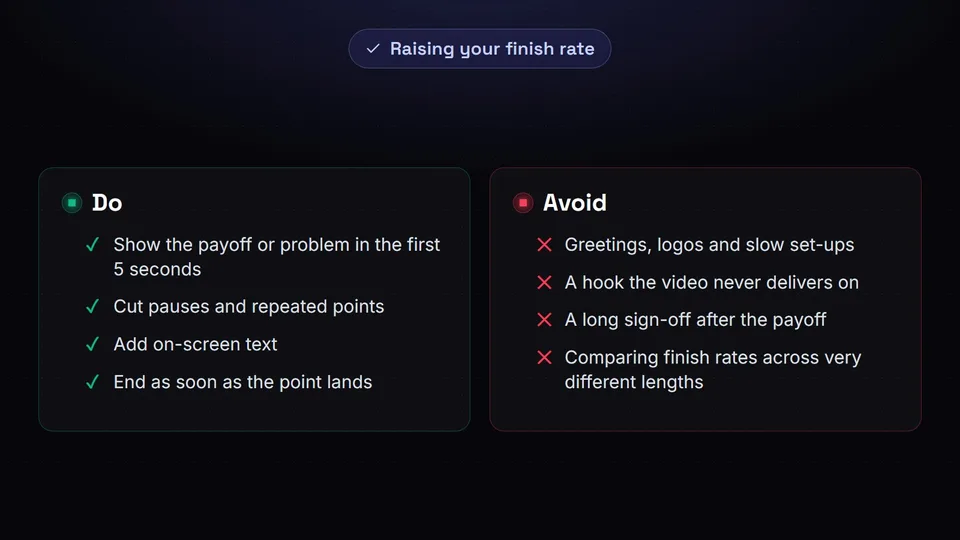
TikTok notes that the finish rate moves with a video's total length, so compare it only between videos of similar duration. Read it alongside two figures from the same screen: average watch time, and retention rate, which TikTok describes as the percentage of your video that people watched and suggests using to find drop-off points. A sharp fall in the opening seconds is a hook problem. A slow slide through the middle is a pacing problem. A fall just before the end often means the video carried on after its payoff.
How to raise it
- Open with the payoff or the problem. TikTok's guidance on the elements of a TikTok video advises putting something that sparks interest early, ideally within the first five seconds. Greetings, logos and slow set-ups spend that time on nothing.
- Make the opening a promise the video keeps. A hook that over-promises lifts the first seconds and then loses people the moment they realise the video will not deliver.
- Cut whatever does not move towards the payoff. Pauses, repeated points and slow transitions are where the middle of a retention curve sags.
- Add on-screen text. TikTok says text helps viewers follow along, which matters for everyone watching without sound.
- End when the point lands. A long sign-off gives viewers a reason to swipe away before the last few seconds, which is exactly the moment the finish rate measures.
- Do not shorten for the sake of it. A shorter video is easier to finish, but if the cut removes the reason to watch, you have traded a good video for a good-looking number.
For more on reading retention and fixing the points where people drop off, see our guide to why TikTok views stall at 200.
One development to watch: on 6 November 2026 the European Commission said in preliminary findings under the Digital Services Act that TikTok should, among other changes, disable viewing time as an indicator for recommending content. The findings are preliminary, and TikTok can respond before any decision is taken. Even if viewing time came to count for less in the EU, a video people choose to finish would still be the clearest sign that a format works.
How often to post on TikTok: what the evidence supports
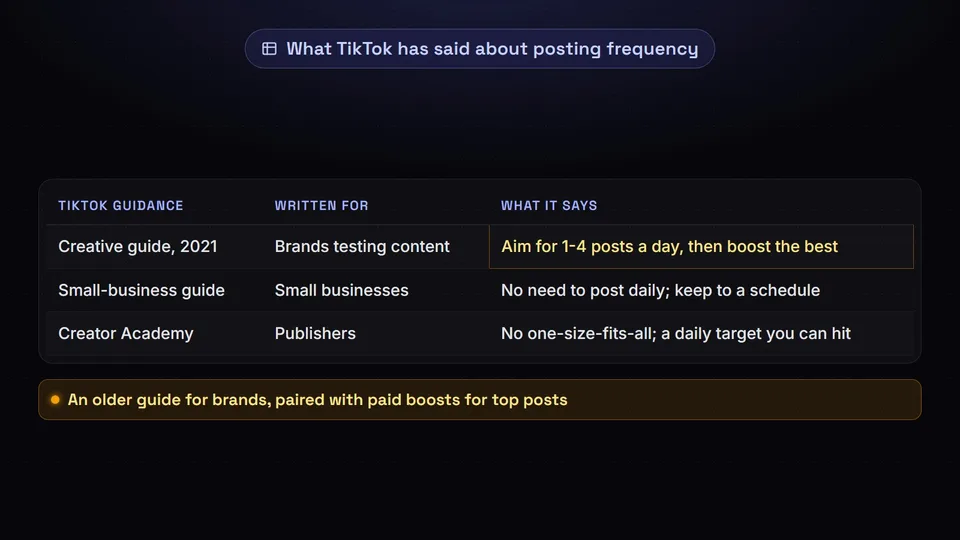
Posting frequency is where TikTok growth advice is most confident and least supported. Many guides quote an exact number of posts per day. TikTok itself has not settled on one.
Its own guidance changes with the audience it is written for. A 2021 TikTok For Business creative guide told brands to aim for one to four posts a day to test how different types of content are received, and suggested adding a paid boost to the best performers. A TikTok guide for small businesses says you do not need to post daily, but that a schedule you stick to helps build momentum. And a Creator Academy article on posting cadence says there is no one-size-fits-all answer: it notes that publishers in TikTok's success cases who posted several times a day saw more views and more exposure on the For You feed, then recommends setting a daily target you can consistently hit.
The common thread is consistency, not volume, which fits what TikTok has said about the feed: each video is ranked on how likely viewers are to respond to it, so a high cadence only helps if each video still holds attention. The real case for posting often while you are finding a format is that every post is another test. Once you have found one, a pace you can sustain matters more than a pace that impresses.
A testing approach instead of a number
- Pick the highest cadence you can hold for a month without the quality slipping. Be honest about bad weeks.
- Keep the format fixed while you test. If you change the videos and the frequency at the same time, you will not know which one moved the numbers.
- Track results per video, not in total. For each post, note views, finish rate and new followers. Totals rise with volume whatever happens to quality; per-video figures show whether the extra posts are diluting it.
- Change one thing at a time. After four weeks, step the cadence up or down and run another four. Keep the level at which new followers per video holds up.
- Post when your audience is around. TikTok lists the time a video was posted among the signals it takes into account. Our best time to post tool converts the commonly cited TikTok windows from your audience's time zone into your own clock as a starting point; after a few weeks, the Viewers tab in TikTok's analytics shows when your viewers were most active over the last seven days, which beats any general table.
Why most viral videos bring in so few followers
Most viral videos convert poorly into followers, and the reason is simple: the people who watched them wanted the video, not the account.
Consider how a video spreads. TikTok has said a viewer may be shown a video that has been well received by other people with similar interests, so a video that does well keeps travelling, and it reaches people whose interest is in that particular video, its joke, topic or sound, rather than in you. TikTok also deliberately mixes in videos outside a viewer's usual interests to keep feeds varied, so a big video lands in front of plenty of people who would never look for your subject.
Then look at what happens once they have watched. TikTok has said the For You feed generally will not show two videos in a row by the same creator, and that it does not recommend videos a person has already seen. The viewer finishes, enjoys it and is moved on to someone else. Your next video is not queued up behind the one that took off. If they want more of you, they have to act: tap follow, or visit your profile and decide there.
Whether they do comes down to one question: will this account give me more of what I just enjoyed? For most viral videos the honest answer is no, or not obviously. The video was a one-off, such as a trend, a lucky moment or a joke with no link to anything else on the profile, and a viewer who opens the profile and sees no connection has no reason to follow. Huge view counts and a flat follower line are not a contradiction; they are what a one-off video looks like in the numbers.
This is why chasing virality on its own is a weak growth strategy. TikTok's own cadence guidance talks about steady growth from a continuous stream of on-brand content, rather than relying on sporadic spikes of engagement. A video that takes off inside a clear format can be the best day an account ever has. One that takes off outside a format is mostly a day of views. For what makes videos spread in the first place, see our guide to going viral on TikTok and the viral trap.
How to turn a viral video into followers
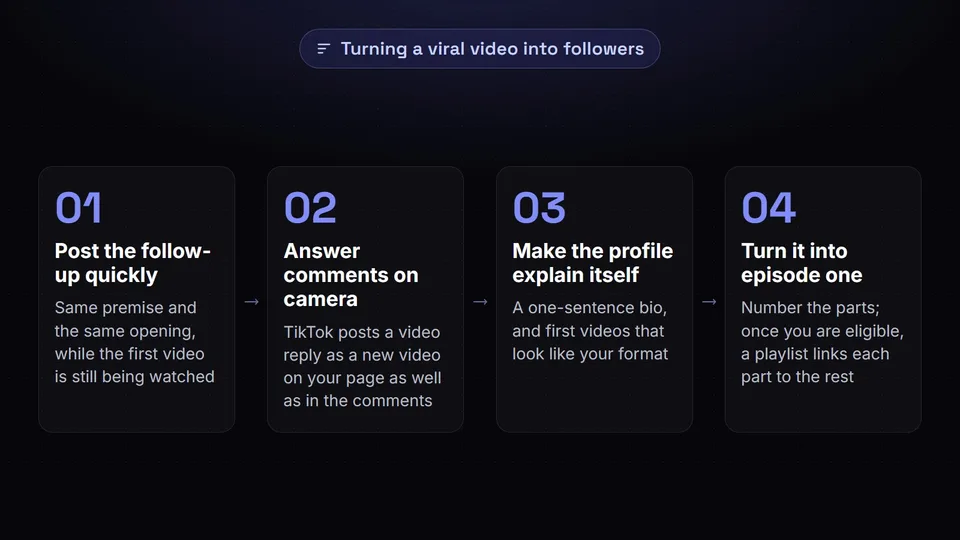
You cannot make every viewer of a big video follow, but you can make following an obvious choice for the people who genuinely enjoyed it. Interest in a single video fades, so the work is about speed and clarity.
- Post the follow-up quickly. Make a second video on the same premise while the first is still being watched: the next part, an answer to the most common question, or the same idea applied to something new. Keep the opening recognisably the same, so anyone who sees both knows they come from one account.
- Answer comments on camera. TikTok lets you reply to a comment with a video, and says the reply is published in the comments and posted as a new video on your page. The comments on a viral video are a ready-made list of what viewers want next, and answering them turns that list into content.
- Make your profile explain the account at a glance. Visitors who tap through are deciding whether to follow. Your bio should say what you post in one plain sentence, and the videos a visitor sees first should look like your format rather than a random assortment. TikTok's analytics count profile views, so you can see how many people got this far.
- Turn the video into episode one. If it can become a series, say so: number the follow-up on screen, number the captions and, once you are eligible, add the parts to a playlist so each one links to the rest. A series is the clearest answer to what a new viewer will get if they follow.
- Ask for the follow only when there is something to follow for. "Follow for part two" works when part two exists or is on its way. A bare "follow for more" on a one-off video tells the viewer nothing about what more means.
- Go LIVE if you are eligible. A LIVE soon after a video takes off gives curious viewers a way to meet you in real time. TikTok's guide to going LIVE suggests posting a video before you start, so viewers can join from the For You feed.
Two things to avoid. Do not try to repeat the success by bolting the viral video's sound or caption onto unrelated content; viewers who arrive expecting one thing and find another swipe away, which is the signal you least want to send. And do not abandon your format to chase the topic that took off unless you are prepared to make that topic your format.
Measure follows, not just views
Views tell you a video was shown. Follows tell you it worked. TikTok's analytics make the second easy to see if you look for it.
- New followers per video. The Your top posts section of TikTok's analytics can rank your best videos by new followers gained as well as by views and likes. Compare the list ranked by followers with the list ranked by views: the videos at the top of the first are the ones building the account.
- Follows per 1,000 views. Divide a video's new followers by its views and multiply by 1,000. It is a rough measure, but it lets you compare a video seen by a few hundred people with one seen by far more, and it shows plainly when a viral video brought in very few followers.
- Retention and finish rate. Open each video's analytics for retention, average watch time and Watched full video, and compare videos of similar length.
- Profile views. The Overview tab shows profile views for the period you choose. If profile views rise and follows do not, the profile is not doing its job.
- Returning viewers. The Viewers tab counts unique and returning viewers. A rising number of returning viewers is a good sign that the format is landing.
Engagement still matters, because comments and shares are part of how people react to a video. Our engagement rate calculator divides a post's likes, comments, saves and shares by your follower count and shows whether the result sits within the typical range for TikTok. Read it with care on a video that took off: most of its interactions came from people who do not follow you, so its rate will look exceptional even if it brought in few new followers. Put it next to that video's new-followers figure to see whether the attention turned into an audience.
For a fuller tour of what each TikTok metric means, see our guide to TikTok analytics.
Conclusion
If you want to know how to get a lot of followers on TikTok, it comes down to a few things done consistently. TikTok does not reward follower count directly, so followers come from videos that earn them: a format people can predict, videos they watch to the end, a pace you can keep, and a clear answer, when a video takes off, to what a new viewer gets by following. Most viral videos convert poorly because viewers wanted the video, not the account. Build the account so that wanting one video means wanting the next.
When you have a format and a cadence, SchedulifyX can schedule your posts, TikTok included, so each new episode goes out on the day you planned it.
