Social Media Slang Glossary: IYKYK, Ate, No Cap & More
SchedulifyX Team · August 28, 2026
Decode Gen Z and Gen Alpha social media slang. Learn the meaning of IYKYK, ate, no cap, and 30+ more terms, plus whether your brand should actually use them.
Navigating the ever-evolving landscape of the internet can sometimes feel like trying to translate an ancient, fast-paced language. If you have ever scrolled through TikTok, Instagram, or X (formerly Twitter) and felt completely lost in the comment section, you are not alone. The world of social media slang moves at lightning speed, driven by Gen Z, Gen Alpha, and internet subcultures that create and discard words in a matter of weeks.
For social media managers and marketers, understanding this digital lexicon is no longer optional—it is a critical component of community management and brand voice. Using the right slang can make your brand feel authentic, relatable, and culturally relevant. Using it incorrectly, however, can result in a viral disaster of cringe-inducing proportions.
While this guide covers the fun, cultural side of the internet, if you are looking for professional marketing terminology, be sure to check out our Social Media Marketing Glossary. But if you want to know how to connect with younger audiences, you are in the right place.
In this comprehensive guide, we will break down 34 of the most important slang terms dominating feeds today. We will explore their meanings, origins, practical examples, and—most importantly—give you a definitive verdict on whether your brand can use them without embarrassment.
Why Brands Need to Understand Social Media Slang

Before we dive into the dictionary, let's address the elephant in the room: why should a professional brand care about the ate slang meaning or what "rizz" is? The answer lies in audience connection.
Social media is inherently conversational. Traditional, stiff corporate speak rarely performs well on platforms like TikTok or Instagram Reels, where users expect entertainment, authenticity, and relatability. When a brand speaks the language of its audience, it breaks down the barrier between "corporation" and "consumer." It shows that the brand is actively participating in the culture, rather than just broadcasting advertisements into the void.
However, there is a fine line between being relatable and trying too hard. The phenomenon known as "silence, brand" occurs when a corporation misuses slang, appearing desperate to appeal to a younger demographic. This glossary is designed to help you navigate that minefield, ensuring you understand the nuances of each term before you hit publish on SchedulifyX.
The Ultimate Social Media Slang Glossary (2026 Edition)
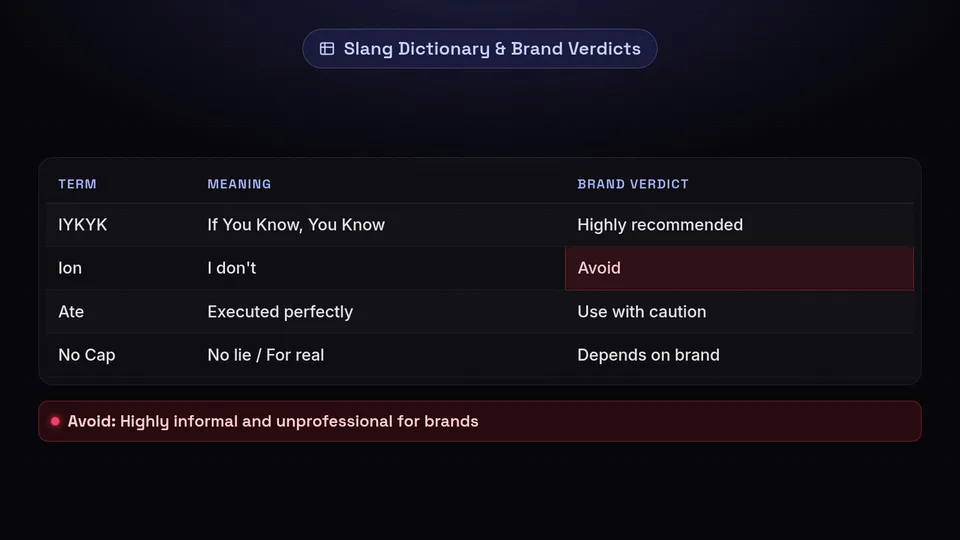
Here is your working glossary of current internet terminology. Bookmark this page, share it with your marketing team, and never feel out of the loop again.
1. IYKYK (If You Know, You Know)
Meaning: People frequently search for the ifykyk meaning when they feel left out of an inside joke. It stands for "If You Know, You Know." It signals that a post contains a hidden layer of context that only a specific group will understand.
Origin: Popularized heavily on Twitter and TikTok, often accompanying niche memes or relatable situational comedy.
Example: A photo of the dreaded spinning beach ball on a Mac with the caption: "The ultimate test of patience. #IYKYK"
Brand Verdict: Highly recommended. Brands can use this to build community by making industry-specific jokes that their core demographic will appreciate.
2. Ion
Meaning: If you are puzzled by the ion meaning in text messages, it is actually incredibly simple. It is an abbreviation/phonetic spelling of "I don't."
Origin: Rooted in African American Vernacular English (AAVE) and text-speak, it emerged as a faster way to type "I don't" on mobile devices.
Example: "Ion even know what to say about this new update."
Brand Verdict: Avoid. It is highly informal and specific to personal texting styles. A brand using "ion" will almost certainly come across as forced and unprofessional.
3. Ate (and Left No Crumbs)
Meaning: The ate slang meaning is used to describe someone who did something exceptionally well, looking great or performing flawlessly. If they "left no crumbs," it means they executed it perfectly with nothing lacking.
Origin: Originated in Black drag and LGBTQ+ ballroom culture before being adopted by mainstream Gen Z internet culture.
Example: "Our design team absolutely ate with this new website launch."
Brand Verdict: Use with caution. It can work for fashion, beauty, or highly stylized lifestyle brands. B2B software companies should probably steer clear.
4. No Cap
Meaning: To understand the no cap meaning, you must know that "cap" means a lie. Therefore, "no cap" means "no lie," "for real," or "I am telling the truth."
Origin: Deeply rooted in AAVE and hip-hop culture (specifically Atlanta hip-hop) before becoming a staple of Gen Z vocabulary.
Example: "This is the best cold brew in the city, no cap."
Brand Verdict: Use sparingly. It is very popular, but can feel a bit dated or "fellow kids" if used by a brand that doesn't natively have a youthful, edgy tone.
5. W and L
Meaning: "W" stands for Win, and "L" stands for Loss. They are used to quickly judge a situation, announcement, or action.
Origin: Sports culture and gaming culture (Twitch streams), where keeping score is literal.
Example: "Taking a massive W today with this new product drop." or "That customer service response was a rare L."
Brand Verdict: Safe to use. It is simple, universally understood, and a fun way to celebrate milestones or playfully acknowledge minor mistakes.
6. Rizz
Meaning: Short for "charisma." It refers to someone's ability to charm or flirt with others.
Origin: Coined by YouTube and Twitch streamer Kai Cenat, it became the Oxford Word of the Year in 2023 and remains heavily used.
Example: "The marketing intern has unspoken rizz."
Brand Verdict: Tread lightly. Because it has romantic/flirtatious undertones, it can be weird for a brand to use unless it's in a highly ironic, self-aware meme format.
7. Delulu
Meaning: A playful abbreviation of "delusional." It is often used to describe someone who holds unrealistic hopes, especially in dating or career aspirations.
Origin: K-pop fan communities (referring to fans who thought they would marry their idols) before spreading to mainstream TikTok.
Example: "Staying delulu until my startup hits a million in ARR."
Brand Verdict: Safe for fun brands. It's great for relatable, self-deprecating humor about the struggles of your target audience.
8. Mid
Meaning: Mediocre, average, or not very good. It is a slightly insulting way to say something is underwhelming.
Origin: AAVE and TikTok audio trends.
Example: "Honestly, their new burger is kind of mid compared to the old recipe."
Brand Verdict: Use carefully. You can use it to playfully roast a competitor (if your brand voice is snarky, like Wendy's), but don't use it to describe your own products.
9. Understood the Assignment
Meaning: When someone perfectly executes a task, meets expectations seamlessly, or dresses perfectly for an occasion.
Origin: AAVE, popularized globally by a viral TikTok song by Tay Money.
Example: "Our graphic designer completely understood the assignment with this campaign."
Brand Verdict: Highly recommended. It is a fantastic, positive phrase to highlight great work, user-generated content, or a successful product.
10. Bet
Meaning: An expression of agreement, approval, or confirmation. It is synonymous with "okay," "sounds good," or "it's on."
Origin: AAVE and 90s hip-hop culture.
Example: User: "You should bring back the pumpkin spice flavor!" Brand: "Bet."
Brand Verdict: Safe. It is a snappy, confident way to reply to customers in the comment section.
11. Sus
Meaning: Short for "suspicious" or "suspect." Used when something seems off, fake, or untrustworthy.
Origin: The video game Among Us made it a global phenomenon during the 2020 pandemic.
Example: "An email asking for your password? That's highly sus."
Brand Verdict: Safe. Great for cybersecurity brands, educational content, or warning customers about scams.
12. Bussin'
Meaning: Extremely good, typically used to describe delicious food.
Origin: AAVE.
Example: "This new taco recipe is bussin'."
Brand Verdict: Avoid. Unless you are a food brand with a very specific, youthful voice, this often crosses the line into cringe territory when used corporately.
13. Rent-Free
Meaning: When you can't stop thinking about something (a song, a video, a person), it is "living rent-free in your head."
Origin: Often attributed to an Ann Landers advice column, but popularized by modern internet meme culture.
Example: "This transition video is living rent-free in our heads today."
Brand Verdict: Highly recommended. A perfect caption for catchy videos, beautiful product shots, or funny memes.
14. Main Character Energy
Meaning: Acting like the star of the movie of your own life. It implies confidence, romanticizing your daily routine, and standing out.
Origin: TikTok trends where users romanticized their lives with cinematic music.
Example: "Bring main character energy to your next Zoom meeting with our new blazer."
Brand Verdict: Safe. Excellent for fashion, lifestyle, travel, and beauty brands promoting self-confidence.
15. Vibe Check
Meaning: Assessing someone's mood, energy, or the general atmosphere of a situation. Passing a vibe check means you have good, positive energy.
Origin: Tumblr and Twitter.
Example: "Time for a Monday morning vibe check. How much coffee have you had?"
Brand Verdict: Safe. A great way to encourage engagement and start conversations in the comments.
16. Slay
Meaning: To do something exceptionally well, similar to "ate."
Origin: Black LGBTQ+ ballroom culture in the 1970s and 80s.
Example: "You are going to slay that presentation today."
Brand Verdict: Use with caution. It has become very mainstream, but can feel forced if it doesn't align with your brand's usual tone.
17. Tea (Spill the Tea)
Meaning: Gossip, drama, or exclusive information.
Origin: Black drag culture (originally "T" for truth).
Example: "We are spilling the tea on our upcoming Black Friday discounts."
Brand Verdict: Safe. A fun way to announce product leaks, behind-the-scenes info, or industry news.
18. Salty
Meaning: Being unnecessarily upset, bitter, or angry over something minor.
Origin: Slang dating back to the 1930s, revived by modern internet culture.
Example: "Don't be salty because you missed the early bird pricing!"
Brand Verdict: Safe. Good for playful banter.
19. Flex
Meaning: To show off or boast about something.
Origin: 1990s hip-hop culture.
Example: "Not to flex, but our new software update just doubled processing speeds."
Brand Verdict: Safe. A great way to frame self-promotional posts so they feel less like traditional ads.
20. Cheugy
Meaning: Outdated, trying too hard, or associated with early 2010s millennial trends (like "Live Laugh Love" signs).
Origin: Coined by a Gen Z high schooler and popularized on TikTok in 2021.
Example: "Are skinny jeans cheugy now? Asking for a friend."
Brand Verdict: Avoid. It is already becoming a bit dated itself, and insulting your audience's taste is rarely a good marketing strategy.
21. Simp
Meaning: Someone who does way too much for a person they like, often at the expense of their own dignity.
Origin: West Coast hip-hop in the 1980s and 90s, heavily popularized by Twitch and TikTok.
Example: "We are officially simping over this new color palette."
Brand Verdict: Use with caution. It can be funny in a self-deprecating way, but ensure you understand the context.
22. Yeet
Meaning: To throw something with force, or an exclamation of excitement.
Origin: A 2014 Vine video.
Example: "Yeeting our old pricing model out the window!"
Brand Verdict: Safe, but dated. It's a bit older, so it might feel like you are behind the times.
23. GOAT
Meaning: Greatest Of All Time.
Origin: LL Cool J's 2000 album title, widely used in sports.
Example: "Our customer support team is the absolute GOAT."
Brand Verdict: Highly recommended. Universally understood and positive.
24. Extra
Meaning: Over the top, dramatic, or excessive.
Origin: AAVE.
Example: "Yes, we added a glitter finish to the packaging. We know we're being extra."
Brand Verdict: Safe. Great for leaning into bold brand choices.
25. Lowkey / Highkey
Meaning: Lowkey means secretly, mildly, or quietly. Highkey means openly, strongly, or proudly.
Origin: Hip-hop culture.
Example: "We are highkey obsessed with this user-generated content. Lowkey might make it our new ad."
Brand Verdict: Safe. Very common conversational filler that makes text feel natural.
26. Drip
Meaning: A highly fashionable outfit or strong sense of style.
Origin: 2000s Atlanta hip-hop.
Example: "Check out the drip on our new limited-edition merch."
Brand Verdict: Safe for fashion/apparel. B2B brands should avoid.
27. Based
Meaning: Being yourself and not caring what others think; an expression of agreement or recognizing something as fundamentally true.
Origin: Rapper Lil B.
Example: "Our CEO's take on remote work is incredibly based."
Brand Verdict: Use with caution. It has some political subculture ties, so be sure of the context.
28. Touch Grass
Meaning: A reality check. Telling someone to "touch grass" means they have been online too long and need to reconnect with the real world.
Origin: Twitter and gaming communities.
Example: "Log off, shut the laptop, and go touch grass this weekend!"
Brand Verdict: Safe. Great for wellness, outdoor, or travel brands promoting offline time.
29. Ratio
Meaning: When a reply to a post gets more likes than the original post, usually implying the original post was bad or wrong.
Origin: Twitter.
Example: "Don't make us ratio you in the comments."
Brand Verdict: Avoid. It is inherently combative and usually involves negative sentiment.
30. Slaps
Meaning: Exceptionally good or awesome (originally used for music, now used for everything).
Origin: Bay Area hip-hop.
Example: "This new Spotify playlist we curated absolutely slaps."
Brand Verdict: Safe. Fun and casual.
31. Valid
Meaning: Understandable, acceptable, or making a good point.
Origin: General vocabulary adapted into Gen Z slang.
Example: "You want more integrations? Valid. We are working on it."
Brand Verdict: Highly recommended. A great, empathetic way to reply to customer feedback.
32. ICYMI
Meaning: In Case You Missed It.
Origin: Early internet forums and Twitter.
Example: "ICYMI: We just launched our biggest feature of the year."
Brand Verdict: Highly recommended. A staple of social media marketing.
33. Stan
Meaning: An overzealous or obsessive fan, now used as a verb meaning to strongly support someone or something.
Origin: Eminem's 2000 song "Stan."
Example: "We have no choice but to stan this incredible review."
Brand Verdict: Safe. Good for hyping up partners, creators, or loyal customers.
34. Math is Mathing
Meaning: When something makes perfect sense or adds up logically. (Conversely, "the math is not mathing" means something is confusing or suspicious).
Origin: TikTok and Twitter.
Example: "High quality + affordable price = the math is mathing."
Brand Verdict: Safe. A clever way to highlight value propositions.
How to Use Social Media Slang as a Brand (Without the Cringe)
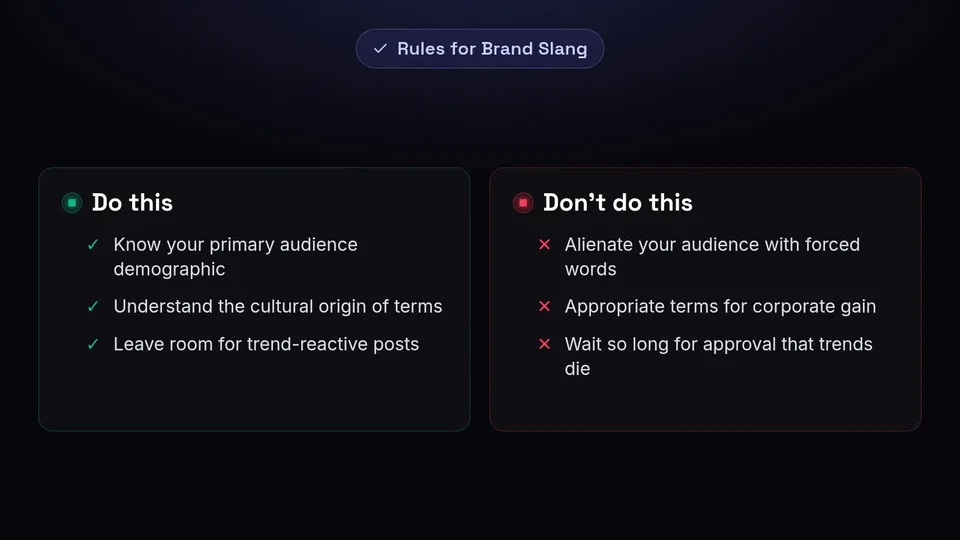
Now that you are equipped with the vocabulary of the modern internet, how do you actually use it? Incorporating social media slang into your brand voice requires strategy. Here are the golden rules:
- Know Your Audience: If your primary demographic is retirees, using the ate slang meaning in a caption will alienate them. If your audience is Gen Z, failing to use their language might make you seem out of touch.
- Understand the Origin: Much of internet slang originates from AAVE (African American Vernacular English) or the LGBTQ+ community. Brands must be mindful not to appropriate or misuse these terms in ways that are disrespectful or purely for corporate gain. Context is everything.
- Don't Force It: If a word doesn't fit your established brand voice, don't use it. Wendy's can get away with roasting people and using slang because they built that persona over a decade. A heritage luxury bank cannot.
- Timing is Everything: Slang evolves rapidly. By the time a corporation gets a meme approved by legal, the trend might be dead. Agility is key. Using SchedulifyX can help you plan your content, but always leave room in your calendar for real-time, trend-reactive posts.
Conclusion: Keep Your Brand Voice Authentic
Mastering the internet's ever-changing dictionary is a continuous process. Whether you are trying to figure out the no cap meaning or deciding if your latest campaign "understood the assignment," the most important thing is to remain authentic to your brand's core identity.
Social media is about connection. When used correctly, slang can be a powerful tool to humanize your brand, participate in cultural moments, and drive deeper engagement with your community. Just remember to read the room, understand the context, and never try too hard.
Ready to put your new vocabulary to the test? Streamline your social media strategy, plan your culturally relevant content, and never miss a trend with SchedulifyX. Our AI-powered platform helps you schedule, analyze, and optimize your posts across all platforms. Sign up today and take your social media presence from mid to GOAT!