Evaluate Buffer Alternatives Against Your Workflow | SchedulifyX
Looking for Buffer alternatives? Learn how to evaluate billing models, team scaling, and approval workflows against your specific social media operations.
SchedulifyX is the AI-powered social media command center built for creators, businesses, and agencies. Schedule posts across 10+ platforms, generate content with 9 specialized AI agents, collaborate with your team using approval workflows, analyze performance with deep analytics, and manage all social engagement from a unified inbox. Trusted by professionals worldwide — free plan available, paid plans from
When your social media operations begin to scale, the tools that once felt intuitive can suddenly feel restrictive. If you are currently researching buffer alternatives: how to evaluate them against your own workflow is the most critical question you can ask. Transitioning to a new platform is not merely about comparing feature checklists; it is about mapping a tool's underlying philosophy to your team's daily operations.
As of September 2026, the social media management landscape is highly fragmented. Some platforms cater explicitly to visual-first creators, others focus heavily on enterprise governance, and newer platforms like SchedulifyX integrate native AI agents to accelerate production. To make an informed decision, you must look beyond the marketing copy and rigorously assess how a platform's billing mechanics, collaboration structures, and publishing workflows align with your reality.
Recent Developments
Understanding Buffer's 2026 Evolution
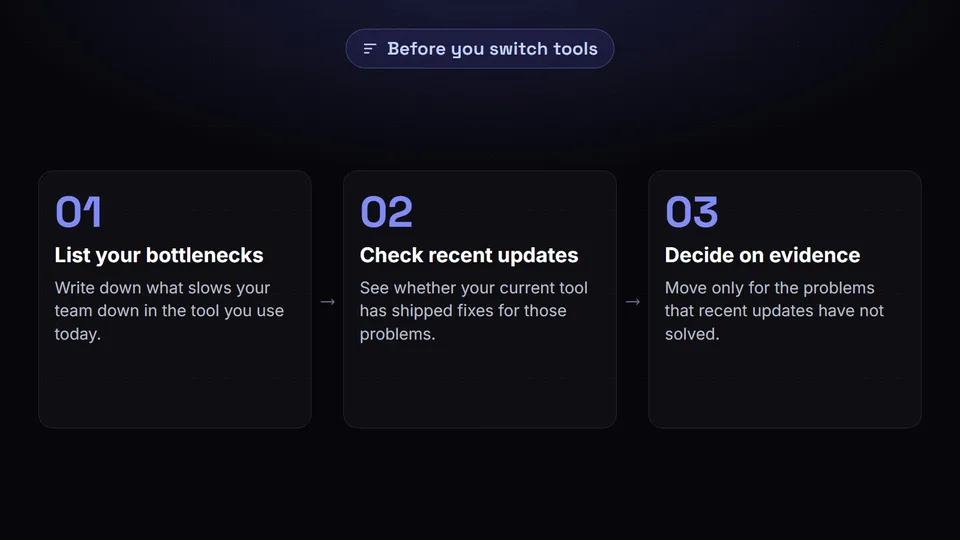
To evaluate alternatives effectively, it is essential to understand where Buffer currently stands. Throughout 2026, Buffer has introduced several workflow-centric updates. If these updates do not resolve your current bottlenecks, it is a strong indicator that you need to evaluate other options.
Custom Templates
Announced on July 22, 2026, by Brandon Lucas Green, Buffer now allows teams to create templates from scratch or convert existing posts via a dedicated Create -> Templates tab.
Community Permissions
Introduced on July 20, 2026, this update provides configurable access levels for team administrators, addressing previous limitations in team management.
X Mentions Tracking
As of July 13, 2026, Mike Eckstein announced a dedicated Mentions tab in Buffer Community to view and respond to X/Twitter mentions directly.
Draft Management
Also on July 13, 2026, Buffer enabled users to view and open draft posts directly from the Calendar interface, streamlining the review process.
Insights & Buffer Home
Following the April 14 launch of a consolidated "Insights" view, Buffer introduced "Buffer Home" on June 24, 2026, to centralise posting activity and channel status.
Billing Shifts
Noted in late 2025 evaluations, Buffer retired its standalone Agency tier in favour of volume discounts per connected channel, whilst moving AI tools to the free tier.
If your team requires robust team collaboration beyond these recent additions, or if the shift to per-channel billing has inflated your software costs, it is time to establish your evaluation criteria.
Evaluation Criteria
How to Evaluate Alternatives Against Your Workflow
When assessing Buffer alternatives, you must verify vendor claims directly. Pricing, plan names, and feature matrices change rapidly. We recommend checking the vendors' own current pricing and feature pages (as of September 2026) to confirm the following workflow criteria.
Analyse Billing Mechanics: Per-Channel vs. Per-Brand
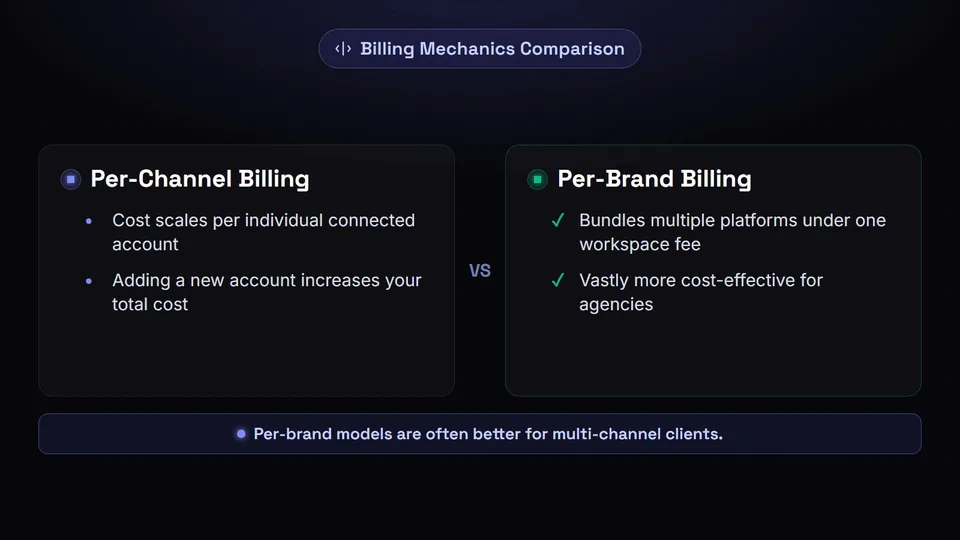
Check vendor pricing pages carefully to determine whether billing scales per individual connected account or per brand profile set. Under a per-channel model (like Buffer's current structure), adding a new TikTok or YouTube account increases your total cost. Per-brand models often bundle multiple platforms under one "workspace" fee, which is vastly more cost-effective for agencies managing multi-channel clients.
Assess Bulk Publishing and Evergreen Recycling
If your strategy relies on evergreen content, check Publer's current pricing and feature pages to verify their bulk CSV upload tools, content recycling capabilities, and free tier account limits. Evaluate if you need category-based recycling—where posts are queued by topic rather than strict chronological order. For this specific workflow, check SocialBee's current feature pages to evaluate their evergreen post recycling and content category queues.
Evaluate Visual Planning and Grid Previews
For brands heavily invested in Instagram aesthetics, visual planning is paramount. Check Later's current pricing and feature pages to evaluate their drag-and-drop content calendar scheduling, visual feed previews, and link-in-bio page customisation. Ensure the visual planner syncs seamlessly with your media library.
Review Agency and Multi-Stakeholder Approvals
If you require client sign-off before publishing, a basic draft folder is insufficient. Check Planable's current pricing and feature pages to review their internal and external client sign-off workflows and team permission tiers. A robust client portal can drastically reduce email back-and-forth.
Verify Competitor Tracking and Analytics Depth
Basic engagement metrics are standard, but competitive benchmarking is not. Check Metricool's current pricing and feature pages to assess their benchmarking depth, competitor tracking features, and multi-profile structures. Compare this against your need for integrated analytics.
Verification Warning
Software pricing and feature limits are subject to change without notice. Always verify the current capabilities on the vendor's official website before committing to a migration.
Scaling Operations
Evaluating Team Scaling and Governance

As workflows mature, the focus shifts from simply publishing content to managing the people who create it. This requires evaluating platforms based on scale and security.
✔ Mid-Market Team Scaling
✗ Enterprise Governance Requirements
- High-compliance industries require strict access controls.
- Check Hootsuite and Sprout Social's current pricing pages to evaluate enterprise access controls and social listening capabilities.
- Be aware that these platforms typically utilise strict per-seat billing models that can become cost-prohibitive for smaller teams.
For highly technical teams with strict data sovereignty requirements, SaaS might not be the right path at all. In these specific workflows, you should check Postiz's official repository and documentation to evaluate open-source self-hosting installation requirements, direct OAuth authentication, and API integrations.
Ready to streamline your workflow?
Discover how SchedulifyX integrates AI-driven scheduling with comprehensive team collaboration tools.
Explore SchedulifyX Today →The SchedulifyX Approach
Where SchedulifyX Fits Into Your Evaluation

When exploring Buffer alternatives: how to evaluate them against your own workflow ultimately leads to identifying your primary bottlenecks. SchedulifyX is engineered for teams whose primary bottlenecks are content ideation and multi-platform distribution.
SchedulifyX provides a unified workspace that bridges the gap between creation and distribution. Instead of relying on external generative tools, teams can utilise the AI Studio to draft, refine, and adapt content for different networks instantly.
- Advanced Scheduling: Comprehensive scheduling capabilities that go beyond simple time-slotting, allowing for nuanced campaign rollouts.
- Unified Content Calendar: A highly visual interface for tracking campaigns across all 10+ supported platforms.
- Seamless Integrations: Deep integrations with your existing asset management workflows.
- Brand Consistency: Options for white label reporting to maintain agency branding when presenting analytics to clients.
By centralising these functions, SchedulifyX reduces the friction often experienced when moving between disparate drafting, approval, and publishing tools.
Honest Comparison
Where Competitors Are Stronger
No single platform is the perfect solution for every conceivable workflow. A thorough evaluation requires acknowledging where other tools excel.
Where SchedulifyX Excels
SchedulifyX is built for speed and intelligent automation. If your workflow demands rapid content generation, multi-platform adaptation via AI agents, and streamlined team collaboration, our platform offers a highly cohesive environment. It is particularly strong for teams looking to consolidate their generative AI tools and their social media schedulers into a single, unified dashboard.
Where Others Lead
We believe in transparent evaluations. If your workflow requires deep, enterprise-grade social listening and brand sentiment analysis, you should evaluate Hootsuite or Sprout Social. If your organisation mandates absolute data sovereignty and requires on-premise deployment, an open-source solution like Postiz is fundamentally stronger. Finally, if your sole focus is highly complex, visual-first grid planning for a single platform, tools explicitly designed for that niche may offer deeper visual customisation.
Pro Tip: Do not pay for enterprise features you will not use. If social listening is not currently part of your daily workflow, avoid platforms that bundle it into high-tier, per-seat pricing models.
Summary
Final Thoughts on Evaluating Alternatives
The transition away from your current scheduling tool should be driven by workflow friction, not just feature envy. Whether you are frustrated by Buffer's shift to per-channel billing, require deeper engagement tools, or need a more robust client portal, your evaluation must be grounded in your daily operational realities.
| Workflow Requirement | Key Evaluation Action (Check Vendor Pages) |
|---|---|
| High-Volume Evergreen Content | Verify bulk CSV limits and category queuing. |
| Multi-Client Agency Management | Assess per-brand vs. per-channel billing mechanics. |
| Strict Client Approvals | Review external stakeholder permission tiers. |
| AI-Driven Ideation & Posting | Evaluate native AI integration vs. third-party reliance. |
Remember that the software landscape evolves rapidly. The features and pricing models discussed here reflect the market as of September 2026. Always confirm the latest details on the respective vendors' websites to ensure the tool you choose perfectly aligns with your team's workflow.
The SchedulifyX Verdict
If your evaluation reveals that your workflow is bogged down by manual content adaptation and fragmented collaboration, SchedulifyX offers a modern, AI-integrated alternative designed to accelerate your social media operations across 10+ platforms.
Sources
Facts checked against the sources below on September 1, 2026.
Get started free — no credit card required.