The Case for Fewer, Better Posts: Quality Cadence Economics
SchedulifyX Team · November 2, 2026
Discover why the modern social media landscape demands a 'post less quality more' approach. Learn platform-specific cadence strategies to boost engagement.
For years, the dominant advice in social media marketing was simply to publish as much as possible. Brands and creators flooded feeds with daily, sometimes hourly, updates in a relentless pursuit of visibility. However, the digital landscape has fundamentally shifted. Today, the most effective approach to digital visibility is rooted in a much more deliberate philosophy: post less quality more. This shift is not merely a preference; it is a direct response to how modern platform algorithms operate and how audience expectations have evolved.
Understanding the economics of your posting schedule means recognising that every piece of content requires an investment of time, resources, and audience attention. When you flood the market with low-effort updates, you dilute your brand equity. Conversely, investing your resources into fewer, highly polished, and deeply insightful posts yields a significantly higher return on investment. In the ongoing debate of quality vs quantity social, quality has definitively won the algorithmic war.
The New Algorithmic Reality
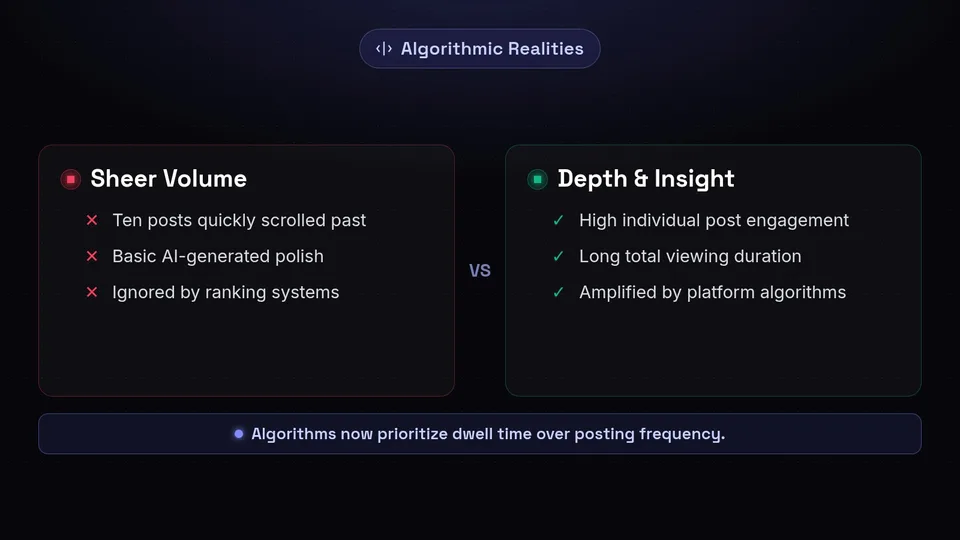
To understand why a deliberate cadence strategy is essential, we must look at how major social platforms evaluate and rank content. As of early 2026, it is well documented that major social platform ranking systems no longer reward sheer posting frequency. Instead, they prioritise individual post engagement and total viewing duration. An algorithm is much more likely to amplify a single post that keeps users reading, commenting, and lingering on the platform than ten posts that users quickly scroll past.
Furthermore, the widespread adoption of generative AI tools has permanently altered the content landscape. By early 2025, it became clear that AI had raised the baseline for content quality across all social channels. Basic polish, correct grammar, and standard formatting are no longer competitive advantages; they are merely the baseline requirements to participate. Because anyone can generate a high volume of average content instantly, strategy must now focus entirely on depth of insight and relevance over posting volume. If your content does not offer unique value or deep expertise, the algorithms will simply ignore it in favour of content that does.
Platform-Specific Cadence Strategy
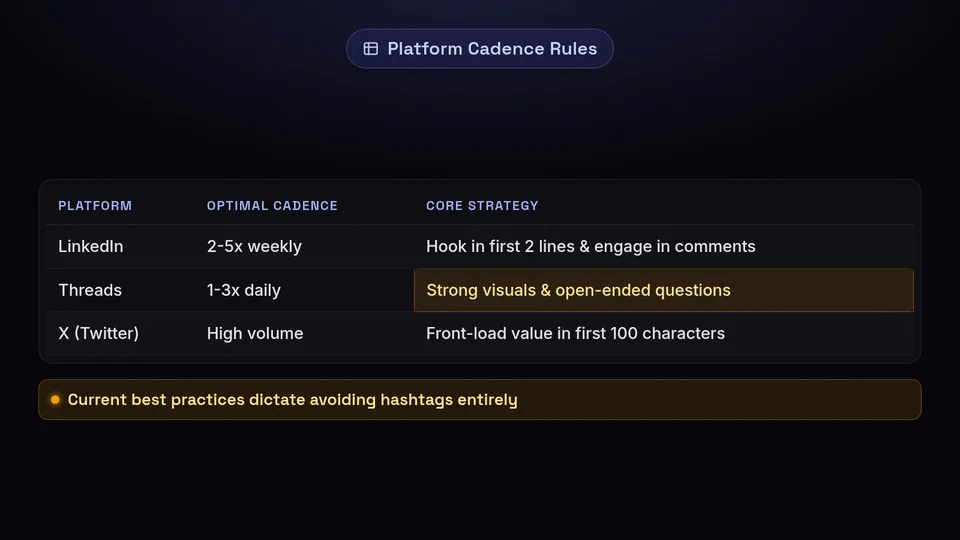
Adopting a 'post less quality more' mindset does not mean abandoning consistency. Rather, it means tailoring your cadence strategy to the specific economic demands and user behaviours of each platform. What constitutes optimal frequency on a professional networking site differs vastly from a micro-blogging feed.
LinkedIn: The Professional Standard
On LinkedIn, the explicit rule among successful creators is to post less, quality more. The optimal posting cadence on this platform is currently identified as 2 to 5 times per week. Because the LinkedIn algorithm heavily favours dwell time and meaningful conversation, publishing multiple times a day often cannibalises your own reach.
To maximise the impact of these infrequent posts, creators must hook readers early—specifically within the first two lines before the 'see more' prompt. Maintaining an authentic yet professional tone is critical. The most successful formats rely on case-study stories that demonstrate real-world expertise. Finally, the economics of a LinkedIn post do not end at publication; creators must engage directly in niche comment threads to signal to the algorithm that the post is fostering an active, valuable discussion.
Micro-Blogging: Threads and X (Twitter)
While micro-blogging platforms tolerate a higher volume than LinkedIn, the principles of quality and strict formatting still apply. On Threads, the recommended cadence strategy is 1 to 3 times daily to maintain reach. Interestingly, current best practices for Threads dictate avoiding hashtags entirely. Instead, creators should focus on using strong visuals and open-ended questions to drive immediate interaction. Crucially, responding to comments within the first hour of posting is vital for initial algorithmic traction.
On X (formerly Twitter), brevity and immediate value are the primary economic drivers. Posts should ideally be concise, sitting between 200 and 250 characters. Because attention spans are exceptionally short here, you must front-load the core value of your message within the first 100 characters. Unlike older strategies that relied on hashtag stuffing, modern X strategies recommend limiting hashtags to just 1 or 2 per post, and consistently attaching media to increase the physical footprint of the post in the feed.
Visual Quality Economics: The Instagram Example
The concept of 'quality' extends beyond the written word; it applies heavily to the technical execution of visual assets. Instagram provides a perfect case study of why technical quality optimisation is a non-negotiable part of your cadence strategy. Many creators spend hours editing photos only to find them blurry or pixelated upon upload. This occurs because of Instagram's automatic, server-side lossy re-encoding pass.
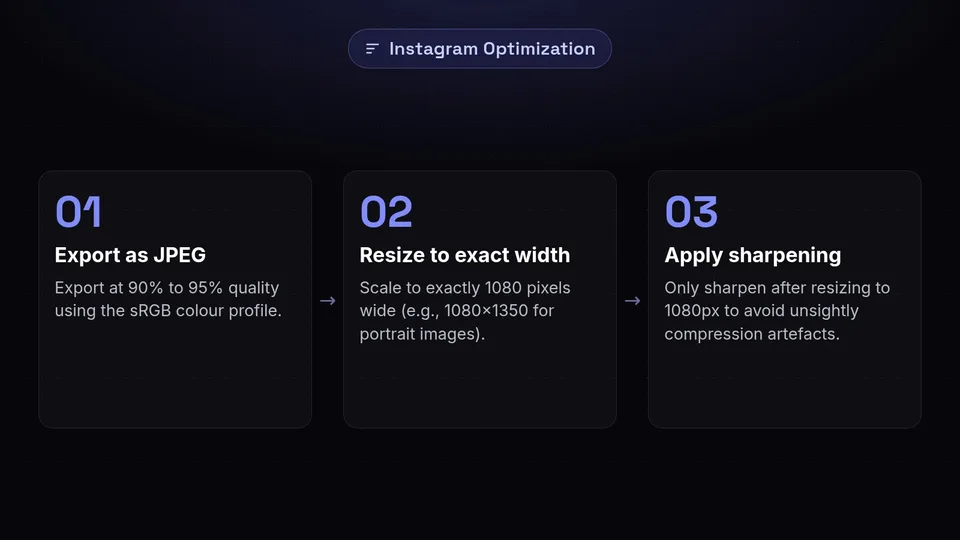
To preserve visual quality and avoid aggressive compression, you must prepare your assets to match the platform's exact technical requirements before uploading. Instagram automatically converts uploaded images to JPEG internally. Therefore, uploading pre-optimised JPEGs—specifically exported at 90% to 95% quality in the sRGB colour profile—reduces the need for the platform's servers to aggressively compress your files.
Exact Dimensions and Sharpening
The mechanism for avoiding the lossy re-encoding pass is to resize your photos to exactly 1080 pixels wide prior to upload. The exact target feed dimensions are:
- 1080 x 1080 pixels for square images
- 1080 x 1350 pixels for portrait (4:5 aspect ratio) images
- 1080 x 1440 pixels for standard 3:4 images
- 1080 x 1920 pixels for Stories and Reels
A critical technical detail often overlooked in the quality vs quantity social debate is the sharpening process. When preparing these images, you should apply image sharpening only after resizing the image to its final 1080-pixel width, rather than before. Sharpening a large image and then scaling it down introduces visual noise, which Instagram's compression algorithms will attempt to crush, resulting in unsightly compression artefacts. By controlling these technical variables, you ensure that the fewer posts you do publish look exceptionally professional.
Orchestrating Your Cadence Strategy

Transitioning to a model where you post less quality more requires discipline. It is easy to fall back into the habit of posting daily just to feel productive. However, the data and algorithmic behaviours clearly show that fewer, highly optimised, deeply insightful posts will generate far more meaningful engagement and brand loyalty than a high volume of mediocre content.
By understanding the economics of attention, respecting platform-specific rules, and ensuring technical perfection in your media assets, you can build a sustainable and highly effective digital presence. Managing this deliberate, cross-platform scheduling requires the right infrastructure. SchedulifyX empowers you to meticulously plan your cadence strategy, ensuring that every piece of content is perfectly timed and technically optimised for its respective platform. Stop chasing volume, start focusing on value, and let SchedulifyX handle the orchestration of your premium content.
Sources
Facts checked against the sources below on November 2, 2026.
- Qf Studio Social Media Post — skillsdirectory.com
- Alekspetrov Navigator Social Media Post — skills.pub
- Qf Studio Social Media Post — typingmind.com
- Why Instagram Ruins Photo Quality — aspectfitstudio.com
- Why Instagram Ruins Your Photo Quality And How To Fix It 2m3c — dev.to
- Why Content Quality Will Matter More Than Quantity In 2026 — velocitas.com
- Quality Vs Quantity — wearesculpt.com
