Platform Diversification: How Many Social Platforms Can One Person Run?
SchedulifyX Team · October 22, 2026
Struggling to manage every network? Discover exactly how many social platforms one person can run effectively without being spread too thin socially.
In the modern digital landscape, the pressure to maintain a ubiquitous online presence is immense. When launching a brand, building a personal profile, or managing digital marketing for a growing enterprise, the initial instinct is often to plant a flag on every available network. From short-form video applications to professional networking sites, text-based micro-blogging platforms, and visually driven image boards, the sheer volume of available channels is staggering. However, for the solo entrepreneur, the independent creator, or the single-person marketing department, this omnipresence is rarely sustainable. The critical question that must be addressed before embarking on any digital strategy is: how many social platforms can one person realistically and effectively manage?
Attempting to conquer every digital space simultaneously frequently leads to a scenario where a brand is spread too thin social media-wise. The quality of content degrades, audience engagement plummets, and the individual responsible for the output inevitably faces severe creative burnout. Instead of a fragmented approach, success in today's algorithmic environment requires strategic platform diversification and the intelligent selection of focus platforms. In this comprehensive guide, we will explore the mechanics of solo social media management, the dangers of over-extension, and a practical framework for determining exactly how many networks you can run well.
The Myth of Omnipresence and the Solo Reality
The concept of omnichannel marketing—providing a seamless and consistent brand experience across all possible channels—is a powerful strategy. It is also a strategy originally designed for large corporations with dedicated, multi-disciplinary teams. A global consumer brand might employ a team of videographers for short-form video, a team of copywriters for professional networks, and a team of community managers to handle customer service inquiries across various messaging applications. When a solo operator attempts to replicate this model, the foundational logic breaks down.
The Cognitive Cost of Context Switching
Managing multiple social networks is not merely a matter of copying and pasting a single piece of content across different input fields. Each platform possesses its own distinct culture, unwritten rules, algorithmic preferences, and audience expectations. Transitioning from the professional, value-driven tone required for a business network to the fast-paced, trend-reliant, and highly visual environment of a short-form video platform requires a significant cognitive shift.
Psychologically, this is known as context switching. Every time an individual shifts their focus from one completely different task or environment to another, there is a cognitive penalty. The brain requires time to adjust to the new set of rules and expectations. For a solo social media manager, constantly jumping between the distinct cultures of five or six different networks drains mental energy rapidly, leaving less capacity for actual creative generation and strategic thinking.
The Illusion of the Universal Post
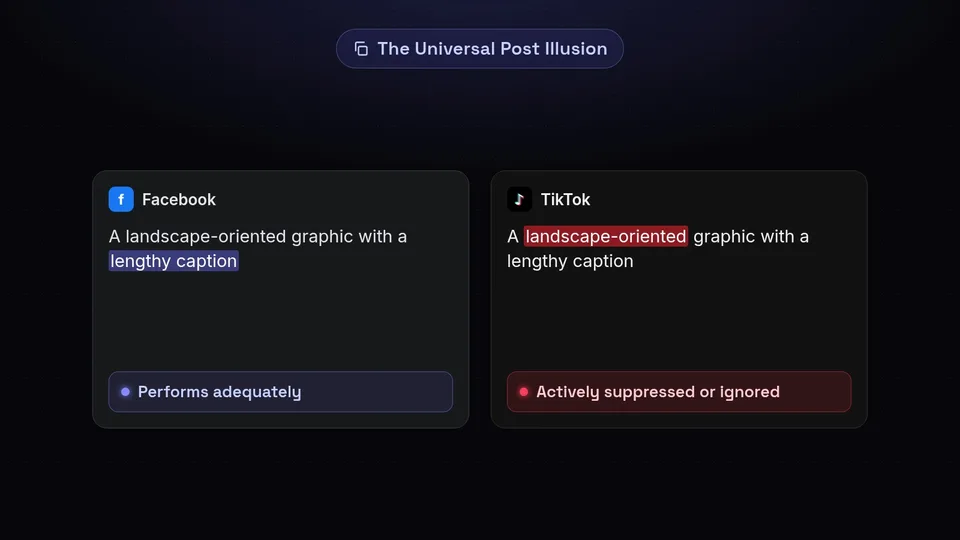
Another driving factor behind the myth of omnipresence is the mistaken belief in the 'universal post'—a single piece of content that performs equally well everywhere. The mechanics of modern social media algorithms actively punish this approach. A landscape-oriented graphic with a lengthy caption might perform adequately on a traditional feed-based network, but it will be actively suppressed or ignored on a platform designed for vertical, full-screen video. Attempting to force native content from one platform onto another without adaptation signals to the algorithm—and the audience—that the brand does not truly understand or value that specific community.
Answering the Core Question: How Many Social Platforms?
So, exactly how many social platforms can one person run well? While the answer depends heavily on the individual's skillset, the nature of the business, and the available tools, a realistic and sustainable number for a solo operator producing high-quality, native content is generally between one and three.
This is not an arbitrary limitation; it is a calculation based on the fundamental mechanics of content creation and community management. To understand why one to three platforms is the optimal range, we must break down the actual time and resource requirements of running a single platform successfully.
The Hidden Demands of a Single Platform
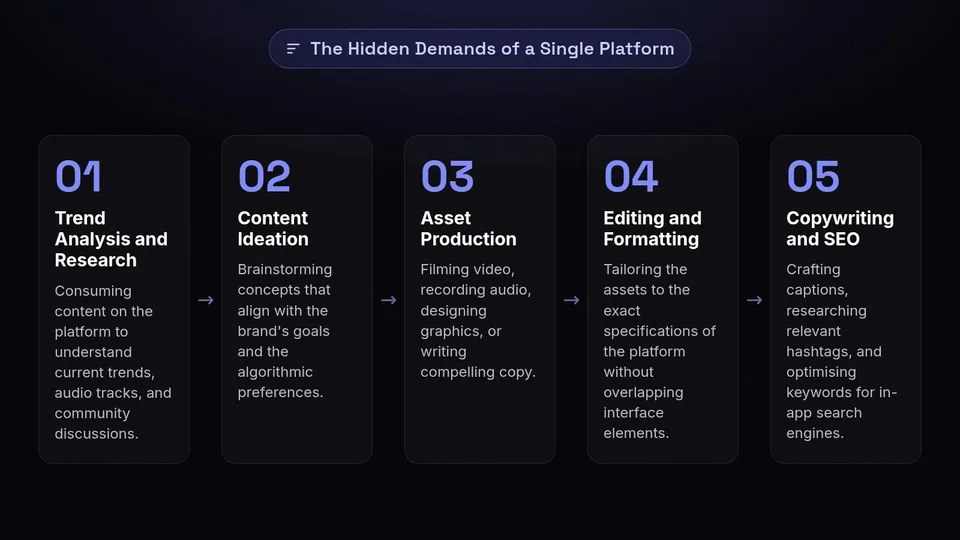
Operating a social media channel effectively involves far more than simply pressing 'publish'. A robust strategy for a single platform requires:
- Trend Analysis and Research: Spending time consuming content on the platform to understand current trends, audio tracks, formats, and community discussions.
- Content Ideation: Brainstorming concepts that align with both the brand's goals and the platform's current algorithmic preferences.
- Asset Production: Filming video, recording audio, designing graphics, or writing compelling copy.
- Editing and Formatting: Tailoring the assets to the exact specifications of the platform (e.g., ensuring text does not overlap with native app interface elements).
- Copywriting and SEO: Crafting captions, researching relevant hashtags, and optimising keywords for in-app search engines.
- Community Engagement: Responding to comments, engaging with followers' content, and participating in broader industry conversations.
- Analytics Review: Analysing performance metrics to understand what worked, what failed, and how to iterate for the future.
When you multiply this workflow by three, four, or five different platforms, it becomes mathematically impossible for one person to execute every step to a high standard within a standard working week. The inevitable result is that corners are cut, leading to the precise situation where a brand is spread too thin social media-wise.
Warning Signs You Are Spread Too Thin Social

Recognising the symptoms of over-extension is crucial for preserving both brand integrity and personal well-being. When a solo operator attempts to manage too many networks, several distinct mechanical and strategic failures begin to emerge. If you observe these warning signs in your own digital strategy, it is a clear indicator that you are spread too thin social media-wise and need to consolidate your efforts.
The 'Ghost Town' Effect
One of the most common symptoms of managing too many platforms is the creation of digital ghost towns. These are social media profiles that were set up with good intentions, branded with the company logo, and perhaps populated with a few initial posts, only to be abandoned when the workload became unmanageable. A dormant profile can actually be more detrimental to a brand's reputation than having no profile at all. When a potential customer searches for a brand and finds an account that has not been updated in months or years, it creates an impression of stagnation, instability, or lack of professionalism.
The 'Echo Chamber' Cross-Posting Strategy
When time is short, the most frequent compromise is automated, unedited cross-posting. This occurs when a user links their accounts together so that an update published on one network is instantly broadcast to all others, without any formatting changes. The result is content that looks broken. You might see posts on a text-heavy platform containing irrelevant hashtags meant for a visual platform, or videos on a professional network that reference trends entirely alien to that audience. This echo chamber approach fails to generate engagement because it actively ignores the context of the platform it is being published on.
Community Neglect
Social media is inherently reciprocal. The algorithms powering these networks favour accounts that foster active communities. If you are only using your platforms as broadcasting tools—publishing content and immediately logging off to create content for the next platform—you are missing the 'social' aspect entirely. When you are spread too thin, community management is usually the first casualty. Comments go unanswered, direct messages are ignored, and opportunities to build genuine relationships with potential advocates are lost.
Metric Stagnation and Algorithmic Suppression
Modern social media algorithms are highly sophisticated. They measure the initial engagement a piece of content receives (likes, comments, watch time, shares) and use that data to determine whether to push the content to a wider audience. When you are producing rushed, generic content across too many platforms, your initial engagement rates will be low. The algorithms will register this lack of interest and subsequently suppress your future posts. This creates a vicious cycle: you work harder to produce more content across more platforms, but your overall reach and growth continue to flatline or decline.
Strategic Selection: Choosing Your Focus Platforms
To escape the trap of being spread too thin, the solo operator must pivot from a strategy of omnipresence to a strategy of intentional selection. This means identifying and committing to a small number of focus platforms. Choosing these platforms is not a matter of guessing which network is currently the most popular; it requires a systematic evaluation of your audience, your capabilities, and your business objectives.
Audience Alignment: Where Does Your Target Market Reside?
The most flawlessly executed social media strategy will fail if it is deployed in a space where your target audience does not spend their time. You must map your ideal customer profile to the demographics and behavioural patterns of the various networks. If you are selling enterprise-level software solutions to corporate executives, your primary focus platform should clearly be a professional networking site. Conversely, if you are marketing visually appealing, trend-driven consumer goods to a younger demographic, a short-form video or image-centric platform is essential.
Do not rely on broad assumptions. Investigate where your specific niche congregates. Look for industry-specific forums, hashtags, and established communities. Your focus platforms must be the places where your target audience is already actively seeking the type of value you provide.
Format Alignment: What Can You Consistently Produce?
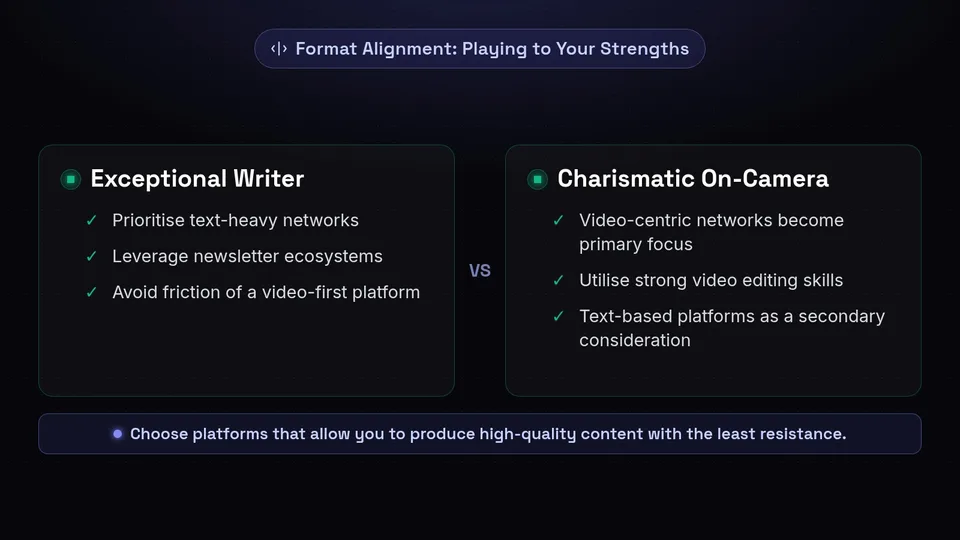
Different platforms demand different types of media. It is vital to align your chosen focus platforms with your own strengths and available resources. If you are an exceptional writer but struggle with on-camera presence, prioritizing a video-first platform will lead to immense friction and eventual burnout. In this scenario, your focus platforms should be text-heavy networks or newsletter ecosystems where your natural talents can shine.
Conversely, if you possess strong video editing skills and a charismatic on-camera persona, text-based platforms might be a secondary consideration, while video-centric networks become your primary focus. The key is to choose platforms that allow you to produce high-quality content with the least amount of resistance.
Resource Reality: The Time-to-Output Ratio
Every content format has a different time-to-output ratio. A short, text-based observation might take five minutes to conceptualise, draft, and publish. A highly polished, educational short-form video might require an hour of scripting, an hour of filming, and two hours of editing. When deciding how many social platforms you can run, you must calculate the weekly time commitment required to maintain a consistent presence on your chosen networks. If your chosen focus platforms are entirely video-based, you may only have the capacity to manage one or two. If they are text-based, you might comfortably manage three.
A Tiered Framework for Solo Management
Once you have evaluated your audience and your capabilities, you can structure your approach using a tiered framework. This model allows a solo operator to maintain a strategic presence across a few networks without becoming overwhelmed. The framework categorizes your chosen networks into Primary, Secondary, and Tertiary tiers.
Tier 1: The Primary Engine (One Platform)
Your Primary Engine is your most important focus platform. This is the network where your core audience is most active and where your content format aligns perfectly with your strengths. For a solo operator, you should only have one Tier 1 platform.
This platform receives the majority of your creative energy and time. Content for the Primary Engine is created natively; it is conceptualised, designed, and written specifically for the nuances of this specific network. You engage deeply with the community here, responding to comments, initiating conversations, and actively studying the platform's evolving trends. If you only have time to do one thing on social media in a given week, it should be maintaining your Primary Engine.
Tier 2: The Secondary Amplifiers (One to Two Platforms)
Your Secondary Amplifiers are platforms where a significant portion of your audience exists, but they do not require the intense, native focus of your Tier 1 platform. You can manage one or two of these networks effectively.
The strategy for Tier 2 platforms relies heavily on intelligent content adaptation. You do not necessarily create net-new concepts for these platforms. Instead, you take the core ideas, themes, or assets generated for your Primary Engine and adapt them to fit the format of the Secondary Amplifiers. This reduces the cognitive load of ideation while still maintaining a high-quality presence. Community engagement is still important here, but it may be batched into specific time blocks rather than monitored continuously.
Tier 3: The Passive Outposts (Optional: One to Two Platforms)
Tier 3 platforms are passive outposts. These are networks where you need to maintain a basic brand presence for search engine discoverability, brand protection, or basic customer routing, but you do not actively try to grow a community there.
Content on Tier 3 platforms is heavily automated or highly standardized. It might consist of automated feeds of your blog posts, simple company announcements, or a pinned post directing users to your Primary Engine. The goal here is not engagement; it is simply to ensure that if someone searches for your brand on that network, they find a professional, accurate profile that points them in the right direction. You spend virtually zero creative energy on Tier 3 platforms.
The Mechanics of Intelligent Content Adaptation
The success of the tiered framework—particularly the management of Tier 2 platforms—relies entirely on your ability to adapt content intelligently. As established earlier, automated cross-posting is a symptom of being spread too thin social media-wise. Intelligent adaptation, however, is the secret weapon of the efficient solo operator.
Deconstructing the Core Asset
Intelligent adaptation begins with a core asset, usually created for your Primary Engine. Suppose your Tier 1 platform is a long-form video network, and you have produced a ten-minute educational video. Instead of simply sharing the link to that video across every other network (which algorithms typically suppress to keep users on their own platform), you deconstruct the asset.
The core asset contains multiple ideas, quotes, and visual moments. You can extract the transcript and rewrite the key points into a compelling, text-based thread for a micro-blogging platform. You can pull out a strong, one-sentence quote and design a visually striking graphic for an image-based network. You can cut a highly engaging 30-second clip, add native captions, and publish it to a short-form video platform.
Respecting Platform Context
The crucial difference between cross-posting and adaptation is context. When you adapt the content, you alter the formatting, the tone, and the framing to suit the destination platform. The text thread will use the specific formatting conventions of that network. The graphic will be sized to the exact aspect ratio required by the image platform. The short-form video will use pacing and caption styles native to that specific app.
By deconstructing and adapting, you are creating native-feeling content for multiple focus platforms from a single session of deep creative ideation. This maximises your output while minimizing the cognitive drain, allowing one person to run multiple platforms well.
Workflow Optimisation for the Solo Manager
Even with a restricted number of focus platforms and a strategy of intelligent adaptation, managing social media requires strict operational discipline. Without a structured workflow, the daily demands of posting and engaging can easily consume your entire schedule.
The Power of Batching
Task batching is the practice of grouping similar tasks together and completing them in a single, focused session, rather than switching between different types of tasks throughout the day. For social media management, batching is essential.
Instead of writing one post, designing one graphic, and publishing it all on a Tuesday morning, a batched workflow separates the processes. You might dedicate Monday entirely to research and ideation, generating a month's worth of concepts. Wednesday could be dedicated solely to asset production—filming all videos or designing all graphics in one continuous flow. Friday might be reserved for copywriting, adapting the assets for your different focus platforms, and scheduling them.
Batching drastically reduces the cognitive penalty of context switching. When you are in 'writing mode', you stay in writing mode, allowing you to produce better copy in less time. When you are in 'filming mode', you only have to set up your lighting and camera equipment once.
Establishing Realistic Cadences
A common mistake that leads to being spread too thin social media-wise is committing to an unsustainable posting cadence. There is a pervasive myth that you must post multiple times a day on every platform to see growth. While high volume can be beneficial if the quality remains high, high volume of low-quality content is actively harmful.
It is far better to establish a lower, consistent cadence of high-quality content than to post erratically. If you can only manage two truly excellent, well-adapted posts per week on your Secondary Amplifier platform, commit to that cadence. Consistency builds trust with both the audience and the algorithm. Establish a baseline cadence that you can maintain even during your busiest weeks, and treat any additional content as a bonus.
Leveraging AI and Scheduling Tools
To truly master platform diversification and manage your chosen focus platforms efficiently, leveraging appropriate technology is non-negotiable. While human creativity and strategic thinking are required for ideation and community building, the mechanical processes of distribution and adaptation can and should be assisted by software.
The Role of SchedulifyX in Solo Management
This is where an AI-powered social media scheduling platform like SchedulifyX becomes a critical component of the solo operator's workflow. SchedulifyX is designed specifically to alleviate the mechanical burdens that cause individuals to become spread too thin socially.
By utilizing SchedulifyX, you can execute your batched workflow efficiently. Once your assets are created and adapted, you can upload them into the platform and schedule them across your designated focus platforms in a single session. This removes the daily friction of logging into multiple native applications, manually uploading files, and remembering to post at specific times.
AI-Powered Efficiency
Beyond simple scheduling, the AI-powered features within SchedulifyX can assist in the intelligent adaptation process. While you provide the core creative direction and the primary assets, AI tools can help streamline the generation of platform-specific copy, suggest optimal posting times based on historical algorithmic data, and help you maintain the distinct tone required for each of your focus platforms. By offloading these mechanical optimisations to SchedulifyX, you preserve your cognitive energy for the high-level strategy and genuine community engagement that actually drive business results.
Scaling Up: When to Add a New Platform
If you successfully implement the tiered framework, commit to a manageable number of focus platforms, and utilise tools like SchedulifyX, you will eventually reach a point of operational stability. Your Primary Engine will be growing, your Secondary Amplifiers will be providing consistent support, and your workflow will feel sustainable.
Only at this point of stability should you consider expanding your footprint. The decision to add a new platform should not be driven by a sudden trend or a fear of missing out, but by a strategic evaluation of your capacity. Ask yourself:
- Do I have surplus creative energy and time that is not required by my current focus platforms?
- Is my target audience migrating to or rapidly growing on this new network?
- Can I adapt my existing content formats to this new platform, or will it require an entirely new production workflow?
If the answers indicate that you have the capacity and the strategic justification, you can introduce a new platform as a Tier 2 or Tier 3 outpost, testing the waters before committing significant resources. If you find that the new platform is draining resources from your Primary Engine, you must be willing to retreat and consolidate. The goal is always sustainable quality over unsustainable quantity.
Conclusion: Quality Over Omnipresence
The digital landscape will continue to expand, and new platforms will inevitably emerge, each demanding your attention. However, the fundamental limitations of solo social media management remain constant. Asking how many social platforms one person can run is the first step toward building a sustainable strategy. The answer—typically one to three carefully selected focus platforms—requires discipline and a willingness to ignore the siren call of omnipresence.
By recognizing the warning signs of being spread too thin social media-wise, strategically selecting your platforms based on audience and format alignment, and utilizing a tiered framework for content adaptation, you can build a powerful, engaging digital presence without sacrificing your well-being. Focus your energy where it matters most, respect the unique context of each network, and rely on robust systems to handle the mechanical distribution.
If you are ready to streamline your workflow and master your chosen networks without the burnout, explore how the AI-powered scheduling tools within SchedulifyX can transform your daily operations. Sign up for SchedulifyX today and start building a sustainable, high-impact social media presence.
