Reach Is Not Distribution: Mastering Your Channel Strategy
SchedulifyX Team · October 27, 2026
Discover why reach differs from distribution. Learn how to build a robust content distribution strategy focused on channels, not just publishing posts.
For years, the standard operating procedure for digital marketing teams has been remarkably straightforward: create high-quality content, press publish, share a link on social media, and wait for the audience to arrive. However, in an increasingly saturated digital ecosystem, this passive approach is no longer sufficient. Hitting 'publish' merely brings a piece of content into existence; it does not guarantee that anyone will actually see it.
To succeed today, marketing professionals must develop a robust content distribution strategy. This requires a fundamental shift in mindset: moving away from a fixation on individual posts and vanity metrics, and moving towards a comprehensive channel strategy. The core of this transition lies in understanding a critical distinction that governs modern digital marketing: the difference between distribution vs reach.
In this comprehensive guide, we will explore the evolving definitions of content distribution, why algorithmic reach is not a substitute for strategic placement, and how to build an infrastructure of attention that guarantees your target audience encounters your most valuable assets.
Understanding the Difference: Distribution vs Reach
It is a common misconception to use the terms 'reach' and 'distribution' interchangeably. However, conflating the two can lead to significant misallocations of marketing resources and severely limit the impact of your content.
On October 22, 2026, marketing strategist Jim Huffman published a framework highlighting this exact distinction. He succinctly noted:
"Publishing means the content exists. Distribution means the right people actually encounter it."
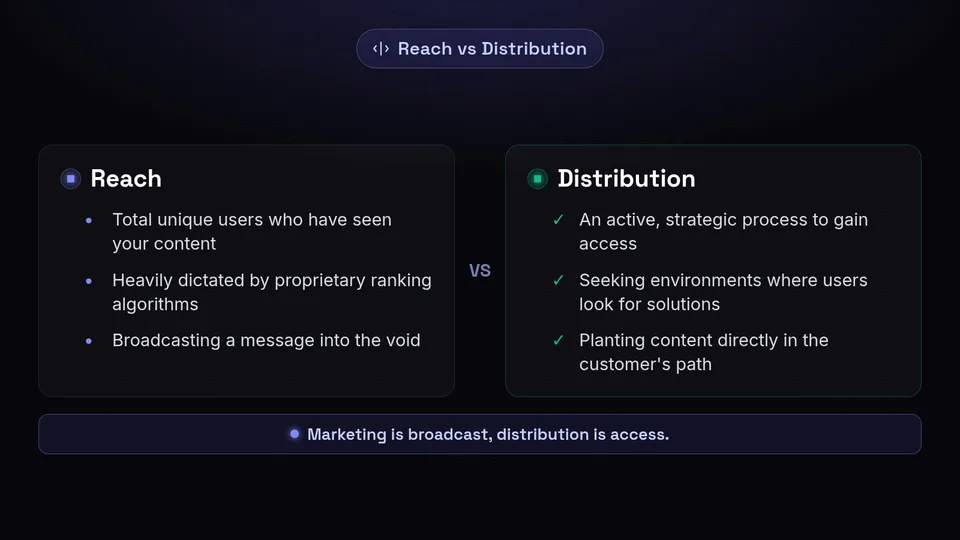
Reach is a metric. It represents the total number of unique users who have seen your content on a given platform. When you post a link on a social media platform, the resulting reach is heavily dictated by the platform's proprietary systems. An analysis of social platform mechanics conducted on August 31, 2026, revealed that low reach is frequently a distribution system issue rather than a measure of audience demand or content quality. Reach is driven by ranking algorithms, your account's historical performance, and the platform's internal recommendation incentives (which typically favour keeping users on the platform rather than sending them away via external links).
Distribution, on the other hand, is an active, strategic process. As defined in startup strategy discussions on February 13, 2026, there is a core operational distinction: "marketing is broadcast, distribution is access."
When you rely solely on reach, you are broadcasting a message into the void and hoping an algorithm favours you. When you focus on distribution vs reach, you are actively seeking access to the precise environments where your target users are already looking for solutions. A channel strategy is about planting your content directly in the path of your ideal customer, rather than waiting for them to stumble upon it.
The Shift to a Distribution-First Era

Historically, content creation was the primary focus, with distribution treated as an afterthought—a checklist of platforms to blast once the piece was finalised. This approach is rapidly becoming obsolete.
On February 25, 2024, Ty Magnin of Animalz outlined the industry's shift toward a "distribution-first era." In this modern paradigm, channel selection and audience opportunity analysis must precede content creation entirely. This represents a significant departure from the traditional reliance on SEO-driven blog strategies, where keyword volume dictated the editorial calendar.
Why SEO Alone Is No Longer Enough
While Search Engine Optimisation remains a valuable component of a broader content distribution strategy, it cannot function as the sole pillar of your channel strategy. Search algorithms are volatile, and the rise of zero-click searches means that even ranking highly does not guarantee traffic to your website. By adopting a distribution-first mindset, marketers decide how and where a piece of content will be consumed before a single word is written.
If the identified distribution channel is a niche industry newsletter, the content might be formatted as a concise, data-rich thought leadership piece. If the primary channel is a visual social media platform, the content must be conceptualised as a series of engaging graphics or short-form videos from the very beginning.
Building an "Infrastructure of Attention"
A successful content distribution strategy cannot rely on ad-hoc sharing. It requires systematic planning and execution. A system-level marketing framework published on March 07, 2026, defined modern distribution as an "infrastructure of attention."
This infrastructure operates across multiple touchpoints to build compounding visibility over time. It is not about a single viral spike, but rather a consistent, omnipresent presence across the channels your audience trusts. This infrastructure typically spans search engines, social media platforms, email newsletters, online communities, strategic partnerships, and paid channels.
The Three Pillars of Channel Strategy
To organise this infrastructure, it is helpful to categorise your distribution efforts. As established in channel definitions on January 22, 2025, a robust content distribution strategy is built upon three primary pillars:
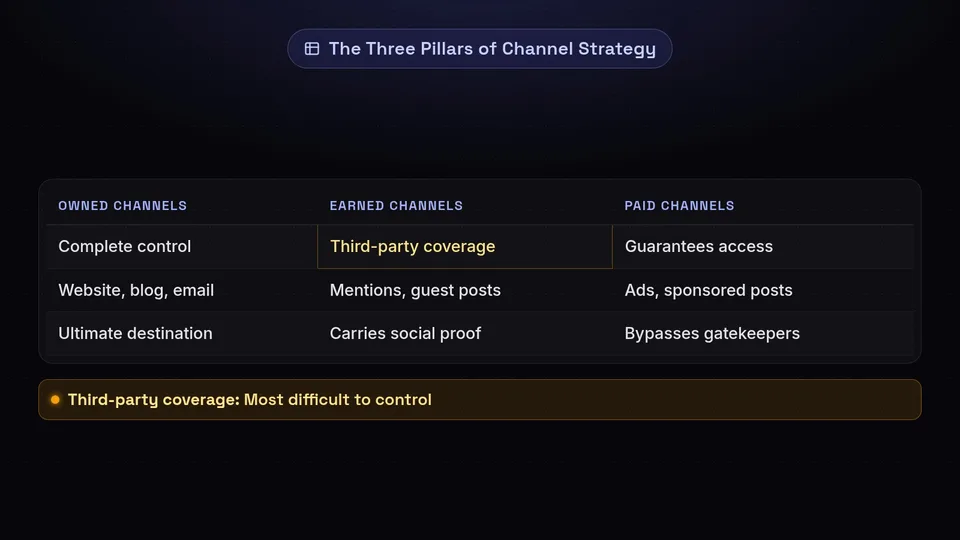
- Owned Channels: These are the platforms over which you have complete control. They include your company website, your blog, your proprietary email lists, and your official social media pages. Owned channels are the foundation of your distribution strategy, serving as the ultimate destination where you want to drive your audience to take action.
- Earned Channels: This encompasses third-party media coverage, organic mentions, guest posts, and shares by industry influencers or satisfied customers. Earned distribution is highly valuable because it carries the weight of social proof, though it is the most difficult to control.
- Paid Channels: This includes paid advertisements, sponsored posts, pay-per-click (PPC) campaigns, and paid influencer partnerships. Paid distribution guarantees access to specific demographics, allowing you to bypass algorithmic gatekeepers and place your content directly in front of a highly targeted audience.
A mature channel strategy does not choose one pillar over the others; it integrates all three to ensure maximum, sustained visibility.
Rethinking B2B and Account-Based Strategies
The rules of distribution are changing particularly rapidly in the Business-to-Business (B2B) sector. The traditional B2B playbook heavily relied on creating extensive whitepapers or reports and hiding them behind lead-capture forms (gated content). The goal was to capture an email address and nurture the lead through automated sequences.
However, buyer behaviour has evolved. On April 08, 2026, Julie Dorr, Lead Growth Strategist at Madison Logic, outlined modern account-based content distribution strategies. She emphasised that modern B2B content must be optimised for multi-channel discoverability and AI-driven consumption, rather than relying solely on gated form downloads.
Decision-makers are increasingly using AI tools to summarise public-facing content, research vendors, and gather insights without ever filling out a form. If your best insights are locked behind a gate, they cannot be ingested by these AI discovery tools, and you risk becoming invisible to a significant portion of your market. Therefore, an effective content distribution strategy must ungate high-value insights, distributing them natively across platforms where buyers are conducting their self-directed research.
Maximising Mileage: Content Gap Analysis
One of the most common pitfalls in content marketing is the relentless pursuit of volume. Marketing teams often feel pressured to produce new content constantly, assuming that more output will naturally lead to more visibility. This approach frequently leads to burnout and diminishing returns.
Revisiting Jim Huffman's October 2026 framework, a superior approach emphasises using content gap analyses to maximise mileage from existing high-value assets rather than continuously increasing content output volume.
Instead of writing a new blog post every day, a sophisticated channel strategy involves looking at your highest-performing historical assets and identifying distribution gaps. Ask yourself:
- Has this comprehensive guide been broken down into a multi-part email course?
- Have the key statistics from this report been transformed into highly shareable infographics for social media?
- Has this successful webinar been repurposed into short-form video snippets?
By focusing on distribution vs reach, you ensure that the deep, valuable content you have already invested in reaches every possible corner of your target market through varied, channel-specific formats.
Tooling Your Channel Strategy: SchedulifyX vs HubSpot
Executing a multi-channel content distribution strategy requires the right technological infrastructure. The market offers various solutions, ranging from comprehensive marketing suites to specialised scheduling tools.
For example, as of September 28, 2026, HubSpot published guidelines detailing multi-channel distribution within their "Loop Marketing" frameworks. Their ecosystem highlights specific features, including using HubSpot's AI to repurpose blog posts into channel-specific formats (such as social snippets, email copy, and video scripts). Furthermore, they utilise HubSpot's Social Media Post Scheduler to coordinate cross-platform publishing from a unified dashboard.
It is important to acknowledge where competitors excel. HubSpot is undeniably stronger for enterprise organisations that require a comprehensive, all-in-one Customer Relationship Management (CRM) system deeply integrated with full-funnel marketing automation. If your primary goal is to inextricably link a specific social media interaction directly to a complex, multi-stage email nurturing sequence within a single, unified database, HubSpot's broad suite is exceptional.
However, for teams whose primary focus is mastering their social media channel strategy without the overhead of a massive CRM, SchedulifyX provides a highly focused, AI-powered social media scheduling platform. SchedulifyX is designed specifically to solve the distribution vs reach dilemma on social platforms. By leveraging AI to determine optimal posting times, format content natively for individual platform algorithms, and seamlessly manage cross-channel calendars, SchedulifyX ensures your content achieves maximum access, not just passive broadcast.
Please note that software pricing models, feature sets, and product capabilities change over time; always confirm current offerings and pricing directly on the respective vendor's own official website.
Conclusion: Stop Broadcasting, Start Distributing
Understanding the fundamental difference between distribution vs reach is the first step toward transforming your marketing efforts. Reach is a passive metric dictated by algorithms; distribution is an active, strategic pursuit of access to your ideal audience. By adopting a distribution-first mindset, building a multi-pillar infrastructure of attention, and leveraging content gap analysis to maximise your existing assets, you can ensure that your content does more than just exist—it actively drives business growth.
Stop leaving your content's success to chance and algorithmic whims. It is time to take control of your channel strategy. Elevate your content distribution strategy today with SchedulifyX's AI-powered social media scheduling platform, and ensure your message consistently reaches the right people, at the right time, on the right channels.
Sources
Facts checked against the sources below on October 27, 2026.
