What Does DM Mean? The 2026 Guide to Direct Messages
SchedulifyX Team · October 9, 2026
Wondering what DM means? Discover the origin of direct messages, platform differences, business impact, and how to master your inbox in our complete 2026 guide.
What Does DM Mean? The Short Answer

If you are asking yourself, what does DM mean? The answer is straightforward: DM stands for direct message, a private digital message sent directly from one social media user to another. Unlike public comments, timeline posts, or forum threads, a direct message is visible only to the sender and the recipient.
As social media has evolved from public broadcasting to private sharing, understanding the DM meaning has become essential for everyday users, creators, and brands alike. Today, direct messaging is not just a way to say hello to a friend; it is the primary engine of social commerce, customer service, and algorithmic reach. In this comprehensive guide, we will explore where the term came from, how direct messages operate differently across major platforms in 2026, and why mastering your DM strategy is the highest-intent channel your business might be ignoring.
The Origin of the DM and How It Evolved
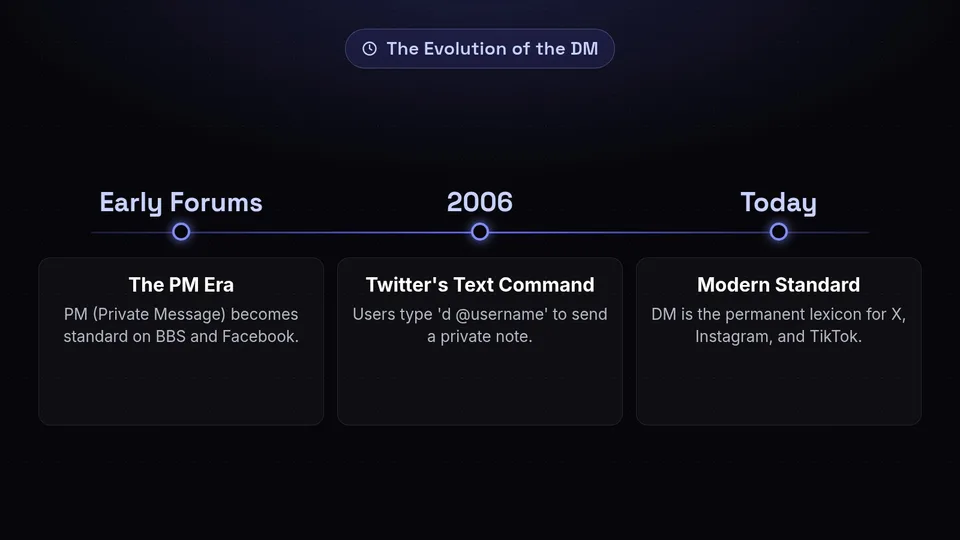
To truly understand the dm meaning in text and culture, we have to look back at the early days of social media. Before the acronym DM took over the internet, users primarily relied on the term "PM," which stands for Private Message. The PM originated in early internet forums, bulletin board systems (BBS), and eventually became the standard terminology on Facebook and Facebook Messenger.
So, what is DM and where did it come from? The term "direct message" specifically originated on Twitter back in 2006. In Twitter's early days, before sophisticated graphical interfaces for private chatting existed on the app, users had to use text commands to send a private note. You would type d @username your message here to send a direct message. Over time, as Twitter grew, the platform formalized this feature into a dedicated inbox, and the term "DM" became a permanent fixture in our digital lexicon.
Today, you will frequently see variations of the term across all platforms. Common related search terms include DMing (the act of sending a direct message) and DM'd (the past tense, having sent a direct message). While "PM versus DM" is still a common debate, the reality is that they mean the exact same thing. PM is simply a legacy term from the forum and Facebook era, while DM is the modern standard popularized by Twitter (now X), Instagram, and TikTok. If you are curious about other evolving internet acronyms, check out our comprehensive guide to social media slang for neighboring terms.
What Does "Slide Into the DMs" Mean?
You cannot discuss what dm means without touching on its most famous cultural idiom: "sliding into the DMs." This phrase first emerged around late 2013 and quickly became a staple of internet culture. To "slide into the DMs" describes the act of sending an unexpected, confident private message to someone you may not know well, usually with romantic, flirtatious, or casual networking intent.
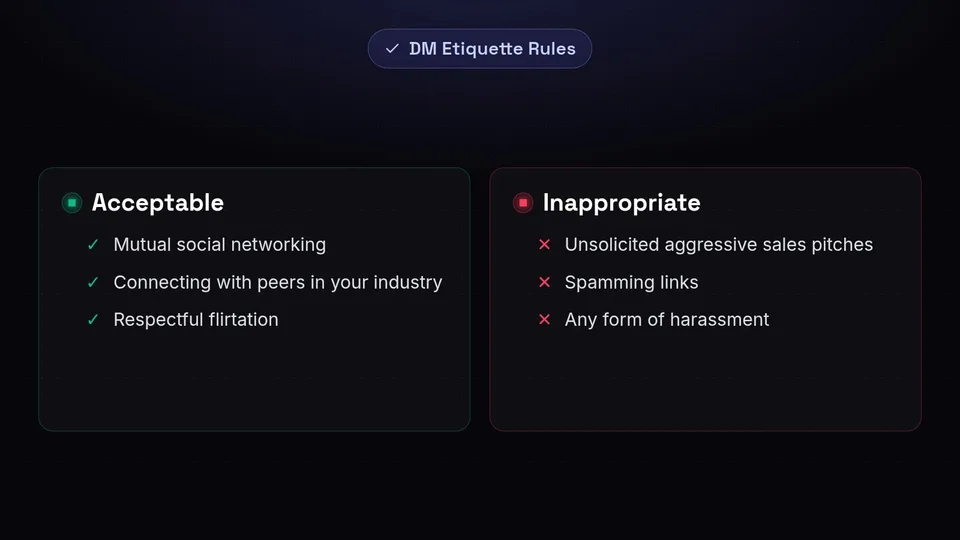
The phrase implies a sense of smoothness or effortless confidence. However, internet etiquette dictates clear boundaries for when this is and is not appropriate. Sliding into the DMs is generally considered acceptable for mutual social networking, connecting with peers in your industry, or respectful flirtation. Conversely, it is widely considered inappropriate and intrusive to use the DMs for unsolicited aggressive sales pitches, spamming links, or any form of harassment. For businesses, this means your outreach must be highly personalized and value-driven, rather than a cold, aggressive pitch.
How DMs Work Across Different Social Platforms in 2026
While the basic dm meaning remains the same across the internet, the functionality, culture, and business utility of direct messages vary wildly depending on the platform. As of 2026, social networks have heavily invested in their private messaging infrastructure.
Instagram: The Engagement Powerhouse
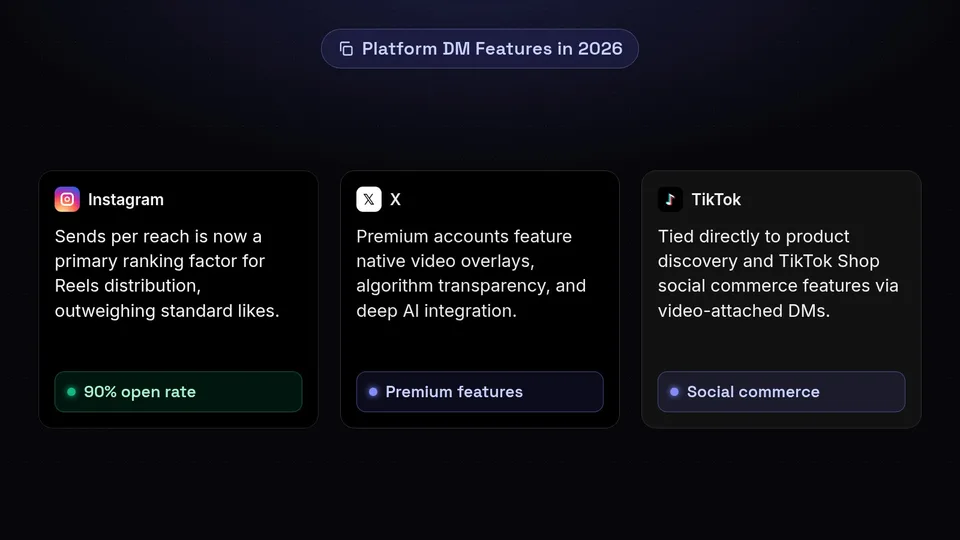
Instagram has transformed its DM feature into the most critical part of its ecosystem. In 2026, Instagram DMs boast staggering metrics: a 90% open rate and up to a 60% reply rate. But the real story is how DMs impact the algorithm. On March 13, 2026, Instagram Head Adam Mosseri formally confirmed that "sends per reach" (the rate at which users privately share your content via DM) is now a primary ranking factor for Reels distribution, heavily outweighing standard likes or comments. If your content isn't being DM'd, it isn't growing.
Meta continues to push the boundaries of what can be done in Instagram DMs. As of October 4–5, 2026, Meta launched a groundbreaking feature: AI-generated song creation directly inside Instagram DMs. Users can now enter custom lyrics and select music genres to generate and send unique audio tracks in private messages. Furthermore, on January 20, 2026, Meta updated its systems to allow external search engines to crawl public Instagram and Facebook photos and videos, linking public DM-driven content trends into general web search index results.
X (Formerly Twitter): The Pioneer
As the originator of the DM, X continues to evolve its private messaging suite. Following aggressive platform overhauls, X introduced several advanced DM features for Premium accounts in August 2026. These include native video overlays, algorithm transparency indicators within chats, and deep AI integration to help users draft and manage their private conversations.
TikTok: Social Commerce and Video DMs
TikTok's approach to the DM is intrinsically tied to its core format: video. TikTok focuses heavily on video-attached DMs, encouraging users to share content seamlessly. More importantly for businesses, TikTok has tied its DM functionality directly to product discovery and TikTok Shop social commerce features. When users share a product video in a DM, the recipient can now often purchase the item without ever leaving the chat interface.
LinkedIn: B2B Professional Networking
Unlike the casual nature of Instagram or TikTok, LinkedIn DMs are the global hub for B2B professional outreach. Because the platform is heavily targeted by automated sales bots, LinkedIn has had to adapt. In September 2026, LinkedIn launched member flagging indicators, which provide feedback flags when members mark unsolicited messages or posts as low-quality AI content. This makes personalized, high-quality messaging more critical than ever for B2B marketers.
Message Requests and Filtering: Navigating the Hidden Inbox
One of the biggest challenges for both users and businesses is dealing with spam. To combat this, almost all major social networks automatically separate incoming messages from non-connected accounts (people who do not follow you, or whom you do not follow back) into hidden or secondary "Message Requests" tabs.
On Instagram, for example, non-follower messages filter automatically into this request folder. If you do not actively check this folder, you could be missing out on valuable leads, customer service inquiries, or partnership opportunities. For brands managing presence across Instagram, X, TikTok, and LinkedIn, checking four different hidden request folders daily is a logistical nightmare. Consolidating these multi-platform inbox requests is essential for modern teams, which can be easily managed via our Unified Inbox feature.
The Business Impact: Why DMs Are the Highest-Intent Channel
Understanding the dm meaning is only the first step; understanding the business impact of direct messages is what drives revenue. Consumers no longer want to call a 1-800 number or wait days for an email reply. They want immediate help where they already spend their time: on social media.
The stakes for ignoring your DMs are incredibly high. According to a Sprout Social report from February 2026, a massive 73% of consumers say they will switch to a competitor if a brand fails to respond on social media. Furthermore, customer expectations for social DM response times are shrinking. The average expectation is now under 4 hours, whereas traditional email averages an 8.5-hour response time.
To meet these demands, businesses are turning to AI and automation. A massive study by SetSmart (conducted from July 2024 to March 2026) analyzed 828,761 AI DM conversations across 391 businesses. The results were staggering. Automated AI systems responded in under 5 seconds, compared to a 47-hour industry average for human teams. More importantly, the study revealed the true value of deep DM conversations: conversations that reached 11 or more messages were 68 times more likely to qualify a lead than brief 1–4 message exchanges. DMs are not just a customer service channel; they are a high-converting sales funnel.
Native Platforms vs. SchedulifyX: Which is Right for You?
When managing direct messages, businesses generally have two choices: manage them natively within the social media apps (Instagram, X, TikTok, LinkedIn) or use a third-party management platform like SchedulifyX.
It is important to be transparent about where native platforms excel. Native social media apps are stronger than SchedulifyX when it comes to immediate access to brand-new, experimental features. For example, when Meta launched AI-generated song creation inside Instagram DMs in October 2026, that feature was exclusively available inside the native Instagram app. Third-party tools rely on official APIs, meaning highly specialized, day-one consumer features (like native augmented reality filters or proprietary AI audio generators) will always be stronger and more immediate on the native platforms themselves.
However, managing DMs natively becomes unsustainable as your business grows. Logging into four different apps, navigating hidden message request folders, and trying to maintain a response time of under 4 hours manually is a recipe for burnout and lost leads. This is where SchedulifyX shines. By bringing all your cross-platform DMs into a single, collaborative workspace, your team can route messages, apply automated triage, and ensure that no high-intent lead is ever lost in a hidden "Requests" folder. Note: Platform API capabilities and pricing models change frequently; always confirm current feature support directly on the respective vendor's official page.
Conclusion: Master Your DMs with SchedulifyX
So, what is a DM? It is far more than just a direct message. It is the modern equivalent of a handshake, a customer service desk, and a sales floor all rolled into one. From its humble origins as a text command on Twitter in 2006 to the AI-powered, algorithm-driving powerhouse it is in 2026, the DM is the most critical communication channel of the digital age.
Whether you are trying to improve your "sends per reach" on Instagram, qualify leads through deep 11-message conversations, or simply provide faster customer support, you cannot afford to ignore your direct messages. Stop letting valuable customers slip through the cracks of hidden request folders. Take control of your private messaging strategy and consolidate your communications today with SchedulifyX.
Sources
Facts checked against the sources below on October 9, 2026.
- Dm Abbreviation Explained — yourdictionary.com
- What Is Direct Message — socialpilot.co
- facebook.com
- To Dm Or Not To Dm — alisonmortonauthor.com
- Lead Response Time Statistics — setsmart.io
- Social Media Updates March 14 2026 — socialday.live
- Social Media Updates And New Features To Know This Week 54 — prdaily.com
- Social Media Marketing Trends — digitalmarketinginstitute.com
- Instagram Vs Tiktok For Creators — creatorflow.so
- Social Media Statistics — sproutsocial.com