What is Trial Reel? Definition, Examples & Why It Matters
Learn what is trial reel? Definition, examples and why it matters for your social media strategy. Test, analyse, and optimise your video content with…
SchedulifyX is the AI-powered social media command center built for creators, businesses, and agencies. Schedule posts across 10+ platforms, generate content with 9 specialized AI agents, collaborate with your team using approval workflows, analyze performance with deep analytics, and manage all social engagement from a unified inbox. Trusted by professionals worldwide — free plan available, paid plans from
In the fast-paced and ever-evolving landscape of short-form video, creating content that consistently resonates with both complex algorithms and human audiences is a continuous challenge for digital marketers. To mitigate risk and maximise engagement, social media professionals increasingly rely on experimental content formats. At the heart of this experimental approach is a concept that is reshaping how brands approach video production. If you are asking, "what is trial reel? definition, examples and why it matters", you are already stepping into a more analytical, data-driven approach to social media management.
Rather than relying purely on intuition or investing heavily in unproven content series, modern creators use trial reels to test the waters. By treating specific pieces of content as controlled experiments, brands can isolate variables, gather actionable audience feedback, and refine their broader content strategy before committing significant resources. This glossary entry explores the comprehensive definition of a trial reel, provides concrete examples of how they are used in practice, and details exactly why this methodology is crucial for sustained digital growth.
Core Concept
What is a Trial Reel? A Comprehensive Definition
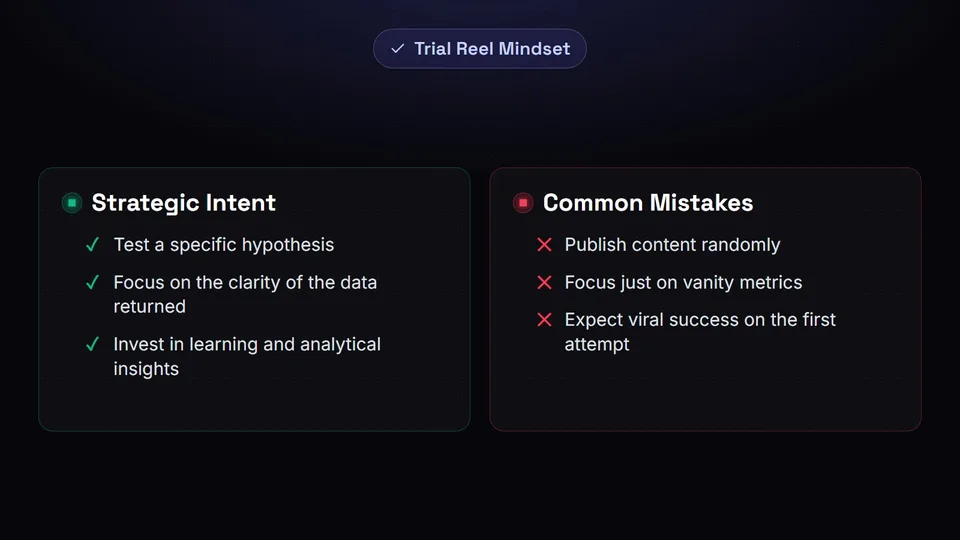
A trial reel is an experimental piece of short-form video content published with the primary intent of gathering performance data, testing a specific hypothesis, or gauging audience reaction, rather than driving immediate conversions or serving as a cornerstone brand asset. It is the social media equivalent of a pilot episode or a beta test.
When marketers deploy a trial reel, they are deliberately testing a specific variable within their content framework. This could be a new visual hook, an alternative pacing structure, a different style of background audio, or a shift in the tone of voice. The goal is not necessarily to achieve viral success on the first attempt, but rather to acquire analytical insights that will inform future content creation.
Intentional Experimentation
A trial reel is never published randomly. It is designed to test a specific hypothesis, such as whether text-on-screen increases watch time or if a direct-to-camera approach resonates better than voiceover b-roll.
Data-Driven Focus
The success of a trial reel is measured by the clarity of the data it returns, not just vanity metrics. It provides a baseline for understanding how the algorithm and the audience process a new format.
In many workflows, a trial reel might be published to a smaller, secondary account, or it might be integrated seamlessly into the main content calendar but monitored with a different set of key performance indicators (KPIs). The defining characteristic is the mindset behind the publication: it is an investment in learning.
Strategic Value
Why Trial Reels Matter in Modern Marketing

Understanding what a trial reel is only forms half the equation; understanding why it matters is where the strategic advantage lies. Social media platforms like Instagram, TikTok, and YouTube employ highly sophisticated recommendation algorithms. These algorithms are designed to keep users on the platform by serving them content that historically holds their attention.
Because these algorithms are constantly updating, and audience preferences shift rapidly, relying on a static content strategy is a recipe for stagnation. Trial reels matter because they provide a structured mechanism for adaptation.
- Algorithmic Alignment: By testing different formats, you can identify which specific elements (such as pacing, lighting, or caption styles) currently trigger the algorithm to push content to a wider audience.
- Risk Mitigation: Producing high-end video content requires significant time and financial investment. Testing concepts via low-fidelity trial reels prevents brands from wasting resources on formats that do not resonate.
- Audience Insight Generation: Trial reels allow you to test new messaging angles or target different audience segments without overhauling your entire brand identity. The resulting data helps define your core demographic's actual preferences.
- Creative Unblocking: When creative teams are allowed to produce trial content without the pressure of achieving immediate high ROI, it fosters innovation and prevents content fatigue.
Key Takeaway: The Feedback Loop
The true value of a trial reel lies in the feedback loop it creates. By continuously testing, measuring, and iterating, you transform your social media presence from a static broadcasting channel into a dynamic, responsive growth engine. Every "failed" trial reel provides the exact data needed to create a successful pillar piece of content later.
Practical Application
Real-World Examples of Trial Reels
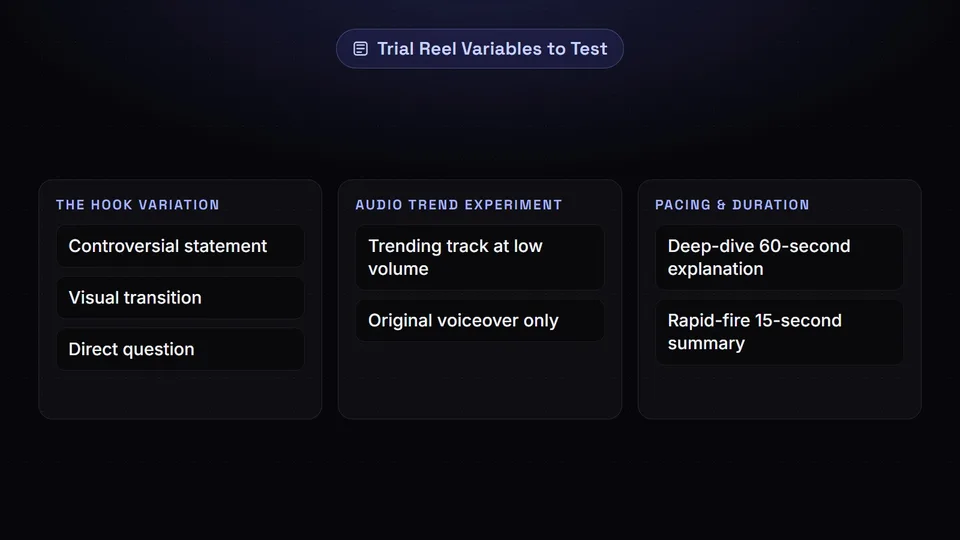
To fully grasp the concept, it is helpful to look at how trial reels are executed in practice. Social media managers typically isolate one specific variable to test per trial reel to ensure the resulting data is clear and actionable. Here are three common examples of trial reel strategies.
The Hook Variation Test
A brand creates three identical videos, but changes the first three seconds (the hook) of each. One uses a controversial statement, one uses a visual transition, and one asks a direct question. These trial reels determine which hook style yields the highest initial retention rate.
The Audio Trend Experiment
To see if trending audio impacts reach within their specific niche, a creator publishes a piece of standard educational content using a trending track at a low volume, comparing its reach against a similar video using original voiceover only.
The Pacing & Duration Trial
A team tests whether their audience prefers deep-dive 60-second explanations or rapid-fire 15-second summaries. They publish trial reels of both formats covering the same topic to measure average watch time and completion rates.
In each of these examples, the creator is not just posting and hoping for the best. They are actively using the platform's native environment as a testing laboratory. By leveraging analytics tools, they can observe exactly where viewers drop off and adjust their subsequent, higher-production-value content accordingly.
Measurement & Analysis
The Metrics That Define a Successful Trial Reel
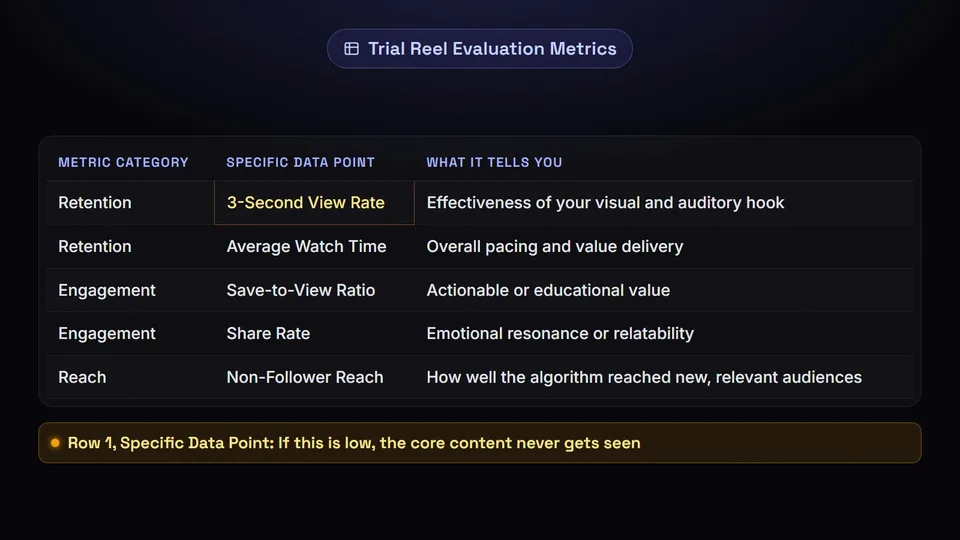
Because the goal of a trial reel is learning rather than immediate conversion, the metrics used to evaluate them differ from standard promotional content. Focusing on the wrong data points can lead to false conclusions. When analysing a trial reel, marketers must look beyond surface-level likes and focus on deep engagement and retention indicators.
| Metric Category | Specific Data Point | What It Tells You About the Trial Reel |
|---|---|---|
| Retention | 3-Second View Rate | Indicates the effectiveness of your visual and auditory hook. If this is low, the core content never gets seen. |
| Retention | Average Watch Time | Measures the overall pacing and value delivery of the video. High watch time signals algorithmic relevance. |
| Engagement | Save-to-View Ratio | Demonstrates that the content provided actionable or educational value that the user wants to reference later. |
| Engagement | Share Rate | Indicates emotional resonance or relatability. Highly shared trial reels often point to a highly scalable content format. |
| Reach | Non-Follower Reach | Shows how well the platform's algorithm categorised and distributed the content to new, relevant audiences. |
By meticulously tracking these metrics across different trial reels, social media managers can build a robust framework of what works for their specific brand. For instance, if a trial reel testing a new text-on-screen style results in a significantly higher 3-second view rate, that style should be immediately integrated into the brand's standard operating procedure for all future videos.
Ready to test and optimise your video strategy?
Use SchedulifyX to schedule your trial reels across multiple platforms and gather the deep analytics you need to refine your content.
Start Free →Execution Strategy
How to Execute a Trial Reel Strategy
Implementing a trial reel strategy requires discipline and a structured approach. Randomly posting different types of videos without a plan will result in messy data that is impossible to interpret. To effectively harness the power of trial reels, follow a scientific, step-by-step process.
Define Your Hypothesis
Before recording anything, decide exactly what you are testing. Are you testing a new hook format? A different video length? A new presenter? Ensure you are only testing one major variable at a time so you can accurately attribute any changes in performance to that specific variable.
Produce the Minimum Viable Video
Do not over-invest in production quality for a trial reel. Create a "minimum viable video" that clearly demonstrates the concept you are testing without requiring expensive editing or equipment. The focus should be on the format and the message, not cinematic perfection.
Schedule and Distribute
Use scheduling software to publish the trial reel at a time when your baseline audience is active. Consistency in posting time helps control external variables that might skew your data.
Monitor and Analyse
Wait for the algorithm to fully process and distribute the video (typically 48 to 72 hours for short-form video). Dive into your analytics dashboard to review retention graphs, average watch time, and engagement ratios.
Iterate and Scale
If the trial reel proves your hypothesis correct (e.g., the new hook format increased retention), integrate that learning into your primary content strategy. If it failed, document the failure, formulate a new hypothesis, and begin the process again.
Pro Tip: When presenting trial reel concepts to stakeholders or clients, frame them as "learning investments." Use a client portal to share the specific hypotheses and the resulting data, demonstrating that every piece of content—even those with lower reach—serves a strategic purpose in the broader campaign.
Content Hierarchy
Trial Reels vs. Pillar Content
To fully integrate trial reels into your workflow, it is essential to understand how they differ from your core, or "pillar," content. A healthy social media presence requires a balance of both.
Trial Reels (Experimental)
Trial reels are agile, low-cost, and focused on discovery. They are the reconnaissance missions of your content strategy. The production value is secondary to the speed of execution and the clarity of the variable being tested. If a trial reel underperforms, it is considered a successful experiment because it provided valuable data on what to avoid in the future. They are often produced quickly, leveraging trending formats or raw, behind-the-scenes styles.
Pillar Content (Core Brand assets)
Pillar content represents the highest quality representation of your brand. These are the videos you invest significant time editing, scripting, and polishing. They are designed to convert viewers, build deep brand loyalty, and serve as evergreen assets. Pillar content strategies should be directly informed by the data gathered from your successful trial reels, ensuring that your largest investments are backed by proven audience preferences.
By maintaining a clear distinction between these two categories, teams can allocate their resources more effectively. You might spend 20% of your production time rapidly testing trial reels, which then provides the data blueprint for the 80% of time spent crafting high-converting pillar content.
Platform Nuances
Testing Across Different Platforms
While the fundamental concept of a trial reel remains consistent, the execution must adapt to the specific nuances of different social media platforms. What works as a test on one network may not yield accurate data on another.
On Instagram, trial reels might focus heavily on visual aesthetics, typography, and how the video loops, as the platform heavily rewards seamless replayability. Conversely, on TikTok, trial reels are often best used to test raw authenticity, participation in niche subcultures, or specific storytelling structures, as the "For You" page algorithm is highly sensitive to watch-time retention on narrative content.
When testing on YouTube Shorts, creators often use trial reels to gauge interest in broader topics before committing to producing long-form horizontal videos on the same subject. Understanding these platform-specific behaviours is vital. Using a unified dashboard to track engagement across all these platforms simultaneously allows marketers to spot cross-platform trends and isolate platform-specific anomalies.
Workflow Integration
Integrating Trial Reels with SchedulifyX
Managing an experimental content strategy requires robust organisation. If you are running multiple trial reels to test different variables, keeping track of the hypotheses, the assets, and the resulting data can quickly become overwhelming without the right infrastructure.
Modern social media teams use comprehensive platforms to streamline this process. By utilising a centralised media library, teams can store raw assets and easily generate multiple variations of a video for testing purposes. Furthermore, when generating ideas for new trial reels, teams can leverage AI Studio tools to brainstorm alternative hooks, suggest trending topics, or draft varied caption styles to accompany the test videos.
Effective team collaboration is also essential. A strategist might formulate the hypothesis, a creator produces the trial reel, and an analyst reviews the data. Having a unified system ensures that the insights gained from a trial reel are immediately accessible to the entire team, allowing for rapid iteration and continuous improvement of the overall content strategy.
Conclusion: Embracing the Experimental Mindset
Answering the question "what is trial reel? definition, examples and why it matters" ultimately reveals a shift in how modern marketing operates. It moves away from the pressure of demanding every piece of content be a viral masterpiece, and instead embraces a scientific, iterative approach to audience building.
By intentionally publishing trial reels, you are actively listening to your audience and the algorithms that serve them. You are gathering the empirical data necessary to refine your hooks, perfect your pacing, and ultimately produce pillar content that you know, with certainty, will perform. In an environment where trends shift daily, the ability to test, learn, and adapt rapidly is the most valuable asset a digital marketer can possess.
Get started free — no credit card required.