How Many Followers to Make Money? The Honest Answer
SchedulifyX Team · November 26, 2026
The real follower thresholds on YouTube, TikTok and Instagram, how brand deals are actually priced, and why a small, engaged audience can out-earn a big one.
Ask how many followers to make money and you will usually be given a single number. The honest answer is that there isn't one. Platform programmes open at anywhere from a few hundred followers to ten thousand or more, and brand deals, brands' own affiliate programmes and selling your own work have no platform minimum at all. None of them pays for followers as such: YouTube pays for watched ads, TikTok for views and engagement, and brands for the attention a post is likely to earn. That is why follower count is a weak predictor of income.
The short version, as of late November 2026:
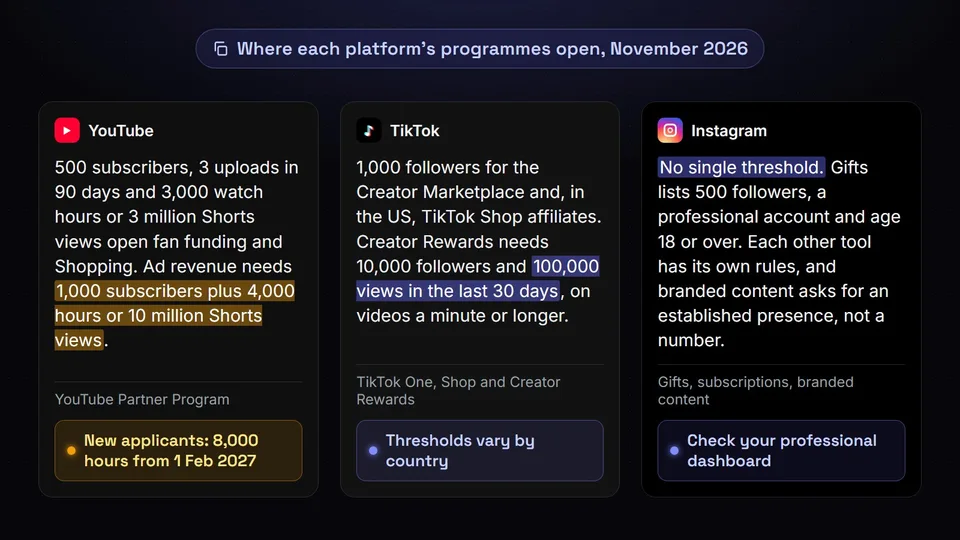
- YouTube: 500 subscribers, plus watch time or Shorts views, to apply for fan funding and Shopping; 1,000 subscribers, plus 4,000 watch hours or 10 million Shorts views, for a share of ad revenue. The bar for new applicants doubles on 1 February 2027.
- TikTok: 1,000 followers for its brand marketplace and, in the US, its Shop affiliate programme; 10,000 followers and 100,000 views in the last 30 days for the Creator Rewards Program.
- Instagram: no single number. Gifts lists 500 followers, and branded content asks for an established presence rather than a figure.
- Brand deals, brand-run affiliate programmes and your own products: no platform minimum. What decides them is whether the right people are paying attention.
Where the monetisation programmes open
Entry rules change, so check each platform's help centre before relying on these figures. Clearing a bar only opens the door; the income still depends on views, watch time or sales.
YouTube
YouTube counts subscribers and has two tiers. Where the expanded YouTube Partner Program runs, 500 subscribers, three public uploads in the last 90 days and either 3,000 watch hours in 12 months or 3 million Shorts views in 90 days let you apply for fan funding, such as channel memberships and Super Thanks, and for Shopping, including its affiliate programme where available. Ad revenue needs 1,000 subscribers plus 4,000 watch hours in 12 months or 10 million Shorts views in 90 days. YouTube's overview of the expanded programme lists both tiers and how to apply.
That ad bar is about to rise. YouTube has announced that from 1 February 2027 new applicants will need 8,000 watch hours in 365 days or 20 million Shorts views in 90 days, still with 1,000 subscribers. Existing partners keep their place, but from that date any channel needs 10 million Shorts views over 90 days to share in Shorts revenue. By YouTube's own figures, creators receive 55 per cent of the revenue on long-form videos and 45 per cent on Shorts, but advertisers pay different prices by topic and audience, so channels of the same size can earn very different amounts.
TikTok
How many TikTok followers you need to make money depends on the programme. Going LIVE, where viewers can send Gifts, needs you to be 18 or over with a minimum follower count that TikTok says varies by market. TikTok One's Creator Marketplace, where brands hire creators, starts at 1,000 followers, though campaigns can ask for more. In the US, TikTok Shop's affiliate programme also starts at 1,000, but accounts under 5,000 begin in a pilot that limits how often they can promote products. The Creator Rewards Program, which pays for original videos a minute or longer, needs 10,000 followers and 100,000 views in the last 30 days under TikTok's US programme terms, and more followers in some other countries.
Notice the views requirement: TikTok's own payout programme treats followers as half the test, and rewards then depend on views and on signals TikTok has named as originality, play duration, search value and audience engagement.
How many Instagram followers you need to make money depends on the tool, because Instagram has no single threshold. Its help centre lists five monetisation tools (badges, bonuses, the creator marketplace, gifts and subscriptions), each with its own eligibility rules and all requiring a professional account. Gifts, which viewers send on Reels, is the one with a published number: at least 500 followers, plus being 18 or over in a country where Gifts is offered. Meta's rules for branded content and partnership ads ask for an authentic, established presence but name no figure. Your professional dashboard shows which tools your account can use.
Why follower count is a weak predictor of income
Every threshold above is an entry ticket; none of the programmes pays per follower. Followers matter only when they turn into watched ads, views, gifts or results for a brand, and three things get in the way.
Recommendation feeds decide who sees a post. TikTok has said follower count is not a direct factor in its recommendation system, and Instagram has said most of what people see in Reels and Explore comes from accounts they don't follow. That cuts both ways: a small account can reach far beyond its followers, and a large account's followers may never see a post that fails to hold attention.
Followers go quiet. People follow for one viral video, a giveaway or a topic you have since dropped, and bought followers barely engage, if at all. The count stays where it is while the audience that actually watches shrinks.
Buyers are a fraction of watchers. Commission, product sales and results-based deals pay only when people trust you enough to act, which depends on relevance more than size.
What brand deals pay at different tiers
There is no public price list for brand deals. They are private contracts, and the rate figures online mostly come from self-reported surveys and agency rate cards that disagree with one another, usually organised by follower count, the number that tells a brand the least. Rather than guess at prices, here is what changes predictably as an account grows: the shape of the deal.
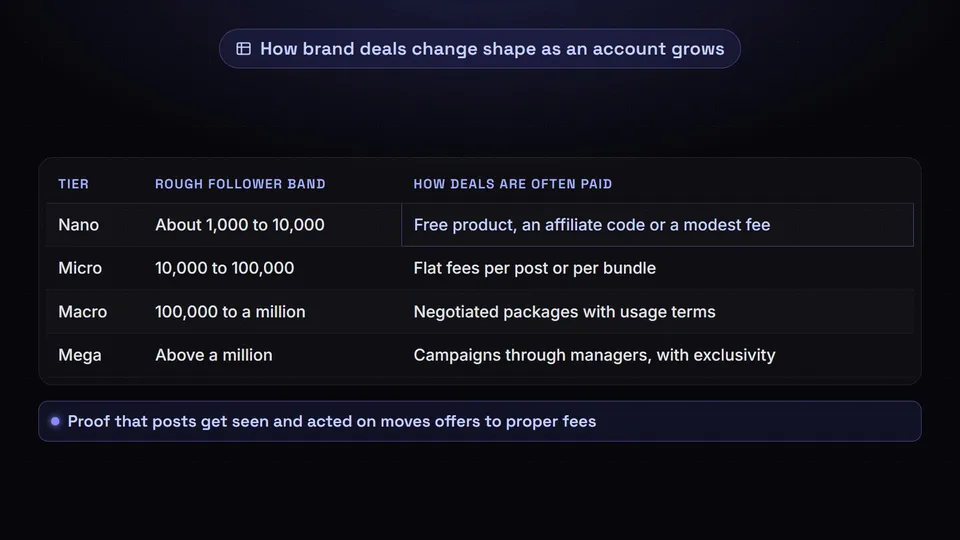
Agencies sort creators into tiers by convention rather than standard: nano, roughly 1,000 to 10,000 followers; micro, 10,000 to 100,000; macro, 100,000 to a million; and mega above that, with some agencies adding a mid-tier band. Small accounts are often offered free product, an affiliate code or a modest fee first, and proof that their posts get seen and acted on moves them to proper fees faster than a follower milestone. In the middle, flat fees per post or bundle become normal; at the top, deals tend to be campaigns negotiated through managers, with exclusivity and usage terms.
At every tier, the fee moves with the same things:
- Typical views per post: your ordinary post, not your best one or your follower count.
- Audience fit: whether your viewers are the brand's customers, in the countries it sells to.
- Deliverables: a Story frame and a scripted video with revisions are different jobs.
- Usage rights: running your video as a paid ad with your handle on it, as Instagram's partnership ads do, is worth more than a post.
- Exclusivity: turning away competitors costs you deals, so it should cost the brand.
A useful anchor is what reaching the same people with ads would cost the brand; ad tools estimate it during campaign set-up, as Meta's Ads Manager does with estimated daily results. And disclose whatever you are paid in. The US Federal Trade Commission's guidance counts free or discounted products as a relationship to disclose, and warns that a platform's disclosure tool may not be enough on its own.
Why engagement rate matters more than size
Engagement rate is the quickest check a brand can run on whether an audience is real and paying attention. The usual version divides a post's likes, comments, saves and shares by the account's followers and multiplies by 100. Followers who no longer see or care about your posts still count in the divisor but add nothing to the interactions, so an account padded with bought, giveaway or long-gone followers shows a low rate even on good posts. Thin, generic comments under a big follower count say the same thing.
Compare like with like. Rates differ by platform, because each one decides differently how many non-followers see a post (our piece on why engagement rate comparisons between platforms mislead explains the trap), and they tend to fall as accounts grow. Brands that sponsor creators regularly often ask for screenshots of your insights too: views per post, and your audience's location and age.
To check your own figure, enter one post's numbers into our engagement rate calculator. It shows the rate and where it sits against the typical range for that platform. Do it for a run of recent posts rather than your best one, and watch the trend.
Why 5,000 engaged followers can out-earn 100,000 passive ones
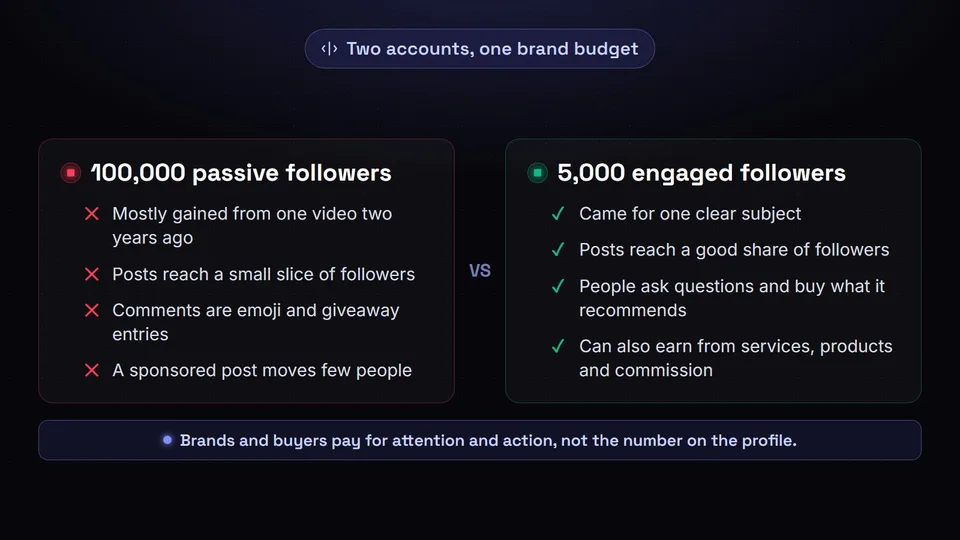
Picture two accounts. One has 100,000 followers, mostly gained from a single video two years ago; its posts now reach a small slice of them and draw emoji and giveaway entries. The other has 5,000 followers who came for one subject, say bookkeeping for freelancers; its posts reach a good share of them, people reply with questions, and some have bought what it recommended. The first is twenty times bigger, yet the second can earn more, for mechanical reasons.
- Brands pay for the audience a post actually reaches. If the big account's sponsored post is seen by few and moves fewer, the brand pays a high price per result and does not return. The small account delivers, and repeat deals follow.
- A niche audience is worth more to the right buyer. A brand that sells to freelancers would rather reach 5,000 of them than 100,000 people who followed for a joke, and can pay more per person for the match.
- Trust converts. Affiliate commission and your own products pay per sale, and an engaged audience buys where a passive one scrolls past.
- Focused accounts have more ways to earn. Services, workshops, templates and coaching sell to people who came for expertise.
- Some brand work ignores audience size. In user-generated content (UGC) deals, a brand pays you to make videos for its own channels or ads, so it is buying your production, not your followers.
Small does not always beat big: a large, engaged account will usually out-earn a small one, and it clears every threshold too. Engagement and fit decide what an audience is worth; size only multiplies them.
How to work out what your audience is worth
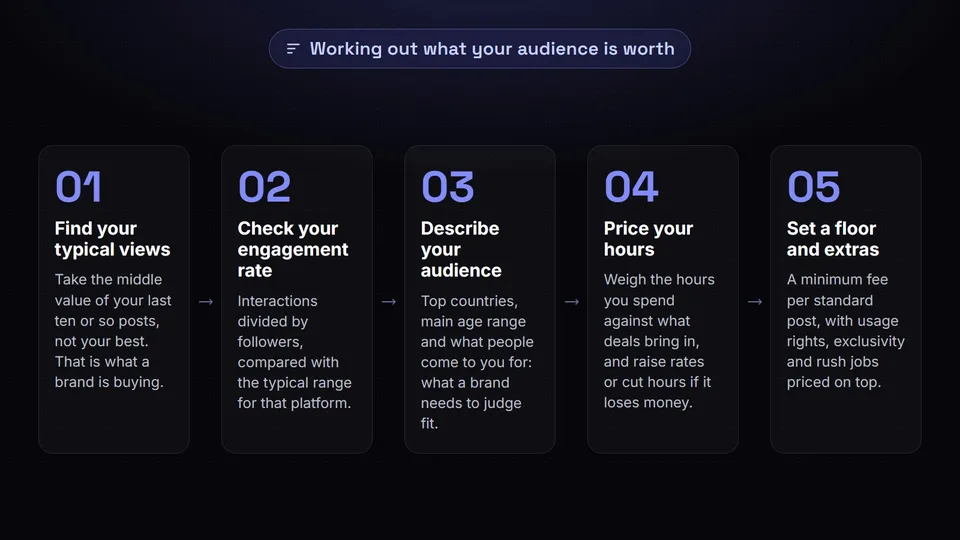
- Find your typical views. Take the views or reach of your last ten or so posts and use the middle value, not the best. That is what a brand is buying.
- Calculate engagement over the same posts. Compare it with the typical range for that platform.
- Describe your audience. Top countries, main age range and what people come to you for: the three things a brand needs to judge fit.
- Price your hours. In our social media ROI calculator, enter your weekly hours and what an hour of your time is worth as the cost. Then treat brand enquiries as leads, the share you turn into paid work as the close rate and your average deal as the value per customer. A negative result means raising your rates or cutting the hours, not chasing more followers.
- Set a floor and a list of extras. Decide your minimum fee for a standard post, then price usage rights, exclusivity and rush jobs on top.
Start with the audience you have
So, how many followers to get paid? On the platforms' terms, from a few hundred to ten thousand or more, alongside views and watch time. On your own terms, enough of the right people paying attention. Until you clear the bars, brand work priced on real views, brands' affiliate programmes, your own products and UGC can pay you anyway. Check your views per post and engagement rate once a month; when they rise, the offers tend to follow. And once you know which posts earn attention, plan the next month of them in SchedulifyX.