From Single Brand to Agency Social Media Workflow Mastery
SchedulifyX Team · October 1, 2026
Discover how scaling social management changes operations. Learn to build a robust multi client setup and streamline your agency social media workflow.
The journey from managing a single brand's social media presence to operating a full-scale digital agency is marked by profound operational shifts. What begins as a highly reactive, deeply intuitive process eventually demands rigorous structure, clear hierarchies, and a robust technological foundation. Understanding these transitions is crucial for anyone looking to grow their operations without sacrificing the quality of their output or the sanity of their team.
When you are responsible for one brand, the primary challenge is depth: how deeply can you understand the audience, and how authentically can you communicate the brand's core values? However, as you begin scaling social management, the primary challenge shifts from depth to breadth and systemic efficiency. You must learn to replicate that deep understanding across multiple, often wildly different, client profiles.
This comprehensive guide explores the structural, technological, and procedural changes that occur at each stage of growth. We will examine the operational mechanics of moving from a solo in-house role to a freelance portfolio, and finally, to a structured agency, highlighting how your agency social media workflow must evolve to sustain growth.
The Single Brand Foundation: Deep Immersion and Intuitive Workflows
Managing a single brand—whether as an in-house marketer or a dedicated solo contractor—offers a unique environment. The operational defining characteristic of this stage is the lack of friction between ideation and execution. Because you are solely focused on one corporate identity, your mental bandwidth is entirely dedicated to a single tone of voice, a single set of visual guidelines, and a single overarching business objective.
Content Creation and the Absence of Context Switching
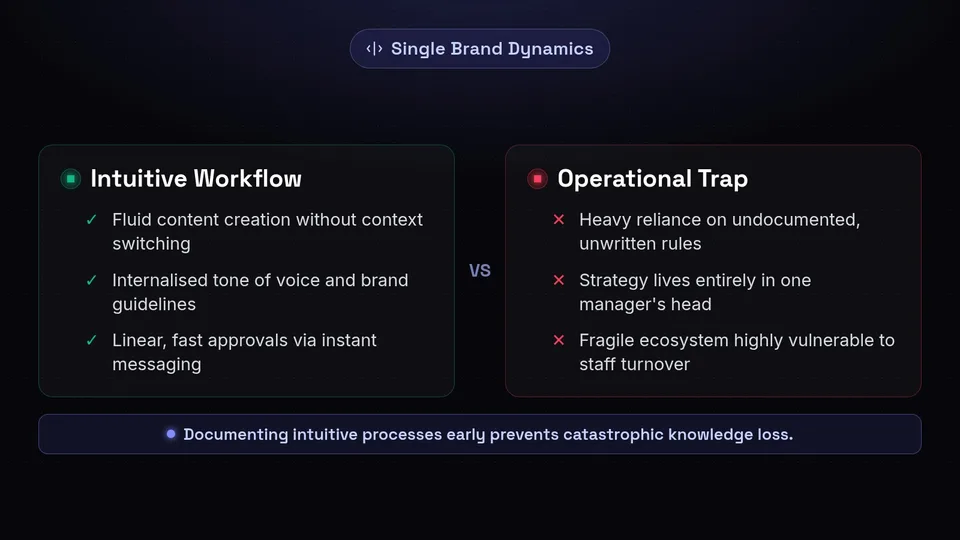
In a single-brand environment, content creation is often fluid. You do not need to constantly reference brand guidelines because you have internalised them. The tone of voice becomes second nature. If a trend emerges on a platform, you can immediately assess whether it aligns with your brand and execute a response within minutes.
Operationally, this means your asset management can be relatively simple. A well-organised local folder structure or a basic cloud drive is usually sufficient to store graphics, video clips, and copy drafts. The naming conventions for files might be informal, understood perfectly by you and perhaps one or two other colleagues.
Streamlined Approvals and Immediate Feedback
The approval process in a single-brand setup is typically linear and fast. It often involves sending a draft to a marketing director, a legal compliance officer (in regulated industries), or a founder. Feedback is direct, often delivered via instant messaging or a quick conversation. There is rarely a need for a complex, multi-tiered approval matrix.
However, the operational trap at this stage is a reliance on unwritten rules. Because the workflow is so intuitive, processes are rarely documented. The strategy lives entirely in the social media manager's head. While this works perfectly for a team of one, it creates a fragile ecosystem that is highly vulnerable to staff turnover. If the person managing the brand leaves, the entire operational memory of what works, what doesn't, and how things are done leaves with them.
Transitioning to a Freelance Portfolio: The Multi Client Setup

The first major operational fracture occurs when you take on your second, third, and fourth clients. This is the transition from a single-brand focus to a multi client setup. The intuitive workflows that served you well previously will immediately begin to break down under the weight of competing priorities and divergent brand identities.
The Psychological Toll of Context Switching
The most significant operational hurdle in a multi client setup is context switching. Moving from drafting playful, emoji-laden copy for a consumer fast-food brand to writing authoritative, data-driven posts for a B2B financial services firm requires a mental gear shift. If you attempt to do this on an ad-hoc basis—jumping between clients as emails arrive—your productivity will plummet, and brand voices will begin to bleed into one another.
To combat this, your operations must shift from reactive to proactive scheduling. Time-blocking becomes an operational necessity rather than a mere productivity tip. You must structure your week so that Mondays are dedicated to Client A's content creation, Tuesdays to Client B's, and so on. This segregation of tasks is the foundational element of an early-stage agency social media workflow.
Establishing the Multi Client Architecture
Technologically, this is the stage where you must adopt tools designed for a multi client setup. Managing multiple clients through native social media applications is a recipe for disaster, carrying a high risk of publishing content to the wrong account.
Operationally, you must establish strict boundaries:
- Asset Segregation: Cloud storage must be rigidly structured. Each client requires a master folder containing sub-folders for raw assets, approved graphics, brand guidelines, and historical reports. Informal file naming conventions must be replaced with standardised formats (e.g., ClientName_Platform_Date_Campaign).
- Calendar Consolidation: You can no longer rely on memory to know what is being published when. A centralised calendar view that allows you to filter by client is essential for maintaining an overview of your entire portfolio's output.
- Communication Channels: Client communication must be moved out of personal text messages and into trackable channels, such as dedicated email threads or client portals. This ensures that feedback is documented and easily retrievable when you are ready to implement revisions.
Building a Small Agency: Introducing Team Dynamics
Scaling social management beyond a solo freelance portfolio invariably means hiring a team. Whether you bring on junior copywriters, graphic designers, or community managers, the introduction of multiple personnel fundamentally alters your operational reality. You are no longer just managing social media; you are managing the people who manage social media.
Redefining the Agency Social Media Workflow
When you were a freelancer, the multi client setup was about organising your own time. As a small agency, the agency social media workflow is about orchestrating the time and output of a team. The "unwritten rules" of the single-brand stage must now be explicitly documented. If a new copywriter joins the team, they need a tangible brand guideline document to understand a client's tone of voice; they cannot rely on your intuition.
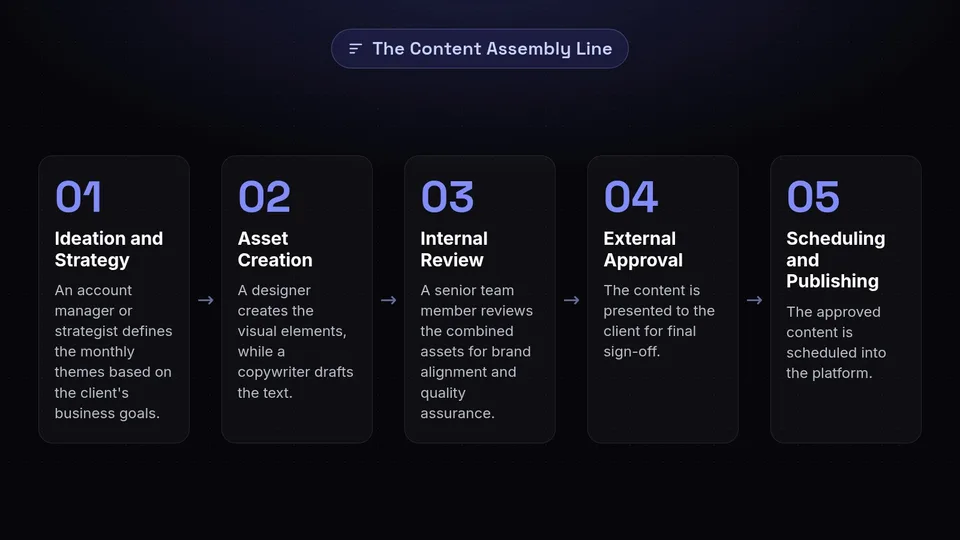
Operationally, content creation transitions from a solo endeavour to an assembly line:
- Ideation and Strategy: An account manager or strategist defines the monthly themes based on the client's business goals.
- Asset Creation: A designer creates the visual elements, while a copywriter drafts the text.
- Internal Review: A senior team member reviews the combined assets for brand alignment and quality assurance.
- External Approval: The content is presented to the client for final sign-off.
- Scheduling and Publishing: The approved content is scheduled into the platform.
This assembly line requires a robust traffic management system. You need clear visibility into where a piece of content sits in this pipeline. Is it waiting for design? Is it stuck in internal review? Has the client requested revisions? The operational mechanism for tracking this must be foolproof to prevent bottlenecks.
Client Onboarding and Asset Management
In an agency environment, client onboarding becomes a critical operational process. You can no longer afford to figure things out as you go. A standardised onboarding protocol ensures that every new client provides the necessary access, brand assets, and strategic direction before any work begins.
This includes establishing secure password management protocols. Sharing login credentials via email or spreadsheets is a severe security risk. A professional agency social media workflow necessitates a platform where access can be granted to team members without exposing the underlying passwords, ensuring that if a team member leaves, client security is not compromised.
Scaling Social Management: The Full Agency Model

As you transition into a mid-to-large agency, managing dozens or hundreds of clients, scaling social management requires a shift towards departmentalisation and hyper-specialisation. The operational structures that worked for a team of five will buckle under the pressure of a team of fifty.
Specialisation vs Generalisation
In a small agency, team members often wear multiple hats—a copywriter might also schedule posts and reply to comments. In a scaled agency, roles become highly specialised. You will have dedicated Community Managers whose sole operational focus is engagement and customer service across client accounts. You will have Paid Social Specialists who handle nothing but advertising budgets. You will have Strategists who never write a single tweet but instead focus on high-level campaign architecture.
This specialisation increases the quality of output but significantly complicates the agency social media workflow. The flow of information between these distinct departments must be meticulously managed. If a Community Manager notices a recurring customer complaint, there must be an operational pathway for that feedback to reach the Strategy department so they can address it in future content.
Advanced Quality Assurance and Multi-Tiered Approvals
At scale, the risk of a public relations disaster increases exponentially. A single inappropriate post can damage a client's reputation and cost the agency a lucrative contract. Therefore, the approval mechanisms must become ironclad.
A scaled multi client setup requires software that supports multi-tiered, conditional approval workflows. For example, a standard post might only require internal review and client sign-off. However, a post referencing a sensitive topic or a regulated financial product might automatically require an additional layer of approval from the client's legal department.
Operationally, the agency must use platforms that lock content from being published until all required digital signatures are collected. The system must maintain an unalterable audit trail of who created the post, who edited it, who approved it, and when it was scheduled. This audit trail is essential for accountability and for resolving disputes if a client questions a published piece of content.
Core Operational Shifts Across the Journey
To fully understand the evolution from single brand to scaled agency, it is helpful to isolate specific operational functions and examine how they transform.
From Ad-Hoc to Standardised Processes
The most profound shift is the move away from bespoke, client-specific processes towards agency-wide standardisation. When you have three clients, you might accommodate the fact that Client A likes approvals via email, Client B prefers a shared spreadsheet, and Client C wants to review everything on a weekly video call.
When you have fifty clients, accommodating bespoke approval methods is operationally impossible. It leads to missed posts, version control nightmares, and massive administrative overhead. Scaling social management requires you to dictate the process to the client, rather than the other way around. You must establish a single, unified approval platform and require all clients to use it. This standardisation is the only way to maintain efficiency and protect your profit margins as you grow.
The Evolution of Data and Reporting
Reporting also undergoes a massive transformation. For a single brand, exporting native analytics from each platform and manually compiling them into a presentation might be acceptable. It takes time, but it allows for deep, narrative-driven analysis.
In an agency setting, manual reporting is a significant drain on resources. If an account manager spends three days at the end of every month building reports, that is three days they are not spending on strategy or client relationship management. A mature agency social media workflow relies on automated reporting mechanisms.
The multi client setup must include analytics tools that can automatically pull data from all connected platforms, aggregate it, and generate standardised, white-labelled reports. The operational focus shifts from gathering the data to interpreting the data. Account managers receive the automated reports and spend their time adding strategic commentary and actionable insights, rather than formatting charts.
The Role of AI in Scaling Operations
As agencies look to scale without linearly increasing their headcount, integrating artificial intelligence into the workflow has become a critical operational advantage. AI is not a replacement for human strategy or creativity, but rather an operational lever that accelerates the execution phase.
In a robust agency workflow, AI-powered tools assist in several key areas:
- Drafting and Ideation: Overcoming the blank page syndrome, especially when context switching between disparate client voices. AI can generate initial copy variations based on specific brand prompts, allowing human copywriters to act as editors rather than starting from scratch.
- Content Repurposing: Scaling social management often involves maximising the value of hero assets. AI can assist in breaking down a long-form blog post or video into multiple, platform-specific social updates, streamlining the production pipeline.
- Workflow Automation: Beyond generative AI, algorithmic automation can suggest optimal posting times based on historical engagement data across a multi client setup, removing the guesswork from scheduling.
By embedding AI into the foundational processes, agencies can increase their content velocity and maintain high quality standards across a growing client roster.
Future-Proofing Your Agency Social Media Workflow
Building an agency is not a static achievement; it is a continuous process of operational refinement. The tools and workflows that get you to ten clients will likely break when you reach thirty. Future-proofing your operations requires a commitment to regular audits.
Every quarter, agency leadership should review the core operational pillars:
Are our asset management structures holding up, or are team members struggling to find files? Is our approval process preventing errors, or is it creating unnecessary bottlenecks that delay publishing? Is our multi client setup securely isolating client data, or are there vulnerabilities in our access protocols?
By constantly questioning the efficiency of your systems, you can identify operational friction before it impacts client satisfaction or team morale. Scaling social management successfully means anticipating the operational needs of your next growth phase before you arrive there.
Conclusion
The evolution from managing a single brand to running a multi-client agency is an operational metamorphosis. It requires abandoning the comfort of intuitive, ad-hoc processes in favour of rigid standardisation, structured team hierarchies, and scalable technology.
Mastering the agency social media workflow is about orchestrating people, processes, and platforms in perfect harmony. It requires a robust multi client setup that handles context switching, asset segregation, and multi-tiered approvals seamlessly. As you focus on scaling social management, your technological foundation becomes just as important as your creative output.
To build a resilient, scalable agency operation, you need a platform designed specifically for the complexities of multi-client management. SchedulifyX provides the AI-powered infrastructure necessary to streamline your scheduling, enforce rigorous approval pipelines, and manage your entire portfolio from a single, secure environment. Equip your team with the tools they need to execute flawlessly at scale, and transform your operational workflow with SchedulifyX today.